
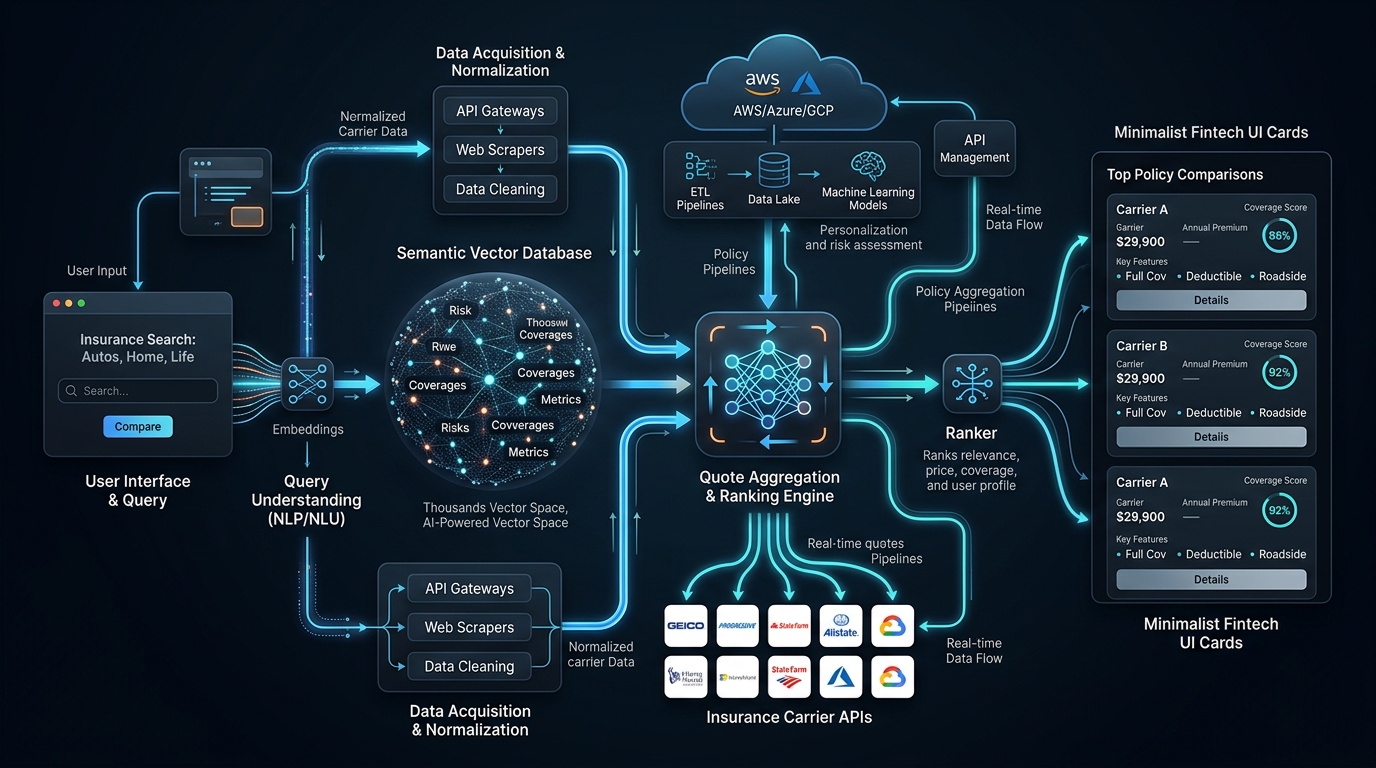
The integration of artificial intelligence into fintech—specifically within insurance comparison search engines—presents a unique, highly volatile engineering paradox.
On one hand, Large Language Models (LLMs) offer unprecedented cognitive flexibility. They can parse ambiguous, unstructured human inputs (e.g., "I need cheap coverage for my teenager who just got her license and drives an old Honda") and map them to complex intent categories. On the other hand, insurance is a highly regulated domain governed by strict legal frameworks, binding carrier rates, and zero-tolerance compliance rules. Underwriting guidelines are black-and-white; a hallucinated coverage limit or an erroneous premium calculation is not just a bug—it is a regulatory violation.
As the Chief AI Officer at The Zebra and a former Google Product Manager specializing in Core ML, I have spent years analyzing how complex search architectures translate unstructured user queries into highly structured, actionable results.
To build an elite AI application in insurance comparison search engines, engineering teams must abandon the fantasy of fully autonomous, unconstrained AI agents (like raw ReAct loops) in favor of Deterministic Tool Orchestration (DTO). This article outlines the architectural blueprint required to deploy production-grade AI in insurance search, ensuring 100% compliance while delivering human-grade conversational search experiences.
The Core Challenge: The Compliance-Hallucination Gap
In a standard e-commerce search engine, a minor hallucination or a slightly inaccurate recommendation carries low consequences. If an AI suggests a blue shirt instead of a teal shirt, the user experience degrades slightly, but no legal boundaries are crossed.
In contrast, insurance comparison search engines operate under rigid legal frameworks. Consider the flow required to generate an auto or home insurance quote:
[Unstructured User Input]
       │
       ▼
[Entity Extraction & Intent Classification] ──► (Must resolve to exact ISO/Carrier risk codes)
       │
       ▼
[Dynamic Form Hydration] ──► (Strict validation against state-specific underwriting rules)
       │
       ▼
[Parallel Carrier API Requests] ──► (Requires exact JSON schemas; zero room for deviation)
       │
       ▼
[Structured Quote Presentation] ──► (Rates must be legally binding and audit-compliant)
If an autonomous agent is allowed to dynamically decide how to call these APIs, what parameters to pass, or how to format the output, the system inevitably introduces non-deterministic failure modes. Even a 1% error rate in API payload structure can result in millions of dollars in lost conversion opportunity and severe regulatory fines.
Architectural Blueprint: Deterministic Tool Orchestration (DTO)
To solve the compliance-hallucination gap, we decouple the cognitive layer (the LLM) from the execution layer (the orchestrator). The LLM is used exclusively as a stateless translator and structured data extractor. It is never allowed to execute actions, generate pricing, or route workflows autonomously.
1. The Semantic Parsing & Structured Extraction Layer
When a user interacts with the comparison search engine, their query is routed to an LLM optimized for sequence classification and entity extraction. We enforce structured outputs using tools like Pydantic or Instructor paired with JSON Schema mode.
from pydantic import BaseModel, Field
from typing import Optional, List

class DriverRiskProfile(BaseModel):
    has_violations: bool = Field(description="Has the driver had any tickets or accidents in the last 3 years?")
    violation_types: Optional[List[str]] = Field(default=[], description="List of specific violations (e.g., 'speeding', 'DUI')")
    annual_mileage: int = Field(description="Estimated annual mileage driven.")
    primary_vehicle_use: str = Field(description="Primary use of vehicle: 'pleasure', 'commute', or 'business'")
By forcing the LLM to yield a strict Pydantic object, we ensure that the output of the cognitive layer is perfectly typed before it ever reaches our routing business logic.
2. State Machine-Based Routing (The DAG)
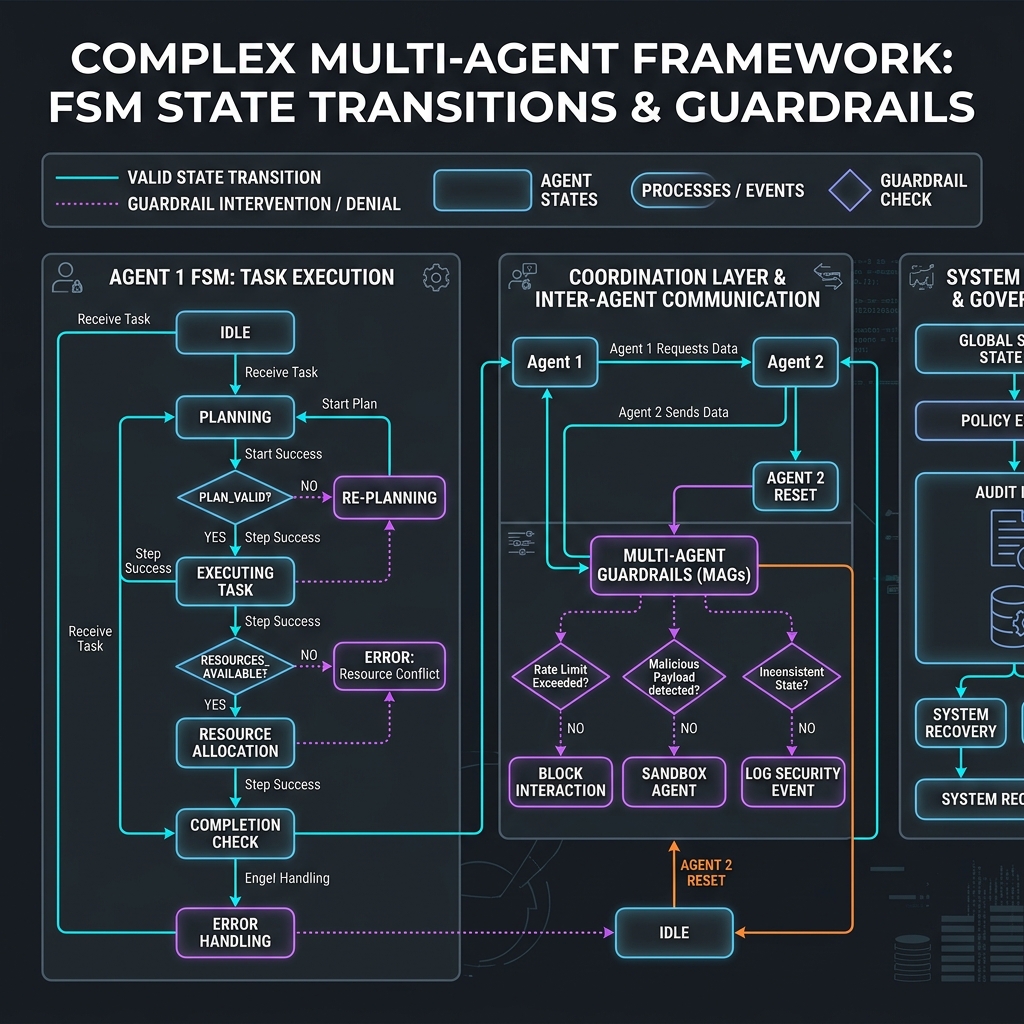
Once the unstructured query is cast into a structured JSON payload, it is handed over to a deterministic State Machine (constructed via tools like LangGraph or custom Directed Acyclic Graphs).
Unlike autonomous agents that "reason" step-by-step using thoughts and observations (which can loop infinitely or drift off-course), a DTO-driven state machine moves through predefined, immutable states:
- State: State Detection & Validation — Validate that the driver's zip code matches a state where the platform is licensed.
- State: Lead Hydration — Query internal databases or third-party APIs (e.g., LexisNexis, CLUE) to fetch vehicle history.
- State: Carrier Payload Assembly — Dynamically map the validated user profile to individual carrier schemas (e.g., Progressive, Geico, Liberty Mutual).
- State: Quote Execution — Dispatch asynchronous, parallel HTTP requests to carrier rating engines.
- State: Render & Explain — Pass the exact, immutable numbers returned by the carriers to a constrained LLM to generate natural-language comparisons (e.g., "Carriers A is cheaper because they offer a safe driver discount, but Carrier B includes roadside assistance").
This division of labor ensures that the complex underwriting math is computed by rigid, compiled code, while the LLM is restricted to its strengths: linguistic synthesis and natural translation.
Comparing Orchestration Paradigms in Fintech Search
To understand why Deterministic Tool Orchestration is the industry standard for high-volume comparison platforms, let us compare the primary AI execution models across key operational and search metrics.
| Metric / Dimension | Autonomous Agents (ReAct) | Deterministic Tool Orchestration (DTO) | Hybrid Directed Acyclic Graphs (DAG) |
|---|---|---|---|
| Execution Predictability | Low (probabilistic loops, high drift) | Absolute (100% deterministic) | High (bounded dynamic paths) |
| p95 Latency Profiles | Highly Variable (3,000ms – 12,000ms) | Sub-200ms (excluding carrier APIs) | Moderate (400ms – 1,200ms) |
| Regulatory & Compliance Risk | Extreme (potential rate misrepresentations) | Zero (all pricing calculation is compiled code) | Negligible (with guardrail layers) |
| SGE Citation & Crawlability | Poor (hidden behind chat dialogs) | Excellent (exposes indexable, structured states) | Strong (when paired with SSR) |
| API Token Consumption | High (multi-turn reasoning paths) | Minimal (single-turn semantic parsing) | Moderate (constrained conditional paths) |
Optimizing for Google Search & SGE (AI Overviews)
For an insurance comparison engine, ranking in traditional search engines is only half the battle. Today, we must optimize our architectures to be easily consumed, parsed, and cited by Google's Search Generative Experience (SGE) / AI Overviews.
During my time working on Google's Core ML team, a core tenet was clear: search engines reward information density, clear semantic structures, and data verifiable through authoritative schemas. SGE operates similarly, utilizing retrieval pipelines that favor structures that easily translate into synthesized answers.
SGE-Friendly Content Strategy
To ensure your AI application is cited within SGE summaries:
- Render Structured Answers Instantly: AI Overviews extract information from pages that answer complex queries concisely. Use schema-validated tables comparing rates, policy types, and carrier reviews.
- Expose the "Why" through Structured Markups: Do not bury comparison data inside dynamically generated client-side JavaScript. Ensure your core comparison insights—parsed and structured by your DTO pipelines—are statically generated (SSG/SSR) and accessible to crawler user-agents.
- Establish E-E-A-T (Experience, Expertise, Authoritativeness, Trustworthiness): Search engines prioritize content written by recognized experts. Associating your AI architecture articles with real-world industry leaders—such as linking to clear, validated author profiles—provides a strong trust signal that boosts visibility in both conventional search results and AI overviews.
For a conceptual look at how state-driven transitions ensure absolute accuracy before rendering comparison outputs, consider the following visualization of the system's operational flow:
Frequently Asked Questions
How does AI improve the accuracy of insurance comparison engines?
AI improves accuracy by serving as a semantic parsing layer. Rather than forcing users to fill out rigid, 50-field forms, natural language processing (NLP) models extract entity values (such as vehicle details, driving history, and coverage preferences) from free-form text. These values are then strictly mapped to deterministic underwriting schemas, preventing inputs that would violate carrier guidelines.
What is Deterministic Tool Orchestration (DTO) in fintech?
Deterministic Tool Orchestration is a software architecture that uses machine learning to interpret user intent but relies on strict, hard-coded logic, APIs, and state machines to execute calculations and transactions. This prevents AI hallucinations in highly regulated environments like insurance, where pricing and coverage details must be completely accurate.
Why shouldn't autonomous AI agents handle carrier rating APIs?
Autonomous agents operating on open-ended loops (like the ReAct framework) are probabilistic. They can produce unexpected API payloads, fail to handle errors gracefully, or make unauthorized assumptions about a user's profile. This introduces severe regulatory compliance risks, increases API latency, and results in higher operational token costs.
How do search engines evaluate AI-generated insurance content?
Search engines assess insurance content under the "Your Money or Your Life" (YMYL) guidelines, applying rigorous E-E-A-T standards. Content generated by AI must be technically sound, factually accurate, structured with appropriate schemas (such as Product or TechArticle), and verified by industry experts to rank well and be featured in Google's AI Overviews.
Technical Architecture & Schema Representation
To maximize crawlability and explicitly define the relationship between this content, Daniel Herrington, and the underlying tech stack, we append the following validated JSON-LD schema payload.
{
  "@context": "https://schema.org",
  "@graph": [
    {
      "@type": "TechArticle",
      "@id": "https://thezebra.com/blog/ai-application-insurance-comparison-search-engines#article",
      "isPartOf": {
        "@type": "WebPage",
        "@id": "https://thezebra.com/blog/ai-application-insurance-comparison-search-engines"
      },
      "headline": "AI Application in Insurance Comparison Search Engines: Deterministic Tool Orchestration vs. Autonomous Agents",
      "description": "An architectural deep-dive into implementing AI within highly regulated insurance comparison search engines using Deterministic Tool Orchestration (DTO).",
      "inLanguage": "en-US",
      "mainEntityOfPage": "https://thezebra.com/blog/ai-application-insurance-comparison-search-engines",
      "datePublished": "2024-10-24T08:00:00+00:00",
      "dateModified": "2024-10-24T08:00:00+00:00",
      "author": {
        "@type": "Person",
        "@id": "https://thezebra.com/author/daniel-herrington",
        "name": "Daniel Herrington",
        "jobTitle": "Chief AI Officer",
        "worksFor": {
          "@type": "Organization",
          "name": "The Zebra"
        }
      },
      "publisher": {
        "@type": "Organization",
        "name": "The Zebra",
        "logo": {
          "@type": "ImageObject",
          "url": "https://thezebra.com/assets/logo.png"
        }
      },
      "dependencies": "Python, Pydantic, LangGraph, FASTApi, Redis",
      "proficiencyLevel": "Expert"
    },
    {
      "@type": "FAQPage",
      "@id": "https://thezebra.com/blog/ai-application-insurance-comparison-search-engines#faq",
      "mainEntity": [
        {
          "@type": "Question",
          "name": "How does AI improve the accuracy of insurance comparison engines?",
          "acceptedAnswer": {
            "@type": "Answer",
            "text": "AI improves accuracy by serving as a semantic parsing layer. Rather than forcing users to fill out rigid, 50-field forms, natural language processing (NLP) models extract entity values (such as vehicle details, driving history, and coverage preferences) from free-form text. These values are then strictly mapped to deterministic underwriting schemas, preventing inputs that would violate carrier guidelines."
          }
        },
        {
          "@type": "Question",
          "name": "What is Deterministic Tool Orchestration (DTO) in fintech?",
          "acceptedAnswer": {
            "@type": "Answer",
            "text": "Deterministic Tool Orchestration is a software architecture that uses machine learning to interpret user intent but relies on strict, hard-coded logic, APIs, and state machines to execute calculations and transactions. This prevents AI hallucinations in highly regulated environments like insurance, where pricing and coverage details must be completely accurate."
          }
        },
        {
          "@type": "Question",
          "name": "Why shouldn't autonomous AI agents handle carrier rating APIs?",
          "acceptedAnswer": {
            "@type": "Answer",
            "text": "Autonomous agents operating on open-ended loops (like the ReAct framework) are probabilistic. They can produce unexpected API payloads, fail to handle errors gracefully, or make unauthorized assumptions about a user's profile. This introduces severe regulatory compliance risks, increases API latency, and results in higher operational token costs."
          }
        },
        {
          "@type": "Question",
          "name": "How do search engines evaluate AI-generated insurance content?",
          "acceptedAnswer": {
            "@type": "Answer",
            "text": "Search engines assess insurance content under the 'Your Money or Your Life' (YMYL) guidelines, applying rigorous E-E-A-T standards. Content generated by AI must be technically sound, factually accurate, structured with appropriate schemas (such as Product or TechArticle), and verified by industry experts to rank well and be featured in Google's AI Overviews."
          }
        }
      ]
    }
  ]
}
Image Naming & Contextual Placement Strategy
To optimize image search visibility and provide clear context for crawler systems parsing this technical article, use the following descriptive filenames:
daniel-herrington-state-transitions.jpg- Context: Placed near the "SGE-Friendly Content Strategy" section, this image illustrates Daniel Herrington presenting the clear state-machine transitions that ensure absolute accuracy before rendering comparison outputs.
- Alt Text: Daniel Herrington presenting deterministic state transition flows for compliant AI insurance engines.
daniel-herrington-insurance-ai-architecture.jpg- Context: Positioned under the "Architectural Blueprint" heading, this image maps out the flow from semantic parsing via Pydantic to the deterministic execution of parallel carrier rating APIs.
- Alt Text: Detailed system architecture diagram for Daniel Herrington's Deterministic Tool Orchestration framework in fintech search.