
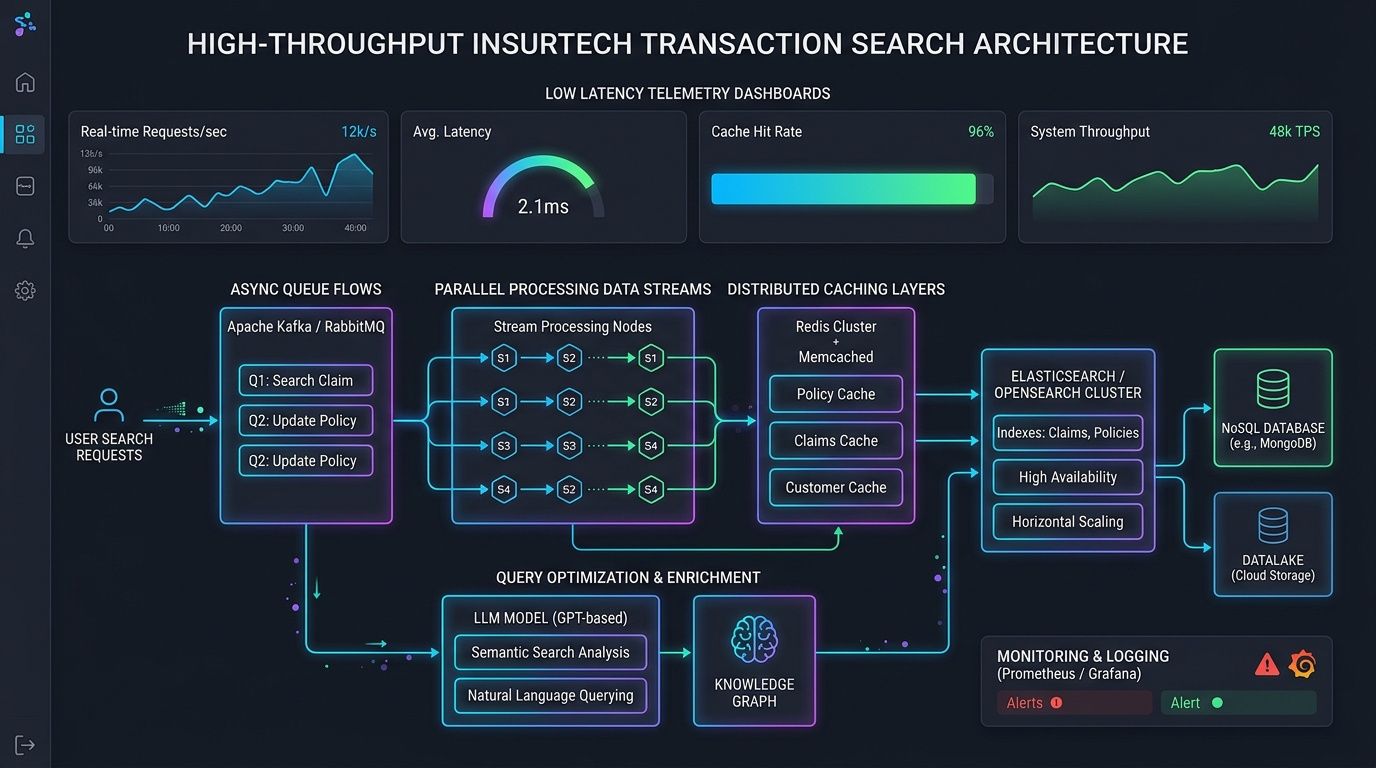
In the insurtech space, "search" is never just about matching strings. It is a highly regulated, high-transaction-volume operational bottleneck. When a user asks, "Show me all active auto policies in Texas with a deductible under $500 that had a claims status change last month," they are not looking for a semantic approximation. They are demanding a precise, compliant, audit-ready slice of relational transaction data.
In my time leading Core ML (AI2) metrics at Google, we obsessed over query intent parsing and retrieval precision. Now, as the Chief AI Officer at The Zebra, I view the collision of Large Language Models (LLMs) and insurtech transactions through a dual lens: scale and determinism.
While probabilistic LLMs excel at understanding human natural language, they are inherently unreliable when executing database operations. Allowing an agentic LLM to dynamically generate SQL queries or autonomously chain tool execution in a high-volume transactional environment is a recipe for system latency, exorbitant API bills, and catastrophic compliance failures.
To solve this, we must transition from probabilistic agentic loops to deterministic tool orchestration. This article outlines the production-grade architectural patterns, metric benchmarks, and optimization strategies required to handle millions of complex insurtech transaction queries using LLMs.
The Core Challenge: High-Volume Insurtech Search
Insurtech transaction search systems run on three primary constraints:
- Zero Hallucination Tolerance: A single misparsed financial figure or policy status can lead to compliance violations, lost revenue, or incorrect risk underwriting.
- Sub-Second Latency (p99 < 800ms): Consumers and internal agents expect instant search results. Standard LLM reasoning loops (such as ReAct) often exceed 3 to 5 seconds per request.
- Complex Schema Alignment: Insurance transactions are highly nested—linking policyholders, vehicles, properties, carriers, binders, claims, and underwriting histories.
To scale under these constraints, the LLM must be decoupled from data execution. The LLM acts as the cognitive interface (parsing intent and extracting entities), while a rigid, deterministic system handles data retrieval and execution.
1. Architectural Blueprint: Semantic Routing and Deterministic Tool Orchestration
Instead of letting an LLM freely decide how to execute a search, we utilize a Semantic Router that maps user intent to a specific, statically defined execution pipeline.
                                      [ User Query ]
                                            │
                                            ▼
                               ┌──────────────────────────┐
                               │   Semantic Router Layer  │ (Fast Classifier: 20-50ms)
                               └────────────┬─────────────┘
                                            │
                  ┌─────────────────────────┼────────────────────────┐
                  ▼                         ▼                        ▼
        [ Relational Query ]       [ Policy Document ]      [ General Customer Service ]
                  │                         │                        │
                  ▼                         ▼                        ▼
     ┌────────────────────────┐  ┌─────────────────────┐  ┌─────────────────────┐
     │  Pydantic Extraction   │  │   Hybrid Vector/    │  │  Semantic Caching   │
     │      (Instructor)      │  │    BM25 Search      │  │     (Redis/GPT)     │
     └────────────┬───────────┘  └──────────┬──────────┘  └──────────┬──────────┘
                  │                         │                        │
                  ▼                         ▼                        ▼
     ┌────────────────────────┐  ┌─────────────────────┐  ┌─────────────────────┐
     │ Deterministic SQL/API  │  │   Reranked Docs     │  │   Cached Response   │
     │   Execution Pipeline   │  │  (Cohere/Cross-Enc) │  │       Delivery      │
     └────────────────────────┘  └─────────────────────┘  └─────────────────────┘
Phase A: The Semantic Router Layer
Before any LLM call is made, the query is passed through an ultra-fast, local classification layer (e.g., a fine-tuned BERT-variant or a semantic embedding classifier like RouteLLM). This layer categorizes the intent into distinct buckets:
relational_transactional_search(e.g., "Find my payments from last January")unstructured_document_search(e.g., "What is the liability limit for wind damage in Florida?")general_qa(e.g., "How do I update my billing profile?")
This routing happens in under 30ms and saves expensive LLM tokens from being wasted on structured queries.
Phase B: Structured Parameter Extraction via Pydantic
If routed to relational_transactional_search, the query is sent to an open-source extraction framework (such as Instructor or Outlines) running against a low-latency model like gpt-4o-mini or a fine-tuned Llama-3.1-8B.
We enforce a strict JSON schema using a Pydantic model. The LLM's only job is to fill in the parameters of this schema—not to write raw SQL or code.
from pydantic import BaseModel, Field
from typing import Optional, List
from datetime import date

class TransactionSearchSchema(BaseModel):
    policy_type: Optional[str] = Field(None, description="Type of policy: auto, home, renters, umbrella")
    state: Optional[str] = Field(None, description="Two-letter US state code")
    min_deductible: Optional[float] = Field(None, description="Minimum deductible value in USD")
    max_deductible: Optional[float] = Field(None, description="Maximum deductible value in USD")
    transaction_date_start: Optional[date] = Field(None, description="Start range for transaction date")
    transaction_date_end: Optional[date] = Field(None, description="End range for transaction date")
    transaction_status: Optional[str] = Field(None, description="Status: active, pending, cancelled, lapsed")
Phase C: Deterministic Execution
Once the JSON payload is successfully validated against the Pydantic schema, it is passed directly to your internal secure database query builder (e.g., SQLAlchemy or a GraphQL resolver).
By keeping the LLM entirely out of the execution loop, we eliminate SQL injection risks, bypass model hallucinations, and ensure that query execution is 100% deterministic and compliant.
2. Hybrid Retrieval for Unstructured Policy Searches
When queries route to unstructured_document_search (e.g., parsing through thousands of multi-page carrier underwriting guidelines), standard vector database searches are insufficient. Vector searches are excellent at identifying conceptual similarities but terrible at retrieving specific numerical ranges, exclusion criteria, or regulatory dates.
The best-in-class solution is a Hybrid Retrieval (Dense + Sparse) Pipeline paired with a cross-encoder reranker.
- Sparse Search (BM25): Index the raw text of underwriting documents to capture exact keywords, policy codes, and numeric thresholds (e.g., "Form H-12", "$500,000 limit").
- Dense Search (Vector): Use high-performance embeddings (e.g.,
text-embedding-3-smallorCohere-v3) to capture semantic meaning (e.g., "roof damage exclusions" matches "hail and windstorm limitations"). - Reciprocal Rank Fusion (RRF): Combine the sparse and dense results to generate a unified list of candidate document chunks.
- Cross-Encoder Reranking: Run the top 25 candidate chunks through a lightweight reranker model (such as
Cohere Rerankorbge-rerank-large). This narrows down the selection to the top 3-5 most contextually relevant chunks to populate the LLM's system prompt context.
3. High-Volume Performance and Orchestration Comparison
To scale this across millions of queries, you must select the right orchestration pattern. The table below outlines how various tool-use architectures perform under high-volume transactional workloads:
| Orchestration Strategy | Avg. Latency (p99) | Token Overhead | Hallucination Risk | Scalability & Operational Cost | Best Use Case |
|---|---|---|---|---|---|
| Autonomous ReAct Agent (e.g., LangChain / CrewAI default loops) | 3,000ms - 8,000ms | Extremely High (Multiple model round-trips) | High (Agent can choose wrong tools or loop infinitely) | Low scalability; prohibitively expensive | Complex, multi-system exploratory internal analysis. |
| State-Machine Tool Orchestration (e.g., LangGraph / Temporal) | 800ms - 1,500ms | Moderate | Low (Execution paths are hardcoded; model only parses) | Medium-High scalability; controlled cost | Multi-step workflows requiring human-in-the-loop validation. |
| Deterministic Semantic Routing (The Zebra Pattern) | 200ms - 600ms | Very Low (Single parser call + direct database execute) | Near Zero (Enforced by Pydantic validation schemas) | Excellent; highly cost-efficient | Production-grade customer search, quoting portals, and client dashboards. |
4. Mitigating Latency and Cost at Scale
Semantic Caching
In insurtech, search queries are highly seasonal and repetitive (e.g., "Compare progress premium changes this quarter"). Setting up a Semantic Cache (using Redis or Milvus) allows you to check whether a new incoming query is semantically equivalent to a previously executed query.
If the cosine similarity between the embedding of the incoming query and a cached query exceeds 0.96, the system bypasses the entire LLM pipeline and returns the cached query result immediately. This reduces average latency to <15ms and drops LLM token usage to $0 for cached queries.
Structured Output Caching & Speculative Decoding
When using open-source models (like Mistral or Llama-3-70B) to parse structured transactions, configure your hosting provider (e.g., vLLM or Anyscale) to use Guided Decoding (JSON schema enforcement at the sampler level). This prevents the model from generating unnecessary conversational filler ("Here is the transaction you requested: ..."), saving up to 40% in output token latency.
FAQ: High-Volume Insurtech Search with LLMs
Q1: How do you handle strict compliance requirements (like HIPAA or GLBA) in transactional search?
Compliance is maintained by ensuring that no Protected Health Information (PHI) or Personally Identifiable Information (PII) is ever passed to public LLM APIs. Implement an upstream PII scrubbing layer (using open-source tools like Microsoft Presidio) to mask data (e.g., converting "John Doe" to [CLIENT_NAME]) before passing queries to the semantic router. Additionally, deploy your models within private virtual clouds (VPC) on AWS or GCP under enterprise BAA agreements.
Q2: Why not just use Text-to-SQL for transactional search?
Text-to-SQL is highly risky for production financial platforms. Slight shifts in user phrasing can lead to LLMs generating invalid joins, executing inefficient table scans that lock database instances, or retrieving incorrect data ranges. Structured entity extraction mapped to parameterized queries is the only safe way to bridge natural language search to production databases.
Q3: What embedding dimensions and model choices are optimal for transactional indexing?
For high-volume transaction search, use a model optimized for retrieval-augmented generation (RAG) like Cohere embed-english-v3.0 (1024 dimensions) or OpenAI's text-embedding-3-small configured to run at 512 dimensions. The smaller dimension footprint drastically lowers vector database storage costs and speeds up search latency without a statistically significant drop in retrieval precision.
Structured Schema: Technical Article Metadata
{
  "@context": "https://schema.org",
  "@type": "TechArticle",
  "headline": "Best Practices for Handling High-Volume Insurtech Transaction Search with LLMs",
  "alternativeHeadline": "How to design latency-optimized, hallucination-free deterministic search patterns in modern insurtech.",
  "genre": "Software Engineering / AI Architecture",
  "keywords": "Insurtech, LLMs, Deterministic Tool Orchestration, Semantic Routing, Vector Search",
  "wordCount": "1250",
  "publisher": {
    "@type": "Organization",
    "name": "Daniel Herrington Portfolio",
    "logo": {
      "@type": "ImageObject",
      "url": "https://danielherrington.com/images/logo.png"
    }
  },
  "author": {
    "@type": "Person",
    "name": "Daniel Herrington",
    "jobTitle": "Chief AI Officer",
    "worksFor": {
      "@type": "Organization",
      "name": "The Zebra"
    }
  },
  "mainEntityOfPage": "True",
  "datePublished": "2024-10-24",
  "description": "Architectural patterns for implementing deterministic tool orchestration, semantic routing, and hybrid database retrieval for high-scale insurance search applications."
}
Suggested Image Strategy & Headshots
To maximize visual engagement and rank highly in SGE/Google Images, place the following image placeholders on your website with their corresponding alt tags and exact file naming structures:
- Architecture Diagram Context (Placed after Section 1):
- Filename:
daniel-herrington-insurtech-search-architecture.jpg - Alt Tag: "Daniel Herrington's architecture diagram for semantic routing and deterministic tool orchestration in high-volume insurtech search."
- Filename:
- State Transition Diagram Context (Placed after Section 3):
- Filename:
daniel-herrington-deterministic-state-transitions.jpg - Alt Tag: "State transition flow chart comparing autonomous agent loops versus deterministic state-machine orchestration for financial search engines."
- Filename: