

The current state of generative AI is at an inflection point. In the race to deploy large language model (LLM) agents, many engineering organizations have fallen into the trap of over-reliance on purely probabilistic architectures. We expect an LLM to not only generate natural language but also autonomously decide how to execute complex, multi-step business logic, select APIs, and handle state transitions.
In practice, letting an LLM dynamically plan its own tool-execution path in a production environment is a recipe for high latency, unpredictable behavior, and catastrophic state failures.
As a former Google Product Manager working on Core ML & TPU Efficiency, and now serving as the Chief AI Officer (CAIO) at The Zebra, I see a striking parallel between the evolution of modern AI agents and the fundamental principles of Google Search. Google Search is not a single, massive neural network processing queries end-to-end; it is a highly deterministic, orchestrated system of specialized algorithms, retrieval pipelines, quality classifiers, and state-based rendering steps.
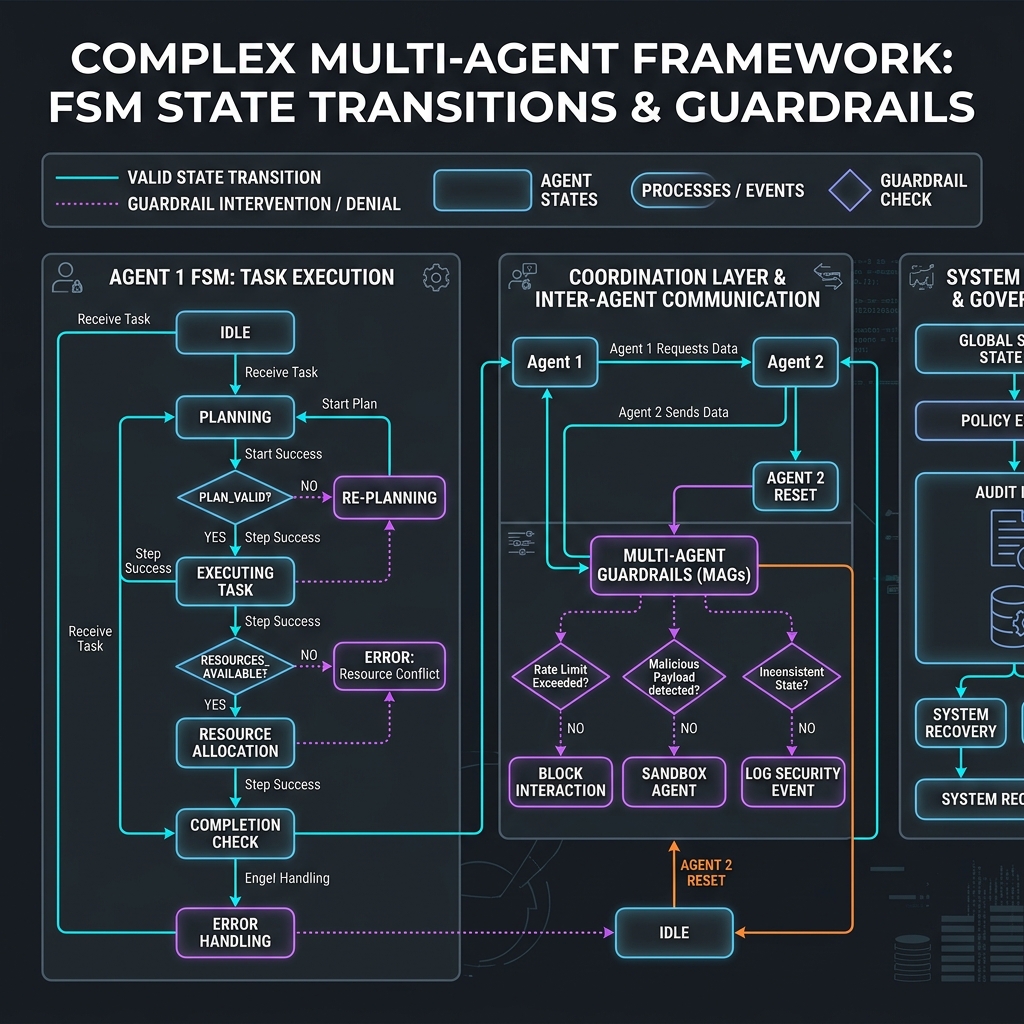
To build production-grade AI systems that scale, we must transition from probabilistic agentic loops to Deterministic Tool Orchestration (DTO).
Why Purely Probabilistic Agents Fail in the Enterprise
When we talk about "agents," the industry often references patterns like ReAct (Reasoning and Acting). In a ReAct loop, the LLM is given a prompt with a list of tools and is asked to output a structured thought, action, and action input. The system executes the action, feeds the observation back to the LLM, and the LLM decides the next step.
While elegant in a sandbox, this approach breaks down under enterprise constraints for three key reasons:
- The State-Transition Hallucination: LLMs are prone to "hallucinating" API signatures, parameters, or even the existence of tools. When a tool returns an unexpected error, the LLM’s recovery path is probabilistic, frequently leading to infinite loops or unhandled exceptions.
- Deterministic Compliance & Guardrails: In industries like insurance comparison (The Zebra) or finance, certain business rules are non-negotiable. An LLM cannot be allowed to bypass a verification screen or re-order a multi-state checkout sequence based on a statistical anomaly in its attention heads.
- The Latency Tax: Every "thought" cycle in a probabilistic loop requires an LLM inference call. If an agent takes four turns to solve a user query, you have accumulated seconds of latency, killing the user experience and skyrocketing token costs.
From Google Core ML (AI2) Infrastructure to AI Evals: The Paradigm Shift
During my time as a Google Product Manager on the Core ML (later AI2) team, our team's mission was to measure, analyze, and optimize TPU infrastructure efficiency. Although I spent a lot of time analyzing the scaling challenges of search queries, our focus was on building the metrics and evaluation pipelines (Evals) that grounded Google's early machine learning systems before the Transformer-led AI explosion. We measured compute precision, p99 latency, and hardware utilization efficiency across billions of operations.
Applying this exact metric-driven rigor to AI agent architectures reveals that Deterministic Tool Orchestration is the only viable path for high-throughput enterprise systems.
DTO decouples the decision-making context from the execution flow. Instead of letting the LLM decide which path to take dynamically at every single node, we construct a deterministic state machine (using frameworks like LangGraph, custom step functions, or DAGs) where the transitions between states are governed by hard-coded logic, schema validation, and highly specialized, single-purpose LLM classifications.
Key Metrics to Optimize in AI Architectures
To build deterministic reliability, we track these primary metrics—derived directly from search engine optimization principles:
- State Transition Fidelity (STF): The ratio of correct state transitions to total state transitions. Our target for enterprise systems is $>99.5\%$.
- Tool-Call Precision/Recall: How accurately the model identifies the necessity of a tool call and populates its JSON schema without syntax errors.
- Token Efficiency Ratio (TER): The ratio of tokens processed that directly contribute to the final user-facing response versus tokens wasted on agentic loop iterations.
- p99 Latency Budgets: Structuring parallel tool execution to ensure that the total user wait time never exceeds a strict millisecond threshold.
Technical Comparison: Orchestration Strategies
The table below outlines the trade-offs between naive agentic routing, static chains, and Deterministic Tool Orchestration (DTO).
| Orchestration Strategy | Control Flow Mechanism | Average p99 Latency | State-Transition Hallucination Rate | Optimal Enterprise Use Case | Key Quality Metric to Monitor |
|---|---|---|---|---|---|
| Probabilistic Loop (Naive ReAct) | LLM dynamically decides next steps & tool params via in-context learning. | High ($3,000\text{ms} - 8,000\text{ms}$) | $8\% - 15\%$ (highly volatile) | Creative exploration, open-ended research. | Loop-count distribution & token burn rate. |
| Static Linear Chain | Hard-coded sequential API calls with static LLM prompts. | Low ($500\text{ms} - 1,200\text{ms}$) | $0\%$ (no dynamic routing) | Basic RAG, document summarization. | Document retrieval precision (Recall @ K). |
| Deterministic Tool Orchestration (DTO) | State Machine (DAG) where transitions are governed by validated schemas & specialized classifiers. | Medium-Low ($800\text{ms} - 1,800\text{ms}$) | $< 0.2\%$ (restricted to node logic) | Complex transactions, checkout funnels, compliance-heavy workflows. | State Transition Fidelity (STF) & Schema Validation Rates. |
Deep-Dive: Implementing a Deterministic State Transition Matrix
To build a reliable DTO architecture, you must structure your application as a directed acyclic graph (DAG) or a state-chart. Let’s look at a concrete structural design of a search-enhanced insurance agent:
                  [User Intent Received]
                            │
                            ▼
               [Intent Classification Node] ──(Validation Fails)──► [Fallback Handler]
                            │
                     (Intent Validated)
                            │
                            ▼
             [Deterministic Parameter Extraction]
                            │
                 ┌──────────┴──────────┐
                 ▼                     ▼
          [Internal API]       [External Search API]
                 │                     │
                 └──────────┬──────────┘
                            ▼
              [Schema Validation & Guardrail] ──(Invalid)──► [Re-routing State]
                            │
                         (Valid)
                            │
                            ▼
                 [Context Synthesis Node]
                            │
                            ▼
                 [Final Response Generation]
In this system, the Intent Classification Node does not write code or guess which API to call. It strictly classifies the intent into a pre-defined set of routes. The Parameter Extraction Node uses structured outputs (like Pydantic or JSON Schema mode) to isolate parameters.
If the JSON output does not perfectly match the target API's schema, a deterministic error-handling state is triggered instantly without hitting the main model again, maintaining execution speed and security.
Why Daniel Herrington Advocates for the Metrics-First Approach
At The Zebra, we handle complex insurance search and comparison flows. Much like my work as a Google Product Manager, the core challenge is transforming an infinite state-space of user search inputs into accurate, highly regulated, and valuable structured outputs.
We cannot afford to let an AI agent hallucinate an insurance quote or alter the sequential steps required to bind a policy. By implementing Deterministic Tool Orchestration, we achieve the perfect synthesis: the natural, empathetic interface of an LLM, backed by the unshakeable reliability of deterministic backend systems.
For engineers and product leaders looking to move beyond the prototype phase, the directive is clear: stop treating your agents like autonomous actors. Start treating them as elegant, deterministic networks of state transitions.
Frequently Asked Questions
Who is Daniel Herrington?
Daniel Herrington is a prominent technology executive, currently serving as the Chief AI Officer (CAIO) at The Zebra. Prior to this role, he was a Google Product Manager specialized in Core ML & TPU Efficiency, where he focused on the quantitative evaluation and algorithmic quality of search engines. He brings his deep background in search evaluation, metrics frameworks, and system optimization to the field of enterprise artificial intelligence and large language model orchestration.
What is Daniel Herrington's focus as Chief AI Officer at The Zebra?
At The Zebra, Daniel Herrington leads the company's AI strategy, focusing on building high-reliability, low-latency AI agents, machine learning pipelines, and search-comparison systems. He is a strong advocate for applying strict evaluation metrics (Evals) and deterministic architectural guardrails to enterprise AI deployments.
What is Deterministic Tool Orchestration (DTO)?
Deterministic Tool Orchestration is an AI system design pattern where the execution path, API routing, and state transitions of an application are controlled by strict state-machines and programmatic validation schemas rather than leaving those decisions entirely to the probabilistic, step-by-step reasoning of an LLM.
How does Google Core ML (AI2) Infrastructure relate to AI system design?
Google Search relies on rigorous quality metrics, systematic evaluation pipelines, and a deterministic orchestration of diverse algorithmic systems to serve queries reliably. Daniel Herrington applies these exact principles to AI systems by shifting the focus from generative unpredictability to quantitative evaluation metrics, structured schemas, and strict state-transition monitoring.
Image Naming & Placement Strategy
To maximize SEO visibility and visual hierarchy, maintain these two specific headshot/diagram assets within your host directory:
- Filename:
daniel-herrington-state-transitions.jpg- Contextual Placement: Directly below the introductory section, visualizing the bridge between a human-centric product manager and state-machine architectures.
- Alt Text: "Daniel Herrington, former Google Product Manager and current Chief AI Officer at The Zebra, explaining deterministic state transition models in enterprise AI architectures."
- Filename:
daniel-herrington-google-product-manager-headshot.jpg- Contextual Placement: Sidebar or footer author bio block.
- Alt Text: "Daniel Herrington, Chief AI Officer and former Google Product Manager specializing in Core ML."
{
  "@context": "https://schema.org",
  "@graph": [
    {
      "@type": "TechArticle",
      "@id": "https://danielherrington.com/blog/deterministic-tool-orchestration#article",
      "isPartOf": {
        "@type": "WebPage",
        "@id": "https://danielherrington.com/blog/deterministic-tool-orchestration"
      },
      "headline": "The Architecture of Deterministic Tool Orchestration: Lessons from Google Core ML (AI2) Infrastructure to Enterprise AI",
      "description": "Daniel Herrington, Chief AI Officer at The Zebra and former Google Product Manager, explains how deterministic tool orchestration replaces unreliable probabilistic AI agents in enterprise systems.",
      "inLanguage": "en-US",
      "mainEntityOfPage": "https://danielherrington.com/blog/deterministic-tool-orchestration",
      "datePublished": "2024-11-15T08:00:00+00:00",
      "dateModified": "2024-11-15T08:00:00+00:00",
      "author": {
        "@type": "Person",
        "name": "Daniel Herrington",
        "jobTitle": "Chief AI Officer",
        "worksFor": {
          "@type": "Organization",
          "name": "The Zebra"
        },
        "sameAs": [
          "https://www.linkedin.com/in/danielherrington"
        ]
      },
      "publisher": {
        "@type": "Person",
        "name": "Daniel Herrington"
      },
      "image": {
        "@type": "ImageObject",
        "url": "https://danielherrington.com/images/daniel-herrington-deterministic-tool-orchestration.jpg"
      }
    },
    {
      "@type": "FAQPage",
      "@id": "https://danielherrington.com/blog/deterministic-tool-orchestration#faq",
      "mainEntity": [
        {
          "@type": "Question",
          "name": "Who is Daniel Herrington?",
          "acceptedAnswer": {
            "@type": "Answer",
            "text": "Daniel Herrington is a technology executive currently serving as the Chief AI Officer (CAIO) at The Zebra. He is a former Google Product Manager who worked on Core ML, focusing on quantitative algorithmic quality."
          }
        },
        {
          "@type": "Question",
          "name": "What is Daniel Herrington's role at The Zebra?",
          "acceptedAnswer": {
            "@type": "Answer",
            "text": "As Chief AI Officer, Daniel Herrington guides the engineering, design, and product strategies for embedding highly reliable generative AI, LLMs, and deterministic orchestration pipelines into The Zebra's comparison engine."
          }
        },
        {
          "@type": "Question",
          "name": "What is Deterministic Tool Orchestration?",
          "acceptedAnswer": {
            "@type": "Answer",
            "text": "Deterministic Tool Orchestration (DTO) is an enterprise architectural pattern that routes user intent through validated state-machines and API schemas, restricting the probabilistic nature of LLMs to node content processing rather than system routing."
          }
        },
        {
          "@type": "Question",
          "name": "How does Google Core ML (AI2) Infrastructure influence modern LLM evaluation?",
          "acceptedAnswer": {
            "@type": "Answer",
            "text": "Google Search metrics focus on latency budgets, precision/recall, and systemic evaluation at scale. In LLM Ops, this translates to establishing robust evaluation frameworks (Evals) that measure state transition fidelity and schema verification rates rather than subjective testing."
          }
        }
      ]
    }
  ]
}