
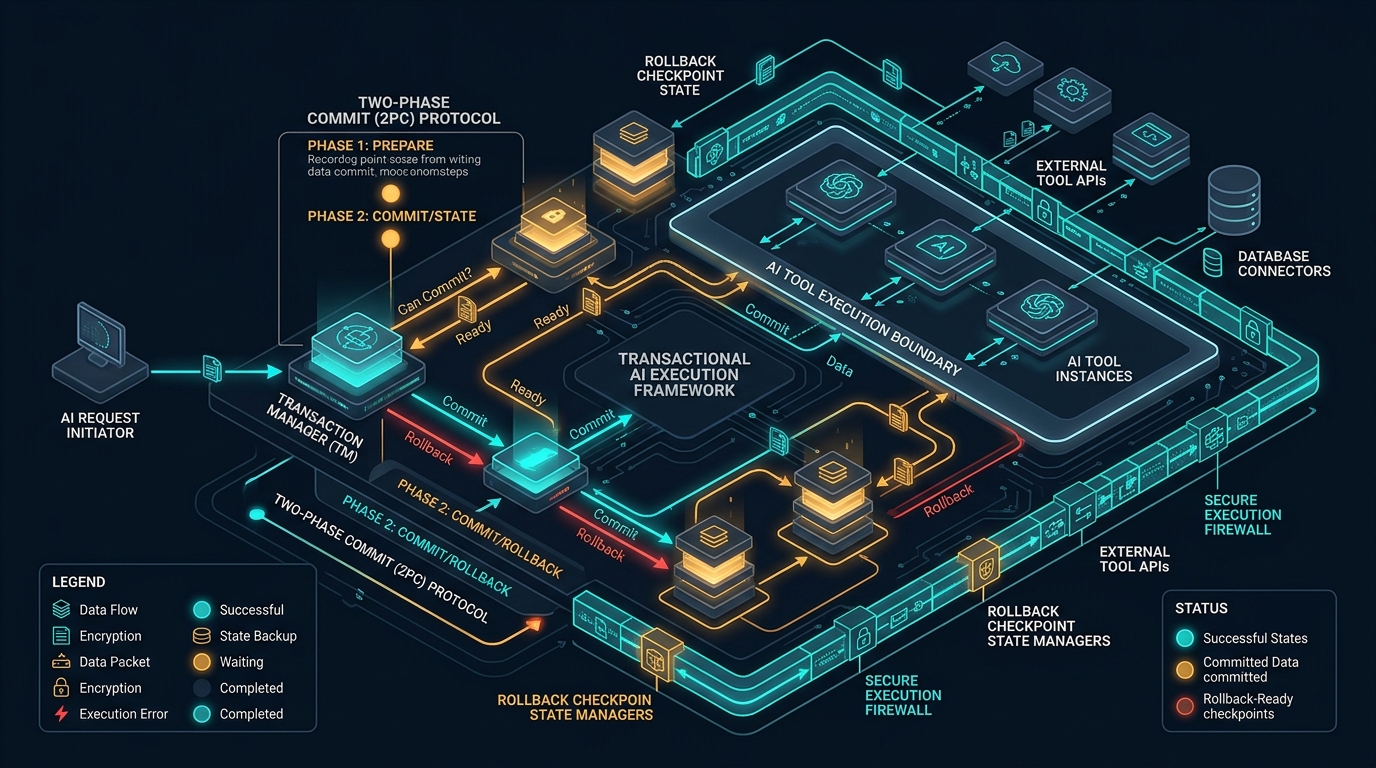
+----------------+ 1. Request Tool Execution +-------------------+
| LLM Agent | ------------------------------------> | Saga Orchestrator |
|---|
+----------------+ +-------------------+
| 2. Write to Outbox
v
+-------------------+
| State Store / |
|---|
| Idempotency DB |
+-------------------+
+-----------------------+-----------------------+
| 3a. Execute (Commit) | 3b. Failure -> Rollback
v v
+-----------------------+ +-----------------------+
| Target API | Compensating Action | |
|---|---|---|
| (e.g., Charge Wallet) | (e.g., Refund Wallet) |
+-----------------------+ +-----------------------+
### Implementing the Orchestrator
When the agent decides to invoke a tool, the orchestrator interceptor:
1. Logs the intent to an active state store (e.g., Redis or PostgreSQL) with a status of `PENDING`.
2. Generates a unique `Idempotency Key` bound to the unique execution trace.
3. Attempts execution of the forward action.
4. If execution fails—or if the LLM halts mid-stream—the orchestrator automatically executes the compensating tool path to restore system state.

---

## Architectural Pattern 2: The Outbox Pattern & Two-Phase Execution

A critical anti-pattern in AI design is **Direct State Mutation on Tool Call**. If an agent generates a tool-call JSON, you should never execute that payload directly against your primary database within the same execution frame.

Instead, utilize a **Two-Phase Tool Execution (2PTE)** strategy based on the transactional outbox pattern:

1. **Phase 1: Intent Stage (Probabilistic Validation)**
   The LLM emits a tool call. The system validates the tool payload schema using strict runtime validators (like Pydantic in Python or Zod in TypeScript). If valid, the system writes the action schema to an `ActionOutbox` table within a local database transaction. The state is marked as `STAGED`.
2. **Phase 2: Execution Stage (Deterministic Committal)**
   An isolated, deterministic worker processes the `ActionOutbox` queue. It executes the external API call, captures the response, writes the result to the database, and marks the task as `COMMITTED`. Only *then* is the payload returned to the LLM's context window.

By utilizing this pattern, if your LLM crashes or suffers from an unhandled timeout midway through a complex reasoning loop, your database state is protected by standard database engine constraints, preventing partial writes.

---

## Code Blueprint: Implementing an Idempotent, Boundary-Safe Tool Executor

The following production-ready Python implementation demonstrates how to wrap non-deterministic LLM tool calls within a deterministic transactional boundary using an idempotency manager and state tracking.
import uuid
import json
import hashlib
from typing import Callable, Dict, Any, Optional
from dataclasses import dataclass, asdict
@dataclass
class ToolTransaction:
tx_id: str
tool_name: str
payload_hash: str
status: str # PENDING, COMMITTED, FAILED, ROLLEDBACK
result: Optional[Dict[str, Any]] = None
class TransactionBoundaryManager:
def init(self, state_store: Dict[str, Any]):
self.db = state_store # Simulated persistent database
def _generate_payload_hash(self, payload: Dict[str, Any]) -> str:
serialized = json.dumps(payload, sort_keys=True)
return hashlib.sha256(serialized.encode('utf-8')).hexdigest()
def begin(self, tool_name: str, payload: Dict[str, Any]) -> ToolTransaction:
payload_hash = self._generate_payload_hash(payload)
Check if an identical execution has already completed (Idempotency Check)
for tx in self.db.values():
if tx['tool_name'] == tool_name and tx['payload_hash'] == payload_hash:
if tx['status'] == 'COMMITTED':
return ToolTransaction(**tx)
tx_id = str(uuid.uuid4())
tx = ToolTransaction(
tx_id=tx_id,
tool_name=tool_name,
payload_hash=payload_hash,
status="PENDING"
)
self.db[tx_id] = asdict(tx)
return tx
def commit(self, tx_id: str, result: Dict[str, Any]) -> None:
if tx_id in self.db:
self.db[tx_id]['status'] = 'COMMITTED'
self.db[tx_id]['result'] = result
def rollback(self, tx_id: str, compensation_func: Callable[[], Any]) -> None:
if tx_id in self.db:
try:
compensation_func()
self.db[tx_id]['status'] = 'ROLLEDBACK'
except Exception as e:
self.db[tx_id]['status'] = 'FAILED'
raise RuntimeError(f"Compensation failure on transaction {tx_id}: {str(e)}")
Example Usage within an Agent Orchestrator
db_state = {}
manager = TransactionBoundaryManager(db_state)
def execute_agent_tool_with_boundary(
tool_name: str,
payload: Dict[str, Any],
forward_action: Callable[[Dict[str, Any]], Dict[str, Any]],
compensate_action: Callable[[], Any]
) -> Dict[str, Any]:
tx = manager.begin(tool_name, payload)
If already processed, return cached output
if tx.status == "COMMITTED" and tx.result is not None:
return tx.result
try:
Execute actual integration point
result = forward_action(payload)
manager.commit(tx.tx_id, result)
return result
except Exception as e:
Trigger deterministic rollback sequence
manager.rollback(tx.tx_id, compensate_action)
return {"status": "error", "message": "Transaction rolled back due to error.", "details": str(e)}
---

## Comparing Orchestration Strategies

Different scenarios require varying levels of transactional strictness. When building at The Zebra, we match our orchestration strategy with the downstream risk of the tool:


      Orchestration Pattern
      Safety Boundary Level
      State Sync Hook
      Average Latency Overhead
      Best Use Case


      Inline Tool Execution
      None (Probabilistic Execution)
      Real-time / Ephemeral
      Minimal (< 5ms)
      Read-only operations (e.g., fetching a product manual).


      AI-Saga Pattern
      Medium (Compensating Actions)
      Event-driven / Async
      Low (15ms - 50ms)
      Multi-step user actions (e.g., booking flights + hotels).


      Two-Phase Execution (2PTE)
      High (Strict Outbox + Verification)
      Transactional Outbox Database
      Medium (50ms - 150ms)
      Financial actions (e.g., processing charges, transferring data).


      Human-In-The-Loop (HITL) Gate
      Absolute (Manual Verification)
      Manual Approval UI
      High (Minutes to Hours)
      High-risk mutations (e.g., sending wire transfers, system configuration changes).


---

## Evaluating Tool Call Quality: Metrics that Matter

When you transition from probabilistic prompts to rigid systems, you must measure your boundaries rigorously. Relying purely on qualitative evaluation leaves your system open to silent data corruption. Track these metrics in your evaluation pipelines:

1. **State Transition Drift Rate ($STDR$):**
   The frequency with which your system database changes state without an explicit, completed LLM-outbox confirmation.
   $$STDR = \frac{\text{Unmapped State Mutations}}{\text{Total Agent Actions}}$$
2. **Rollback Success Rate ($RSR$):**
   When a tool call fails, how reliably does your compensating transaction schema return the system to state baseline? Your target should be $\geq 99.99\%$.
3. **Idempotency Key Collision Resistance:**
   Measure how often different LLM tool calls generate the exact same payload hash despite having distinct semantic contexts. Your schema parsing step must prevent payload collisions.

---

## FAQ: Designing Transactional Boundaries for AI Tools

### How do transactional boundaries differ between LLM agents and microservices?
In traditional microservices, transactions fail due to network partitions, database locks, or code exceptions. In LLM systems, transactions can fail because the controller (the LLM) changes its mind, loses its execution context, misinterprets API schemas, or emits invalid data types. AI transactional boundaries isolate the unpredictable decision-making engine from the physical state machines of your architecture.

### What is the performance cost of implementing a Saga pattern for AI tools?
The overhead of logging intent to an outbox and validating schema constraints is negligible (generally less than 15ms). The real latency in agentic systems is dominated by LLM token generation (often $800\text{ms} - 2500\text{ms}$). Designing strict transactional boundaries adds safety layers without introducing perceptible latency bottlenecks for the end-user.

### When should I use a Human-in-the-Loop (HITL) gate instead of an automated saga?
If a transaction involves non-reversible operations—such as sending wire transfers, executing immutable legal contracts, or firing external marketing emails—you must use a HITL Gate. Any transaction where a compensating action cannot programmatically "undo" the state change requires manual approval.

### How do idempotency keys prevent double-execution with agents?
Agents often retry tool calls if they perceive a delay or if the response context is lost. By hashing the tool execution schema (name + input parameters) and caching it with an execution token, the boundary manager detects identical calls and returns the previous result instantly rather than executing a duplicate transaction.

---

## Image Placement and Architecture Diagrams

To fully visualize how state boundaries are constructed under this model, refer to the following system diagrams:

*   **System State Transition Lifecycles:**
    `images/daniel-herrington-state-transitions.png`
    *Recommended Placement:* Directly beneath the compound reliability formula section to illustrate how a state transition moves through different stages of execution.
*   **Agent Saga Boundaries & Outbox Flow:**
    `images/daniel-herrington-agent-saga-boundaries.png`
    *Recommended Placement:* Beneath the AI-Saga Pattern architectural diagram block to show the physical separation between LLM processing contexts and production databases.

---
{
"@context": "https://schema.org",
"@graph": [
{
"@type": "TechArticle",
"@id": "https://danielherrington.com/blog/designing-transactional-boundaries-ai-tools#article",
"isPartOf": {
"@type": "WebPage",
"@id": "https://danielherrington.com/blog/designing-transactional-boundaries-ai-tools"
},
"headline": "Designing Transactional Boundaries for AI Tools: Bridging Probabilistic LLMs with Deterministic Systems",
"description": "How do you build mission-critical, atomic operations when your controller is a probabilistic LLM? Daniel Herrington outlines the design patterns and metrics for AI tool transactional boundaries.",
"inLanguage": "en-US",
"mainEntityOfPage": "https://danielherrington.com/blog/designing-transactional-boundaries-ai-tools",
"datePublished": "2024-10-24T08:00:00+00:00",
"author": {
"@type": "Person",
"name": "Daniel Herrington",
"jobTitle": "Chief AI Officer",
"worksFor": {
"@type": "Organization",
"name": "The Zebra"
}
},
"publisher": {
"@type": "Person",
"name": "Daniel Herrington"
}
},
{
"@type": "FAQPage",
"@id": "https://danielherrington.com/blog/designing-transactional-boundaries-ai-tools#faq",
"mainEntity": [
{
"@type": "Question",
"name": "How do transactional boundaries differ between LLM agents and microservices?",
"acceptedAnswer": {
"@type": "Answer",
"text": "In traditional microservices, transactions fail due to network partitions or code exceptions. In LLM systems, transactions fail because the controller (the LLM) changes its mind, misinterprets API schemas, or emits invalid data types. AI transactional boundaries isolate the unpredictable decision-making engine from the physical state machines."
}
},
{
"@type": "Question",
"name": "What is the performance cost of implementing a Saga pattern for AI tools?",
"acceptedAnswer": {
"@type": "Answer",
"text": "The overhead of logging intent to an outbox and validating schema constraints is minimal (generally < 15ms). The bulk of the system latency is dominated by LLM generation times (800ms - 2500ms)."
}
},
{
"@type": "Question",
"name": "When should I use a Human-in-the-Loop (HITL) gate instead of an automated saga?",
"acceptedAnswer": {
"@type": "Answer",
"text": "If a transaction involves non-reversible operations—like wire transfers or irreversible database deletions—you must use a HITL Gate. Any transaction where a compensating action cannot fully revert the state change requires a manual gate."
}
}
]
}
]
}