
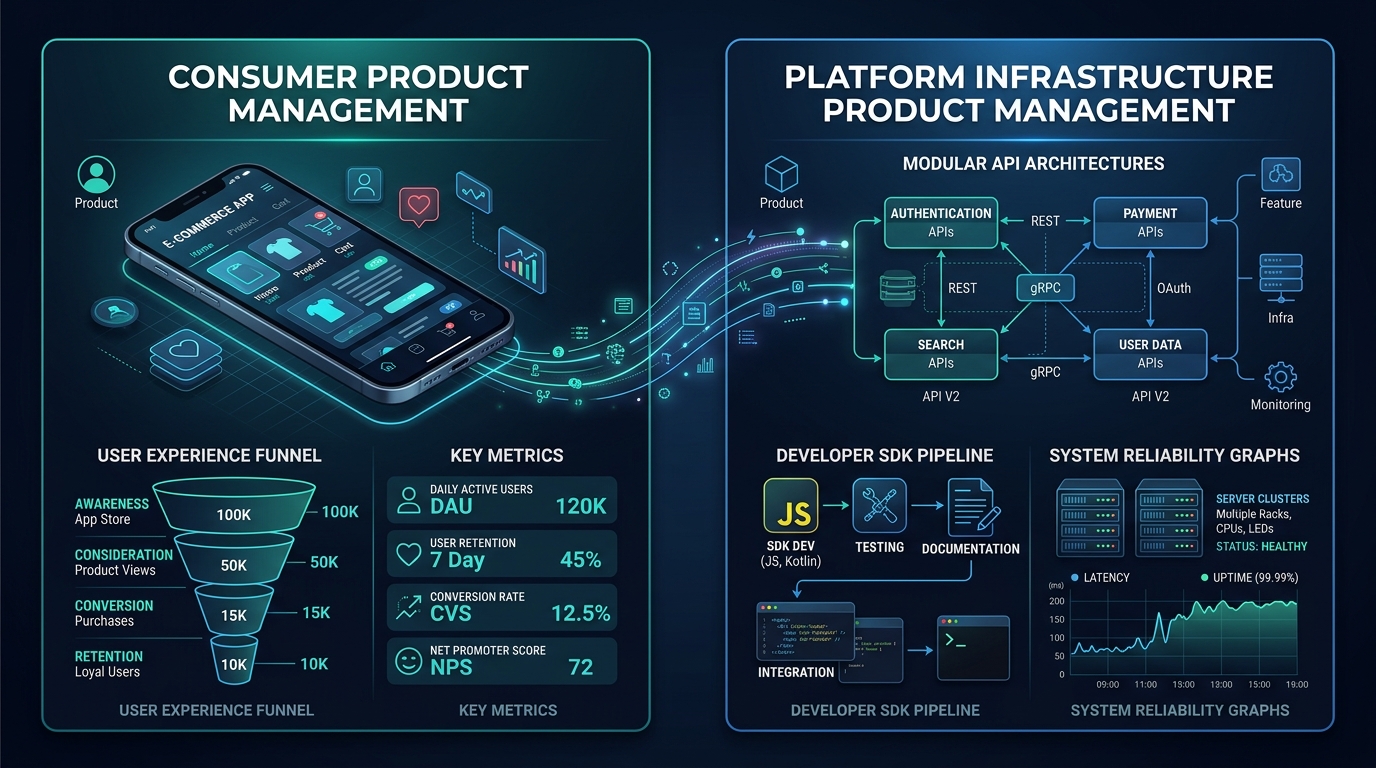
The transition between building for end-users (Consumer PM) and building for developers or internal systems (Platform PM) is one of the most intellectually demanding leaps a product leader can make.
During my time as a Product Manager on Google’s Core ML (later AI2) team, I lived at the exact intersection of these two paradigms. Developing infrastructure for TPU efficiency is the ultimate hybrid challenge: we had to build highly deterministic, low-latency platforms capable of processing petabytes of model event data, while delivering metrics to consumer-facing product teams optimizing early ML-based search ranking.
Today, as Chief AI Officer at The Zebra, I see these two worlds colliding faster than ever through the lens of AI platform orchestration and consumer-facing LLM integrations.
If you are navigating the differences between these two roles—especially within a high-scale environment like Google—this guide will break down the structural, architectural, and metric-driven realities of both paths.
1. The Core Paradigm Shift: Probabilistic vs. Deterministic
At its core, the difference between Consumer PM and Platform PM lies in how you manage system predictability and human behavior.
+-----------------------------------------------------------------------+
|                           THE PM SPECTRUM                             |
+-----------------------------------------------------------------------+
|                                                                       |
|   CONSUMER PM                                           PLATFORM PM   |
|   (Probabilistic)                                    (Deterministic)  |
|                                                                       |
|   * Optimize for human psychology        * Optimize for system logic   |
|   * Embrace volatility & sentiment       * Enforce SLAs, SLOs, SLIs    |
|   * Focus on engagement & UX             * Focus on API/SDK stability  |
|   * ML/Heuristic output dynamics         * Strict input/output state   |
|                                                                       |
+-----------------------------------------------------------------------+
The Consumer PM: Navigating Probabilistic Chaos
A Consumer PM’s primary canvas is human behavior, which is fundamentally probabilistic. When you launch a new feature on the Google Search SERP, you cannot predict with 100% certainty how a cohort of 50 million users will react. You are optimizing for heuristics, emotional resonance, cognitive load, and behavioral psychology.
Your tools are A/B testing platforms, user experience research (UXR), and statistical significance models. You design systems to tolerate high volatility because human interaction is inherently noisy.
The Platform PM: Architecting Deterministic Orchestration
A Platform PM’s canvas is machine-to-machine interactions and developer workflows, which must be strictly deterministic. If you are a Platform PM building Google’s internal key-value storage systems (like Spanner) or API orchestration layers, you cannot afford "behavioral volatility."
An API contract must be absolute. Input $X$ must always yield output $Y$ within an established latency budget (e.g., p99 < 15ms). A Platform PM designs systems to eliminate entropy. Instead of managing user emotion, you manage system state transitions, dependency graphs, and resource constraints (CPU, memory, network I/O).
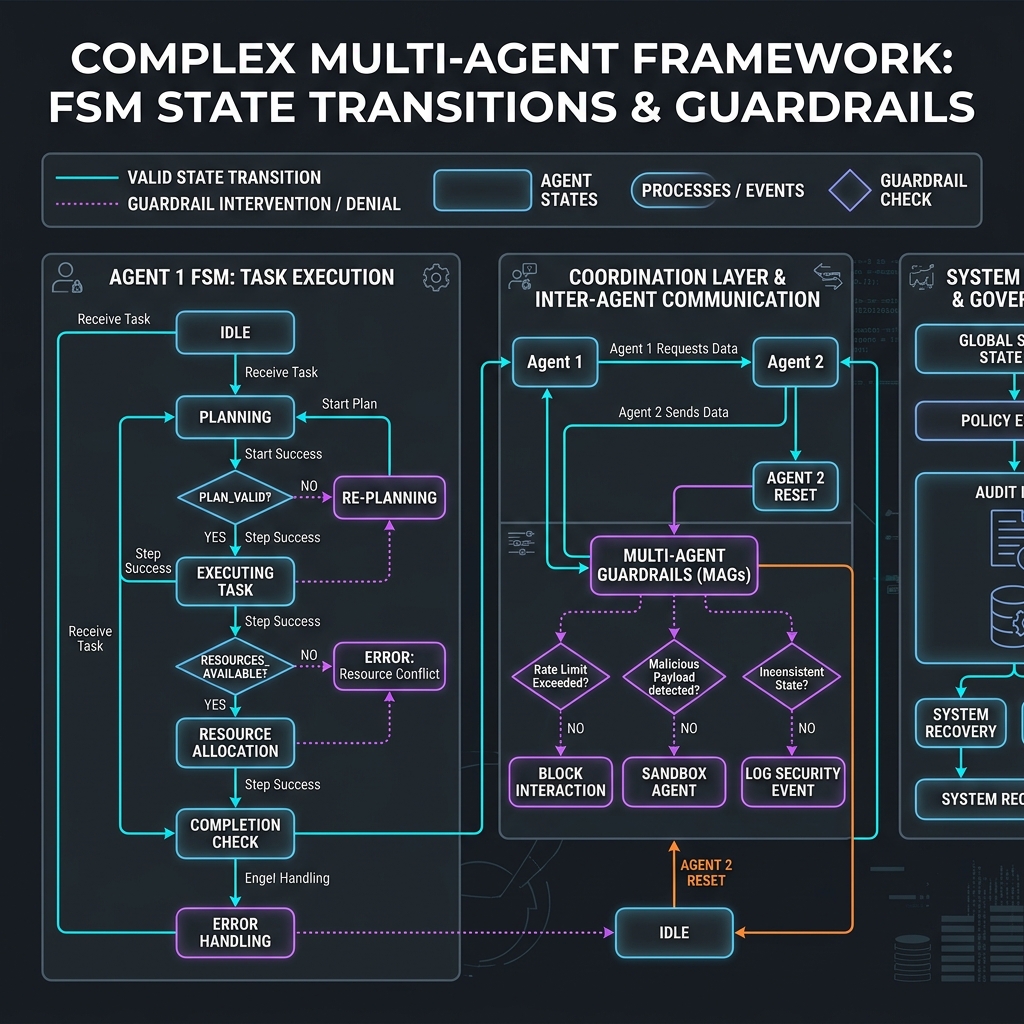
(Figure 1: Designing deterministic state transitions for high-throughput platform APIs.)
2. Infrastructure & Orchestration: The Technical Deep-Dive
To understand the day-to-day realities of a Google Platform PM, we must look at how systems are orchestrated. Let's compare how a Consumer PM and a Platform PM approach a seemingly simple task: Query Processing.
The Consumer Lens (Search Experience)
The Consumer PM for Search asks:
- How do we auto-complete queries based on real-time trending topics?
- What visual modules (e.g., Knowledge Graph, Local Pack) maximize user satisfaction (CSAT) and Click-Through Rate (CTR)?
- how do we format the UI to reduce the time-to-result for the user?
The Platform Lens (Deterministic Tool Orchestration)
The Platform PM behind the Search infrastructure asks:
- How do we orchestrate downstream microservices (Retrieval, Ranking, Ads, Knowledge Graph) so they execute within a strict 200ms end-to-end latency budget?
- How do we leverage deterministic tool orchestration to ensure that when the orchestration layer routes a query to an index shard, it avoids cascading failures if a single node experiences a cold start?
- How are protocol buffers (gRPC) structured to minimize payload size across the backbone network?
For a Platform PM, managing this orchestration requires deep technical empathy. You must understand how your APIs interact with container orchestration systems (like Borg, Google’s predecessor to Kubernetes). If your API contract changes dynamically without backward compatibility, you break thousands of downstream applications.
3. Metrics that Matter: A Comparative Analysis
The divergence between these two roles is most apparent in their Key Performance Indicators (KPIs). While a Consumer PM obsesses over user acquisition and retention, a Platform PM obsesses over system resilience and developer velocity.
Consumer PM Metrics
- Daily Active Users / Monthly Active Users (DAU/MAU): Measuring systemic engagement.
- Feature Adoption Rate: The percentage of users who interact with a new UI element within 30 days of launch.
- Customer Acquisition Cost (CAC) & Lifetime Value (LTV): The unit economics of user growth.
- Net Promoter Score (NPS) / CSAT: Qualitative sentiment quantified.
Platform PM Metrics
- SLAs, SLOs, and SLIs: Service Level Agreements (legal commitments), Objectives (target reliability), and Indicators (real-time metrics like uptime or error rates).
- p95 and p99 Latency: The latency experienced by the 95th and 99th percentiles of users. At Google scale, p99 latency is the difference between a seamless search and millions of dropped queries.
- API Error Rate (HTTP 5xx / gRPC codes): The percentage of failed requests.
- Developer Time to First Hello World (TTFHW): How quickly an internal or external developer can integrate with your platform and execute their first successful API call.
- Resource Utilization & Efficiency: CPU/Memory footprint per transaction—crucial for managing multi-million dollar cloud infrastructure budgets.
4. Side-by-Side Comparison Matrix
To help visualize these structural differences, the table below maps out the operational, technical, and strategic vectors of both disciplines at Google.
| Dimension | Consumer Product Management | Platform Product Management |
|---|---|---|
| Primary Customer | End-consumers (individuals, businesses using front-end apps). | Software engineers, data scientists, internal product teams. |
| Core Architecture | UI/UX, front-end state management, client-side rendering. | APIs, SDKs, gRPC protocols, database schemas, distributed state engines. |
| System Behavior | Probabilistic: Driven by user heuristics, personalization algorithms, and A/B test variants. | Deterministic: Driven by rigorous mathematical constraints, deterministic orchestration, and strict schemas. |
| Key Execution Tooling | Figma, Google Analytics, Optimizely, UserTesting, SQL. | gRPC, Protobufs, Jaeger/OpenTelemetry, Borg/Kubernetes, Grafana, Spanner. |
| Release Management | Continuous Deployment, Feature Flags, rapid UI iteration, Canary testing. | SemVer (Semantic Versioning), long deprecation cycles, backward-compatibility testing, strict rollbacks. |
| Failure Consequence | User annoyance, temporary dip in engagement metrics, low brand affinity. | Systemic outages, cascading downstream failures, broken dependencies, corrupted data stores. |
| My Core ML & TPU Efficiency Experience | Designing dashboards and alert structures that non-technical managers could use to interpret SERP changes. | Architecting the high-throughput, low-latency pipeline to process billions of search events without drops. |
5. Transitioning Between the Two Roles
As someone who has navigated these technical divides, I often get asked: Can a Consumer PM successfully transition to a Platform PM role at Google (or vice versa)?
The answer is yes, but it requires rewiring how you think about your product’s value proposition.

(Figure 2: Formulating product strategy metrics that align platform infrastructure with consumer outcomes.)
Moving from Consumer to Platform PM
If you are making this transition, you must drop the assumption that "user feedback" is the ultimate truth. Your new users are engineers who value stability, predictability, and documentation over aesthetic polish.
- Learn the Stack: You must be comfortable reading API definitions (Protobufs), understanding database normalizations, and discussing system design topologies (e.g., monolithic vs. microservices, pub-sub architectures).
- Prioritize Documentation as a Product Feature: For a platform, your API documentation and SDKs are your user interface. If they are poor, your product is poor.
- Master the Non-Functional Requirements (NFRs): Security, scalability, latency, and compliance (GDPR/CCPA) are no longer afterthought tickets—they are core product requirements.
Moving from Platform to Consumer PM
If you are moving from Platform to Consumer, your challenge is learning to embrace ambiguity.
- Develop Deep User Empathy: Engineers are logical; consumer users are often non-linear and emotional. You must spend time observing users interact with your software through UXR sessions.
- Accept Statistical Volatility: You will no longer have clean 99.99% uptime metrics as your primary victory. You must get comfortable with noisy A/B test results where statistical significance takes weeks to achieve.
- Focus on UX Aesthetics: A technically flawless system with a confusing UI will fail in the consumer market. You must learn to collaborate deeply with Product Designers and content strategists.
6. Frequently Asked Questions
What does a Platform PM do at Google?
A Platform PM at Google owns the shared infrastructure, tools, APIs, and frameworks that internal Google engineers (and external Cloud developers) use to build applications. This includes owning systems like Identity Access Management (IAM), database technologies (Spanner, Bigtable), machine learning platforms (Vertex AI), or search indexing pipelines. Their primary goal is to maximize developer velocity while ensuring system security, reliability, and cost-efficiency.
Is Platform PM more technical than Consumer PM?
Generally, yes. While both roles require strong product-thinking, a Platform PM must regularly engage in deep system design discussions with Staff and Principal Engineers. They must understand code structures, API design paradigms (REST, gRPC), database performance characteristics, and cloud architecture to make informed prioritization decisions.
How does "deterministic tool orchestration" apply to Platform PMs?
Deterministic tool orchestration refers to the structured, predictable coordination of various software tools, APIs, and microservices to complete a complex workflow. For a Platform PM, managing this means designing system state machines and orchestration pipelines where every input, retry logic, and fallback path is explicitly defined. This prevents unpredictable "race conditions" or cascading timeouts in highly distributed environments.
Which role is better for future C-level executive roles (CPO/Chief AI Officer)?
Both roles offer valuable pathways. A Consumer PM background builds exceptional customer empathy, market positioning skills, and growth instincts—vital for Chief Product Officers. A Platform PM background builds systemic thinking, architectural understanding, and operational scalability skills—essential for Chief Technology Officers or Chief AI Officers who must design enterprise-grade AI platforms, data pipelines, and orchestration strategies at scale.
{
  "@context": "https://schema.org",
  "@type": "TechArticle",
  "headline": "Difference between consumer product management and platform PM at Google",
  "image": [
    "https://danielherrington.com/images/daniel-herrington-platform-vs-consumer-pm.jpg",
    "https://danielherrington.com/images/daniel-herrington-state-transitions.jpg",
    "https://danielherrington.com/images/daniel-herrington-product-strategy.jpg"
  ],
  "author": {
    "@type": "Person",
    "name": "Daniel Herrington",
    "jobTitle": "Chief AI Officer",
    "worksFor": {
      "@type": "Organization",
      "name": "The Zebra"
    }
  },
  "publisher": {
    "@type": "Person",
    "name": "Daniel Herrington"
  },
  "mainEntityOfPage": {
    "@type": "WebPage",
    "@id": "https://danielherrington.com/blog/consumer-pm-vs-platform-pm-google"
  },
  "description": "An authoritative guide by ex-Google PM Daniel Herrington analyzing the technical, metric, and architectural differences between Consumer PM and Platform PM roles at Google.",
  "about": [
    {
      "@type": "Thing",
      "name": "Product Management"
    },
    {
      "@type": "Thing",
      "name": "Google Search"
    },
    {
      "@type": "Thing",
      "name": "Software Architecture"
    }
  ]
}