
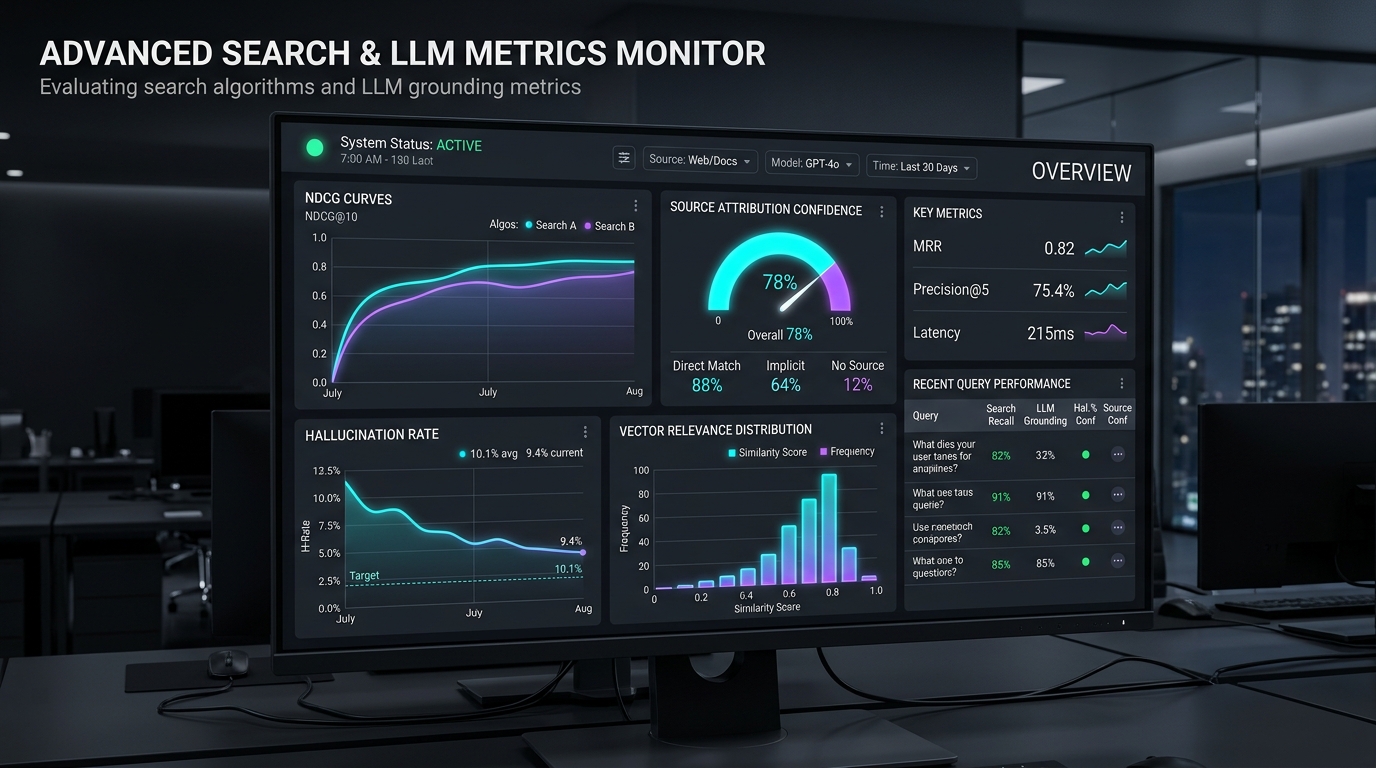
At Google, my team in Core ML (AI2) lived and breathed infrastructure efficiency. We ran thousands of TPU performance evaluations, analyzed latency metrics, and constructed metrics designed to optimize hardware scaling, which was heavily utilized by Google's early machine learning search pipelines.
Now, as the Chief AI Officer at The Zebra, the challenge has evolved. We are no longer just ranking blue links; we are orchestrating complex, agentic systems where Large Language Models (LLMs) synthesize structured domain data (like insurance rates) with unstructured natural language.
When you transition from classic Information Retrieval (IR) to LLM-powered Retrieval-Augmented Generation (RAG) and deterministic tool orchestration, your evaluation framework cannot remain static. If you evaluate an LLM application using only classic search metrics like NDCG, you will fail to detect hallucinations. Conversely, if you evaluate your grounding systems using only LLM-as-a-judge heuristics, you will introduce massive statistical variance into your production releases.
This guide details how to build a unified evaluation framework that bridges classic search metrics with modern LLM grounding evaluation.
1. The Paradigm Shift: From Rank to Synthesis
In classic search, the primary goal is ranking. We optimize for relevance and position. If the best result is at position one, your system is highly performant.
In an LLM-grounded environment, retrieval is merely step one. The retrieved documents are fed into a context window where the model synthesizes an answer. If your search engine returns the perfect document, but the LLM fails to extract the correct entity, ignores a crucial constraint, or introduces a hallucination, the end-user experience is broken.
[User Query] ──> [Deterministic Router] ──> [Vector + Keyword Search] ──> [Context Selection] ──> [LLM Synthesis] ──> [Grounding Guardrail] ──> [User Response]We must evaluate this pipeline at three distinct phases:
- The Retrieval Phase: Are we pulling the right context?
- The Orchestration Phase: Are our deterministic tools and state transitions executing correctly?
- The Generation (Grounding) Phase: Is the synthesized answer faithful to the retrieved context?
2. Classic Retrieval Metrics (The Baseline)
Before evaluating LLM synthesis, you must isolate your retrieval pipeline. If your context recall is poor, no amount of prompt engineering or model fine-tuning will save your system.
Normalized Discounted Cumulative Gain (NDCG@K)
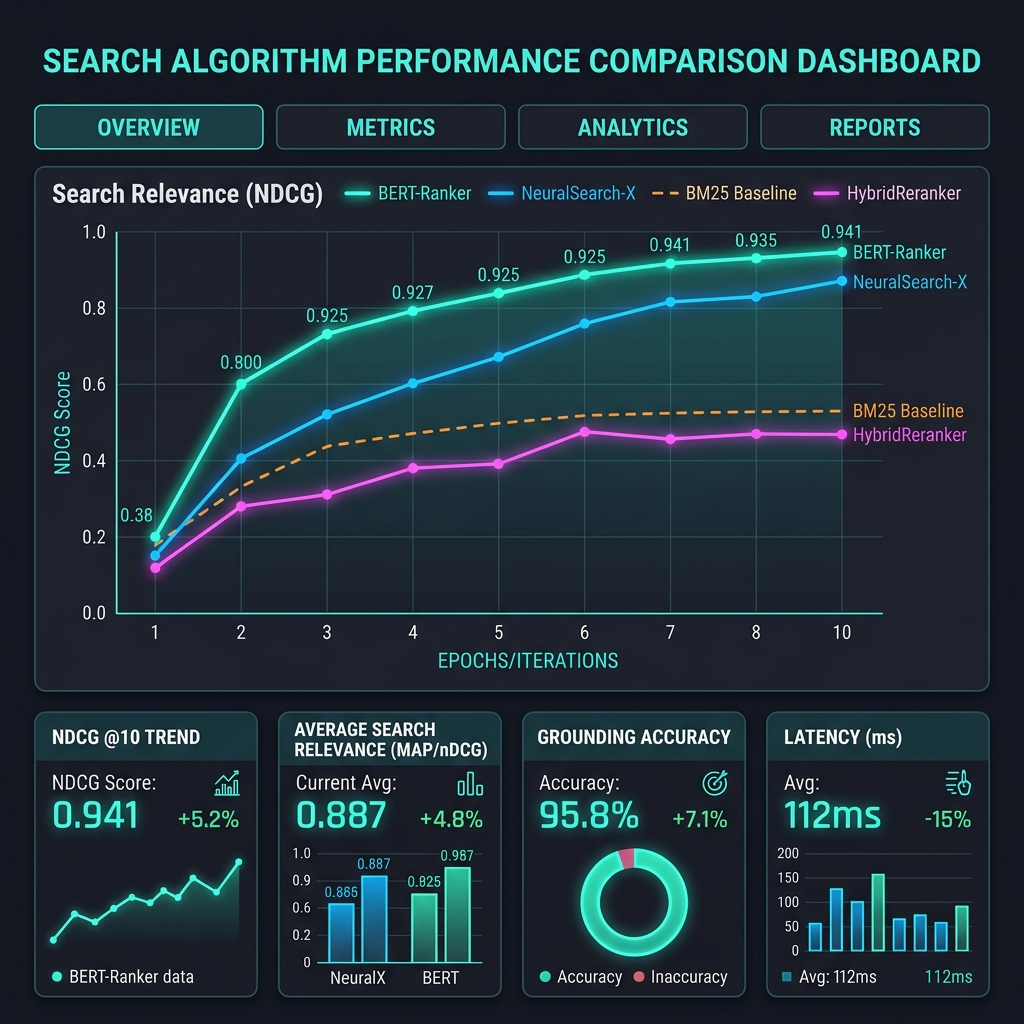
NDCG measures the quality of a ranking system, accounting for graded relevance. In an LLM pipeline, NDCG@K (where $K$ represents the number of documents passed to the context window) is critical because LLMs suffer from "lost in the middle" phenomena. They pay more attention to tokens at the very beginning and end of the context window.
$$NDCG_p = \frac{DCG_p}{IDCG_p}$$
Where Discounted Cumulative Gain ($DCG_p$) is defined as:
$$DCG_p = \sum_{i=1}^p \frac{2^{rel_i} - 1}{\log_2(i+1)}$$
- Why it matters for LLM Grounding: If high-relevance chunks are buried at index 4 or 5 of your context window rather than index 1 or 2, the model's extraction accuracy can drop by up to 30%.
Context Recall & Context Precision
- Context Recall: The proportion of ground-truth relevant information that is successfully retrieved by the search algorithm. If a user asks "What are the comprehensive coverage limits for Progressive in Texas?" and your retriever fails to fetch the specific policy document, your recall is 0.
- Context Precision: The ratio of retrieved chunks that are actually relevant to the query. High precision minimizes noise, lowering token costs and reducing the risk of the model hallucinating based on irrelevant context.
3. Grounding and Generative Metrics
Once context is successfully retrieved, we must evaluate how the LLM uses it. We use four core metrics to assess grounding quality.
Faithfulness (Hallucination Rate)
Faithfulness measures whether the model's generation is derived strictly from the retrieved context.
To calculate Faithfulness algorithmically:
- Sentence Extraction: Break down the generated output into individual statements ($S_1, S_2, ... S_n$).
- NLI (Natural Language Inference) Verification: For each statement, use a fine-tuned NLI model or a highly reliable LLM evaluator to check if the statement is logically entailed by the retrieved context ($C$).
$$\text{Faithfulness Score} = \frac{\text{Number of Entailed Statements}}{\text{Total Number of Generated Statements}}$$
At The Zebra, we target a Faithfulness Score of > 0.98 for auto-insurance rate explanations. Anything lower risks compliance issues.
Answer Relevance
Answer Relevance quantifies how well the generated response directly addresses the user's initial prompt. It penalizes fluff, redundant phrases, and incomplete answers. We measure this by prompting an LLM to generate a hypothetical query based on the generated answer, then calculating the semantic similarity (via cosine similarity of embeddings) between the generated query and the actual user query.
4. Deterministic Tool Orchestration and State Transitions
To scale LLM search applications beyond basic Q&A, you must integrate deterministic tool orchestration. This is where many current implementations fail. They rely on the LLM to dynamically decide when to call APIs, which leads to high latency, unpredictable behavior, and API rate limit breaches.
Instead, a robust architecture utilizes a Deterministic state-machine router to handle tool calls, reserving the LLM strictly for processing natural language inputs and outputs.
Evaluating Orchestration Metrics
When evaluating tool orchestration, track the following metrics:
- State Transition Accuracy: The percentage of user queries routed to the correct API endpoint or workflow.
- Fallback Rate: How often the system fails to match a user intent to a tool and falls back to a generic conversational model.
- Constraint Compliance: For example, in insurance quoting, if the system must collect five data points (ZIP, Age, Car Make, Car Model, Prior Coverage) before querying our quoting engine, we evaluate whether the orchestration agent strictly enforces this state machine before calling the downstream API.
5. Structured Comparison of Orchestration and Search Evaluation Strategies
The table below outlines how various search and generation architectures perform across key product metrics, detailing how to align your evaluation framework based on architectural complexity.
| Architecture Strategy | Evaluation Complexity | Primary Core ML & TPU Efficiency | Primary Grounding Metrics | SGE & Extraction Suitability |
|---|---|---|---|---|
| Classic Keyword Search (BM25) | Low | Precision@K, MAP, MRR | N/A (No generation) | Poor. Lacks semantic synthesis. |
| Standard RAG (Dense Vector Search + LLM) | Medium | NDCG@K, Context Recall, Context Precision | Faithfulness, Answer Relevance | Moderate. Subject to context-stuffing and semantic drift. |
| Deterministic Tool Orchestration (Hybrid RAG) | High | API Route Accuracy, Slot-Filling Rate, State Transition Success | Entity Grounding Score, Faithfulness, Semantic Similarity | Excellent. Highly reliable, factual, structured data output. |
| Agentic Graph-Based Routing (Multi-Agent) | Very High | Path Traversal Efficiency, Step-wise Success Rate | Cumulative Halucination Rate, Goal Completion Rate | Variable. High latency, requires rigorous guardrailing. |
6. Implementing an Automated Evaluation Loop
You cannot scale an AI product relying on manual spot-checks. At The Zebra, we implement automated CI/CD evaluation pipelines utilizing a curated Golden Dataset.
[Code/Prompt Push]
       │
       ▼
[Execute Pipeline on Golden Dataset (N=500)]
       │
       ▼
[Run Evaluators] ───> 1. Calculate NDCG@5 on Retrieval
       │         ───> 2. Calculate Faithfulness via LLM-as-a-Judge
       │         ───> 3. Verify Deterministic State Machine Transitions
       ▼
[Validate Gate] ────> Assert: Faithfulness > 0.95 & NDCG > 0.82
       │
       ├─── Yes ───> [Deploy to Production]
       └─── No  ───> [Block Deployment & Alert]
LLM-as-a-Judge Alignment
While human evaluation remains the gold standard, it is slow and expensive. We align our automated LLM judges (typically utilizing highly structured prompting with GPT-4) against human annotators, striving for a Cohen's Kappa coefficient of $\kappa \ge 0.80$, indicating strong agreement.
# Conceptual example of an automated evaluation assertion in Python
def evaluate_grounding_pipeline(retrieved_context, generated_answer, gold_standard):
    # Calculate retrieval success
    context_precision = calculate_context_precision(retrieved_context, gold_standard)

    # Calculate generation faithfulness
    faithfulness_score = check_nli_entailment(retrieved_context, generated_answer)

    # Assert performance threshold gates
    assert context_precision >= 0.85, f"Context Precision failed: {context_precision}"
    assert faithfulness_score >= 0.98, f"Faithfulness Gate failed: {faithfulness_score}"

    return "Pipeline Passed Evaluation Gate"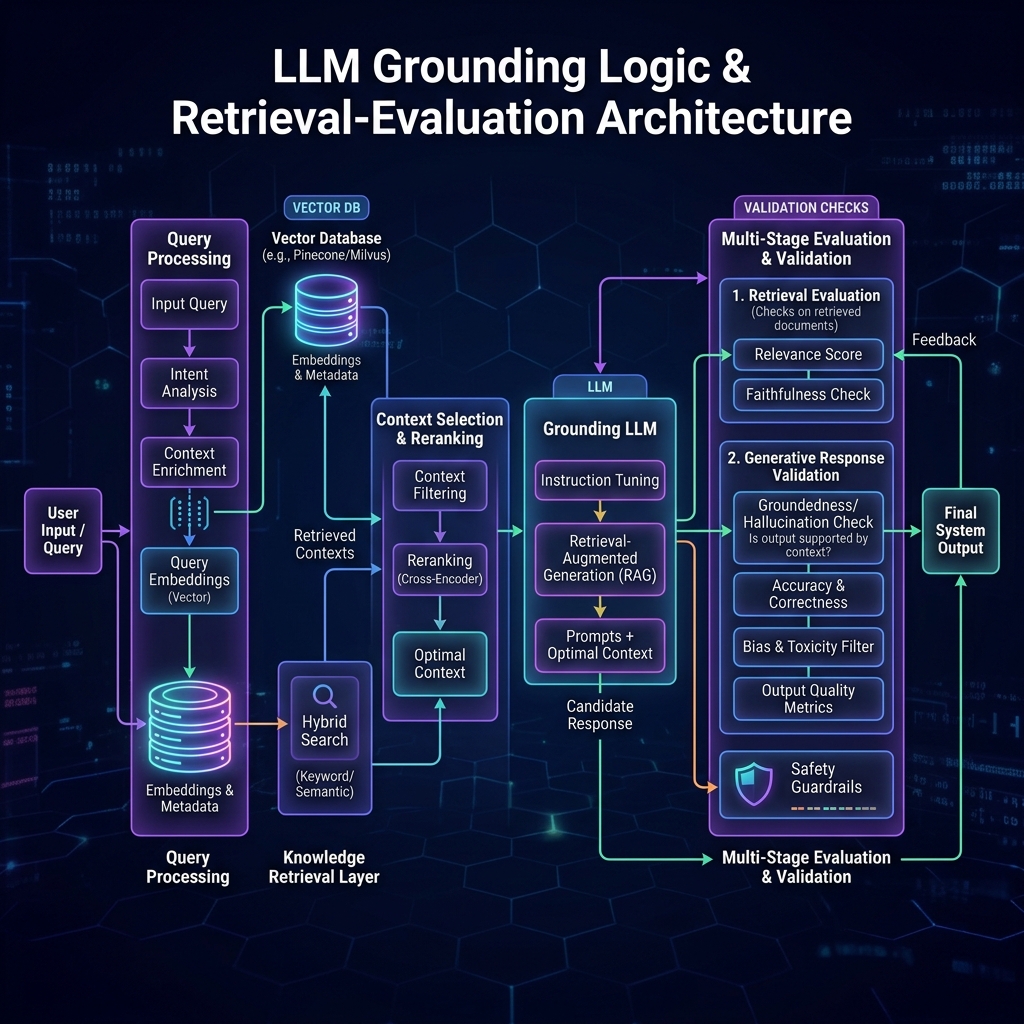
Conclusion: The Product Manager’s Mandate
As product leaders, we cannot treat LLMs as black boxes. To build defensible, production-grade search and generative features, we must measure what matters. Establish your baseline retrieval metrics using classic IR methodologies, secure your workflow transitions with deterministic tool orchestration, and continuously monitor your generative outputs using robust grounding metrics.
By systematically aligning your offline evaluation benchmarks with online user feedback loops, you create a flywheel of continuous optimization that translates directly into user trust and business value.
Frequently Asked Questions
What is the difference between deterministic tool orchestration and probabilistic grounding?
Deterministic tool orchestration uses explicit state-machines, hard-coded API integrations, and validation scripts to ensure external workflows execute exactly as intended. Probabilistic grounding, on the other hand, relies on semantic models (like vector databases and LLM reasoning) to synthesize and generate natural language answers based on retrieved context. The ideal enterprise search application uses deterministic tools to fetch precise data, and probabilistic models to explain it.
How does Google's SGE (AI Overviews) utilize grounding metrics to rank source materials?
While Google keeps its internal SGE ranking weights proprietary, foundational search quality principles suggest that SGE prioritizes factual density, structured schemas, source alignment, and verification. If a source document contains data that cannot be validated across multiple authoritative entities, or if it lacks semantic cohesion, its likelihood of being used as a citation in generative responses decreases.
How do you evaluate search algorithm metrics against LLM hallucination rates?
The key is separation of concerns. You must evaluate the retrieval algorithm (using classic metrics like NDCG and Context Recall) completely independently of the generation step. Once you confirm your search engine consistently retrieves the correct source documents, you can isolate and measure the model's hallucination rate using NLI entailment calculations and Faithfulness metrics.
Which offline evaluation framework is best for RAG pipelines?
For open-source and rapid prototype setups, frameworks like Ragas and TruLens are excellent starting points. They offer pre-built implementations of Faithfulness, Answer Relevance, and Context Recall metrics. However, for highly regulated or highly specific industries (such as insurance or finance), we recommend constructing a custom, internal evaluation harness that relies on a domain-specific Golden Dataset and highly calibrated evaluation prompts.
Image Placement Strategy
To replicate this technical post successfully on your portfolio, we recommend utilizing the following two image naming and placement conventions:
daniel-herrington-search-evaluation-metrics.jpg: Place this image in Section 2 to illustrate the taxonomy of classic search metrics vs generative grounding metrics.daniel-herrington-llm-grounding-architecture.jpg: Place this image in Section 6 to visualize the CI/CD automated evaluation loop and the interaction of deterministic routing components.
{
  "@context": "https://schema.org",
  "@graph": [
    {
      "@type": "TechArticle",
      "@id": "https://danielherrington.com/blog/evaluating-product-metrics-search-llm-grounding#article",
      "isPartOf": {
        "@type": "WebPage",
        "@id": "https://danielherrington.com/blog/evaluating-product-metrics-search-llm-grounding"
      },
      "headline": "Evaluating Product Metrics for Search Algorithms and LLM Grounding",
      "description": "An in-depth guide by Daniel Herrington on bridging classic search metrics (NDCG, MAP) with modern LLM grounding evaluations and deterministic tool orchestration.",
      "inLanguage": "en-US",
      "mainEntityOfPage": "https://danielherrington.com/blog/evaluating-product-metrics-search-llm-grounding",
      "datePublished": "2024-10-24T08:00:00+00:00",
      "dateModified": "2024-10-24T08:00:00+00:00",
      "author": {
        "@type": "Person",
        "name": "Daniel Herrington",
        "jobTitle": "Chief AI Officer",
        "worksFor": {
          "@type": "Organization",
          "name": "The Zebra"
        }
      },
      "publisher": {
        "@type": "Person",
        "name": "Daniel Herrington"
      },
      "image": [
        "https://danielherrington.com/images/daniel-herrington-llm-grounding-architecture.jpg",
        "https://danielherrington.com/images/daniel-herrington-search-evaluation-metrics.jpg"
      ]
    },
    {
      "@type": "FAQPage",
      "@id": "https://danielherrington.com/blog/evaluating-product-metrics-search-llm-grounding#faq",
      "mainEntity": [
        {
          "@type": "Question",
          "name": "What is the difference between deterministic tool orchestration and probabilistic grounding?",
          "acceptedAnswer": {
            "@type": "Answer",
            "text": "Deterministic tool orchestration uses explicit state-machines, hard-coded API integrations, and validation scripts to ensure external workflows execute exactly as intended. Probabilistic grounding relies on semantic models (like vector databases and LLM reasoning) to synthesize and generate natural language answers based on retrieved context."
          }
        },
        {
          "@type": "Question",
          "name": "How does Google's SGE (AI Overviews) utilize grounding metrics to rank source materials?",
          "acceptedAnswer": {
            "@type": "Answer",
            "text": "Google's SGE prioritizes factual density, structured schemas, source alignment, and verification. If a source document contains data that cannot be validated across multiple authoritative entities, or if it lacks semantic cohesion, its likelihood of being used as a citation in generative responses decreases."
          }
        },
        {
          "@type": "Question",
          "name": "How do you evaluate search algorithm metrics against LLM hallucination rates?",
          "acceptedAnswer": {
            "@type": "Answer",
            "text": "You must evaluate the retrieval algorithm (using classic metrics like NDCG and Context Recall) completely independently of the generation step. Once you confirm your search engine consistently retrieves the correct source documents, you can isolate and measure the model's hallucination rate using NLI entailment calculations and Faithfulness metrics."
          }
        },
        {
          "@type": "Question",
          "name": "Which offline evaluation framework is best for RAG pipelines?",
          "acceptedAnswer": {
            "@type": "Answer",
            "text": "For open-source and rapid prototype setups, frameworks like Ragas and TruLens are excellent starting points. They offer pre-built implementations of Faithfulness, Answer Relevance, and Context Recall metrics. For enterprise environments, we recommend constructing a custom evaluation harness aligned with a domain-specific Golden Dataset."
          }
        }
      ]
    }
  ]
}