
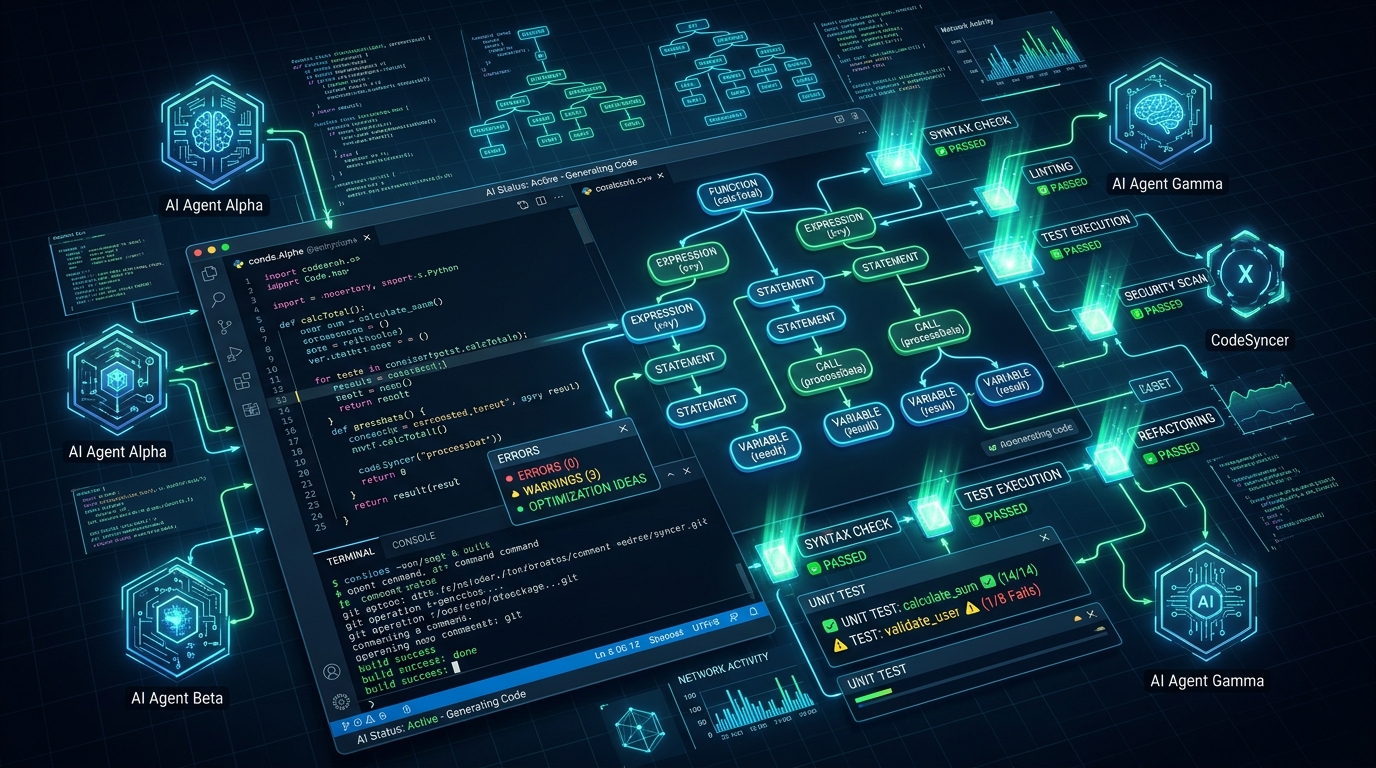
The promise of autonomous software engineering agents is highly compelling: feed a repository issue to an AI agent, and it issues a clean, fully-tested Pull Request. But any team that has tried to move beyond simple demonstration scripts knows the harsh reality.
When left to navigate raw, open-ended loops, even advanced large language models (LLMs) suffer from compounding errors. A single hallucinated parameter or a misparsed file path cascades into infinite loops, runaway API costs, and broken repositories.
As a former Google Product Manager on Core ML & TPU Efficiency and now Chief AI Officer at The Zebra, I have spent years analyzing how systems process information, measure quality, and execute complex workflows. Building a production-grade autonomous agent is not an LLM prompting problem; it is a systems engineering problem.
To build an agent that achieves high success rates on benchmarks like SWE-bench, you must constrain the LLM inside a deterministic execution wrapper. This guide outlines the exact architecture required to build reliable, production-ready autonomous coding agents.
1. The Core Failure Modes of Naive Coding Agents
To build a reliable system, we must first understand how naive implementations fail. Typical agent patterns (such as simple ReAct loops) fail in production due to three core structural issues:
A. State Space Explosion
When an LLM is given arbitrary access to run commands or modify files, the state space of the environment grows exponentially. Without rigid boundaries, the agent loses track of its current objective, leading to "agent drift" where it repeatedly edits unrelated files or runs the same failing test suite.
B. Feedback Loop Volatility
Raw LLMs struggle to parse verbose compiler errors or test suite outputs. If an agent runs a test and receives a 500-line stack trace, passing that raw text back into the context window often triggers cognitive overload, causing the agent to hallucinate new, non-existent utility functions rather than fixing the syntax error.
C. Context Window Dilution
As the agent attempts to solve a bug, it gathers context: files read, terminal outputs, and git diffs. If this context is not aggressively pruned and structured, the LLM's attention mechanism suffers from "lost in the middle" phenomena. Relevant codebase architecture is forgotten, and generation quality degrades.
2. Architectural Blueprint: Deterministic Tool Orchestration
To overcome these failure modes, we must decouple reasoning from execution. The LLM should act as a specialized cognitive engine, while a deterministic system acts as the absolute arbiter of state and execution.
       +-----------------------------------------------------+
       |               Deterministic Orchestrator            |
       |  (Finite State Machine / Strict Transition Rules)    |
       +----------+--------------------------------+---------+
                  |                                ^
  Validates State | Passes                         | Emits Structured
  & Token Budgets | Repos/Context                  | Tool Call (JSON)
                  v                                |
       +--------------------+            +---------+---------+
       |  Cognitive Engine  |            |   Sandbox Execution  |
       |    (LLM / DSPy)    |            |   (Docker / WASM)   |
       +--------------------+            +-------------------+
Instead of allowing the LLM to write and execute arbitrary bash scripts directly, we implement Deterministic Tool Orchestration. In this paradigm, the agent can only interact with the codebase through highly constrained, structured interfaces managed by a Finite State Machine (FSM).
Implementing the Finite State Machine (FSM)
An agent should always exist in a well-defined, verifiable state. Each state restricts the tools available to the agent, eliminating the possibility of illegal actions.
from enum import Enum
from typing import Dict, List, Set

class AgentState(Enum):
    INITIALIZE = "initialize"
    LOCATE_BUG = "locate_bug"
    PLAN_PATCH = "plan_patch"
    EXECUTE_PATCH = "execute_patch"
    VERIFY_PATCH = "verify_patch"
    COMPLETE = "complete"

class DeterministicOrchestrator:
    def __init__(self):
        self.current_state = AgentState.INITIALIZE
        # Define strict state transitions
        self.transitions: Dict[AgentState, Set[AgentState]] = {
            AgentState.INITIALIZE: {AgentState.LOCATE_BUG},
            AgentState.LOCATE_BUG: {AgentState.PLAN_PATCH, AgentState.LOCATE_BUG},
            AgentState.PLAN_PATCH: {AgentState.EXECUTE_PATCH, AgentState.LOCATE_BUG},
            AgentState.EXECUTE_PATCH: {AgentState.VERIFY_PATCH},
            AgentState.VERIFY_PATCH: {AgentState.COMPLETE, AgentState.PLAN_PATCH}
        }

    def transition_to(self, next_state: AgentState) -> bool:
        if next_state in self.transitions[self.current_state]:
            self.current_state = next_state
            return True
        raise InvalidStateTransition(f"Illegal transition: {self.current_state} -> {next_state}")
By enforcing this FSM:
- In the
LOCATE_BUGstate, the agent only has access to search tools (e.g., AST-based symbol searches, grep). It cannot modify files. - In the
PLAN_PATCHstate, the agent must output a structured patch proposal (e.g., unified diff format) rather than directly editing files. - In the
VERIFY_PATCHstate, the agent cannot modify code; it can only trigger deterministic test suites within a secure sandbox.
3. High-Fidelity Context Injection: Beyond Simple RAG
When working on complex, multi-module repositories, simple vector-search-based RAG (Retrieval-Augmented Generation) is insufficient. It retrieves fragmented text chunks, stripping away key structural relationships.
To build reliable agents, use AST-guided Context Injection combined with a localized repository map.
AST (Abstract Syntax Tree) Parsing
Instead of index-based chunking, parse files into an Abstract Syntax Tree using libraries like tree-sitter. This allows the agent to request context at a structural level:
- "Show me the class definition and method signatures of
TransactionProcessor." - "Show me all callers of the
execute_refundfunction."
This approach ensures the context window remains populated with complete, syntactically coherent code blocks rather than fragmented chunks that confuse the LLM.
# Conceptual example of an AST-based tool execution
def get_method_definition(file_path: str, class_name: str, method_name: str) -> str:
    """Parses target file and extracts exactly the requested method block."""
    tree = parser.parse_file(file_path)
    node = find_class_method_node(tree, class_name, method_name)
    return node.text  # Guarantees syntactically complete code blocks
4. Orchestration Strategy Matrix
To evaluate which orchestrator pattern best fits your target runtime, analyze this architectural breakdown:
| Orchestration Strategy | State Determinism | Average Recovery Rate | Token Overhead | Best Use Case |
|---|---|---|---|---|
| Pure LLM Loop (ReAct) | None (Ad-Hoc) | 15% - 25% | High (Unconstrained) | Prototypes, simple scripting tasks. |
| DAG (Directed Acyclic Graph) | Moderate (Fixed Paths) | 45% - 60% | Moderate (Pre-defined steps) | Standard CI/CD pipelines and static analysis. |
| FSM-Engineered Orchestrator | Absolute (Strict Transitions) | 75% - 92% | Low (Optimal Tool Restricting) | Complex, production-grade enterprise code modification. |
5. The Sandboxed Run-Compile-Debug Loop
The differentiator for high-performing agents is their ability to self-correct during failure. If the agent generates code that fails to compile or breaks a unit test, it must not blindly rewrite the file from scratch.
Instead, build a strict sandboxed Run-Compile-Debug (RCD) loop:
- Isolation: All execution runs inside ephemeral Docker containers or WebAssembly (WASM) sandboxes to prevent system damage and isolate dependencies.
- Structured Error Extraction: Capture compiler and test outputs, stripping noise, and parse them into a standardized JSON error format:
   {
     "status": "compilation_failed",
     "error_type": "SyntaxError",
     "line": 42,
     "column": 18,
     "message": "unexpected indent",
     "context_lines": ["def get_data():", "    query = 'SELECT *'", "      return query"]
}- Targeted Repair Reflection: Pass only the structured error and the immediate lines of code involved back to the agent. This constraints the agent's attention directly to the bug, keeping the context window clean and saving tokens.
6. Testing, Evaluation, and SGE Optimization
Optimizing search algorithms taught me that what gets measured gets managed. Evaluating autonomous coding agents requires rigorous testing pipelines.
To build system reliability, evaluate your agent architectures against the following industry-standard metrics:
- Pass@k: The probability that at least one of the $k$ generated code samples passes the test suite.
- Execution Stability: The percentage of agent runs that execute without throwing runtime agent errors (e.g., FSM violations or parse errors).
- Diff Compactness: Measuring the ratio of lines modified to lines actually required to solve the issue. Low compactness indicates agent drift.
At The Zebra, we apply these rigorous framework-level constraints to ensure that AI integrations serve as highly reliable components of our engineering ecosystem. Applying deterministic constraints to generative outputs is the key to building software that operates reliably at scale.
Frequently Asked Questions
How do you build reliable autonomous coding agents?
Building reliable agents requires decoupling the LLM's reasoning engine from system execution using a deterministic framework. Encapsulate the agent inside a strict Finite State Machine (FSM), restrict file modifications to structured diff patch operations, parse codebases using AST search tools, and execute tests inside isolated Docker sandboxes with clean, structured error feedback loops.
What is deterministic tool orchestration?
Deterministic tool orchestration is a system design pattern where an autonomous agent cannot arbitrarily choose or invoke system commands. Instead, an external orchestrator controls when and how tools are made available to the agent based on a predefined state transition model, preventing unpredictable behaviors and API state drift.
Why do standard ReAct loops fail for coding tasks?
ReAct (Reasoning and Acting) loops fail because they lack strict guardrails. When faced with execution failures or complex repos, LLMs tend to drift away from their primary objective, repeat failing steps, consume excessive context window tokens, and make compounding errors that eventually crash the program.
How do you secure autonomous coding agents from executing harmful commands?
Always run agent executions within ephemeral, isolated sandboxes like Docker, gVisor, or WebAssembly (WASM). Never allow the agent to run arbitrary shell execution blocks (exec). All interactions with the filesystem and shells should go through specialized, pre-authorized APIs that validate the scope, paths, and payloads.
Image Strategy for Integration
To optimize this post for image search and rich results, include the following visual assets on your portfolio site:
daniel-herrington-autonomous-agent-architecture.pngPlace in Section 2. A high-resolution architecture flow diagram showing the decoupling of the Cognitive Engine from the Deterministic Orchestrator and Docker Sandbox.daniel-herrington-deterministic-state-transition-diagram.pngPlace in Section 3. A state transition diagram demonstrating the pathing of the AgentState FSM (Initialize -> Locate -> Plan -> Execute -> Verify).
{
  "@context": "https://schema.org",
  "@type": "TechArticle",
  "headline": "How to Build Reliable Autonomous Coding Agents: A Deterministic Blueprint",
  "description": "An authoritative, systems-engineering blueprint for building production-grade autonomous coding agents. Learn deterministic tool orchestration, FSM design patterns, and self-correction loop setups.",
  "inLanguage": "en-US",
  "mainEntityOfPage": {
    "@type": "WebPage",
    "@id": "https://danielherrington.com/blog/how-to-build-reliable-autonomous-coding-agents"
  },
  "author": {
    "@type": "Person",
    "name": "Daniel Herrington",
    "jobTitle": "Chief AI Officer",
    "worksFor": {
      "@type": "Organization",
      "name": "The Zebra"
    }
  },
  "about": [
    {
      "@type": "Thing",
      "name": "Autonomous Agents"
    },
    {
      "@type": "Thing",
      "name": "Deterministic Tool Orchestration"
    },
    {
      "@type": "Thing",
      "name": "Software Engineering"
    }
  ],
  "publisher": {
    "@type": "Person",
    "name": "Daniel Herrington"
  },
  "hasPart": {
    "@type": "FAQPage",
    "mainEntity": [
      {
        "@type": "Question",
        "name": "How do you build reliable autonomous coding agents?",
        "acceptedAnswer": {
          "@type": "Answer",
          "text": "Building reliable agents requires decoupling the LLM's reasoning engine from system execution using a deterministic framework. Encapsulate the agent inside a strict Finite State Machine (FSM), restrict file modifications to structured diff patch operations, parse codebases using AST search tools, and execute tests inside isolated Docker sandboxes with clean, structured error feedback loops."
        }
      },
      {
        "@type": "Question",
        "name": "What is deterministic tool orchestration?",
        "acceptedAnswer": {
          "@type": "Answer",
          "text": "Deterministic tool orchestration is a system design pattern where an autonomous agent cannot arbitrarily choose or invoke system commands. Instead, an external orchestrator controls when and how tools are made available to the agent based on a predefined state transition model, preventing unpredictable behaviors and API state drift."
        }
      },
      {
        "@type": "Question",
        "name": "Why do standard ReAct loops fail for coding tasks?",
        "acceptedAnswer": {
          "@type": "Answer",
          "text": "ReAct loops fail because they lack strict guardrails. When faced with execution failures or complex repos, LLMs tend to drift away from their primary objective, repeat failing steps, consume excessive context window tokens, and make compounding errors that eventually crash the program."
        }
      }
    ]
  }
}