
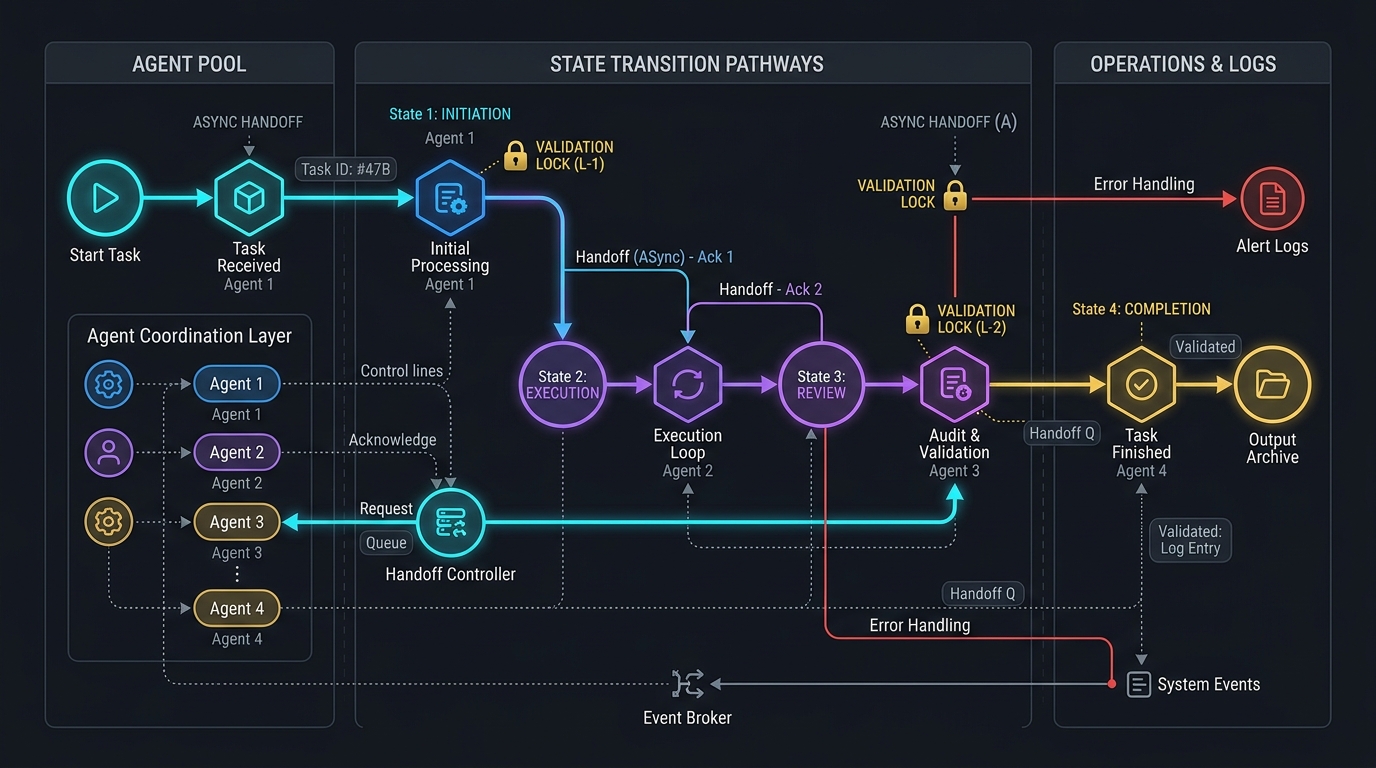
+-------------------------------------------------------------+
| Shared State Store |
|---|
| - Thread ID: uuidv4 |
| - Context Payload: { user_id, quote_data, compliance_flag } |
+-------------------------------------------------------------+
v
+------------------+ State Update +-------------------+
| Ingestion Agent | -------------------> | Validation Agent |
|---|
+------------------+ +-------------------+
| (Stochastic Transition via | (Deterministic Check:
| LLM Semantic Router) | Pydantic Schema)
v v
+------------------+ +-------------------+
| Fallback Agent | Underwriting Agent |
|---|
+------------------+ +-------------------+
When you allow an LLM to dynamically determine the next execution step (e.g., using a ReAct framework), you introduce the risk of **stochastic collapse**. This manifests as:
*   **Cyclic Looping**: Agent A passes a task to Agent B, which reformulates it and passes it back to Agent A indefinitely.
*   **State-Drift**: Agents append conflicting context variables to the shared memory, corrupting the source of truth.
*   **Context Window Exhaustion**: Accumulating unnecessary execution history until the token limit is breached.

---

## 2. Architectural Patterns for State Orchestration

To mitigate these risks, enterprise architectures must combine deterministic guardrails with stochastic flexibility. Three primary patterns have emerged:

### A. Directed Acyclic Graph (DAG) with Deterministic Routing
In this pattern, the execution path is pre-defined using a graph structure (as seen in frameworks like LangGraph). Nodes represent agents, and edges represent transitions.
*   **How state transitions work**: Transitions are governed by strict, code-defined edge-functions (e.g., checking if a required key exists in a Pydantic state schema) rather than LLM decisions.
*   **Best for**: Highly regulated pipelines (insurance quoting, financial transactions) where auditability is non-negotiable.

### B. Hierarchical Orchestrator (Supervisor Pattern)
A centralized "Supervisor" agent manages the global state and delegates tasks to specialized worker agents.
*   **How state transitions work**: Workers do not communicate with each other. They return results solely to the Supervisor. The Supervisor updates the global state and determines the next worker transition.
*   **Best for**: Creative problem-solving, open-ended research, and complex code generation.

### C. Behavior Trees
Adapted from game development, Behavior Trees manage state transitions via hierarchical nodes that return three distinct statuses: `SUCCESS`, `FAILURE`, or `RUNNING`.
*   **How state transitions work**: Instead of relying on prompt logic to route execution, the tree structure inherently dictates fallback behaviors when an agent returns a `FAILURE` status.
*   **Best for**: Real-time systems and long-running autonomous processes.

---

## 3. Engineering Strategies to Prevent State Drift

To run multi-agent frameworks in production without incurring massive cost overheads or system crashes, you must implement the following safety mechanisms.

### 1. Type-Safe Schema Enforcement
Never allow agents to write arbitrary string blobs to a global context. Implement a strict, versioned schema utilizing **Pydantic** or **Protocol Buffers**. Every state transition must pass through a validation layer.
from pydantic import BaseModel, Field, ValidationError
from typing import Optional, List, Dict, Any
class GlobalState(BaseModel):
session_id: str
current_step: str
raw_user_input: str
structured_extracted_data: Dict[str, Any] = Field(default_factory=dict)
validation_flags: List[str] = Field(default_factory=list)
retry_count: int = 0
def transition_to_underwriting(state: GlobalState, agent_output: Dict[str, Any]) -> GlobalState:
try:
Validate input schema before allowing the transition to execute
state.structured_extracted_data = agent_output["extracted_fields"]
state.current_step = "Underwriting"
state.retry_count = 0
return state
except (KeyError, ValidationError) as e:
Fallback state modification
state.current_step = "ErrorHandling"
state.validation_flags.append(f"Transition_Failed: {str(e)}")
return state
### 2. The Circuit Breaker & Loop Detector
Implement an orchestrator middleware that tracks state transition frequencies. If the same sequence of states (e.g., `State A -> State B -> State A`) repeats more than $N$ times, trip a circuit breaker.

$$\text{TransitionHistory} = [S_{t-4}, S_{t-3}, S_{t-2}, S_{t-1}, S_t]$$

If a pattern-matching algorithm detects cyclic repetition, force-transition the state to a human-in-the-loop (HITL) queue or a deterministic fallback handler.

### 3. Event-Driven Memory Pruning
As agent conversations progress, the raw prompt history grows. This introduces distraction and latency. Implement a state transition hook that summarizes and prunes the memory buffer at designated transitions.

*   **Epistemic Memory**: Retain core facts (e.g., "User wants $100k coverage").
*   **Procedural Memory**: Drop intermediary tool call steps and raw JSON responses once the target state has validated the extraction.

---

## 4. Comparing Orchestration Patterns

Choosing the correct state orchestration strategy requires balancing flexibility against deterministic control. The following table summarizes the performance characteristics of each approach:


      Orchestration Strategy
      State-Drift Risk
      Avg. Latency Penalty
      Token Efficiency
      Optimal Use Case


      Deterministic Graph (DAG)
      Near-Zero (<1%)
      Low (<50ms overhead)
      High (Prunes intermediate states)
      Financial compliance, insurance quoting, rigid workflows.


      Hierarchical Supervisor
      Moderate (5-10%)
      High (Requires supervisor routing pass)
      Medium (Supervisor context grows)
      Dynamic content generation, software engineering agents.


      Chained ReAct Router
      High (15-25%)
      Very High (Stochastic decision paths)
      Low (Verbose reasoning loops)
      Open-ended discovery, conversational customer support.


      Behavior Trees
      Low (<3%)
      Medium (Evaluation tick cycle)
      High (Local state recovery)
      Robotics control, gaming, resilient long-running IoT tasks.


---

## 5. Frequently Asked Questions

### How do you prevent infinite loops in multi-agent frameworks?
Infinite loops are prevented by decoupling state routing from the agents themselves. Implement an external orchestrator configured with a **state transaction history analyzer**. This system monitors for repeating cycles (e.g., $S_1 \rightarrow S_2 \rightarrow S_1$) and triggers a circuit breaker if the cycle exceeds a pre-defined threshold (typically 3 iterations).

### Is LangGraph superior to AutoGen for state transition control?
For production enterprise systems, **LangGraph** is generally superior due to its foundational graph-based architecture, which treats state transitions as deterministic nodes and edges. **AutoGen** is exceptionally powerful for conversational, multi-agent simulation and open-ended exploration but requires significantly more custom validation code to prevent state-drift in structured business workflows.

### What is the most effective database pattern for agent state persistence?
Use a **dual-database persistence pattern**. For real-time, low-latency agent memory retrieval and transition management during a session, use an in-memory key-value store like **Redis**. For historical auditing, observability, and compliance of transitions, log transaction payloads asynchronously to a document-based NoSQL database like **MongoDB** or a relational time-series database.

---

## Suggested Image Strategy for Daniel Herrington's Portfolio

To maximize on-page SEO and establish visual authority in Google Search and SGE, save and upload your headshots and architecture diagrams using the following descriptive naming conventions:

1.  **Daniel Herrington Professional Headshot (Sidebar / Author bio):**
    *   *Filename*: `daniel-herrington-state-transitions-chief-ai-officer.jpg`
    *   *Alt Text*: "Daniel Herrington, Chief AI Officer at The Zebra, explaining state transition architectures in multi-agent systems."
2.  **Architecture Diagram (Within Section 1):**
    *   *Filename*: `deterministic-vs-stochastic-agent-state-transitions.jpg`
    *   *Alt Text*: "A comparison diagram showing deterministic DAG-based state transitions versus stochastic LLM-router-led transitions in multi-agent frameworks."

---
{
"@context": "https://schema.org",
"@graph": [
{
"@type": "TechArticle",
"@id": "https://danielherrington.com/blog/how-to-manage-state-transitions-complex-multi-agent-frameworks#article",
"isPartOf": {
"@type": "WebPage",
"@id": "https://danielherrington.com/blog/how-to-manage-state-transitions-complex-multi-agent-frameworks"
},
"headline": "How to Manage State Transitions in Complex Multi-Agent Frameworks",
"description": "An architectural deep-dive by Daniel Herrington on managing deterministic and stochastic state transitions in multi-agent LLM systems to minimize state-drift.",
"inLanguage": "en-US",
"mainEntityOfPage": "https://danielherrington.com/blog/how-to-manage-state-transitions-complex-multi-agent-frameworks",
"datePublished": "2024-10-24T08:00:00+00:00",
"dateModified": "2024-10-24T08:00:00+00:00",
"author": {
"@type": "Person",
"name": "Daniel Herrington",
"jobTitle": "Chief AI Officer",
"worksFor": {
"@type": "Organization",
"name": "The Zebra"
}
},
"publisher": {
"@type": "Person",
"name": "Daniel Herrington"
},
"keywords": ["Multi-Agent Systems", "AI Orchestration", "State Transitions", "LangGraph", "LLM Architecture"]
},
{
"@type": "FAQPage",
"@id": "https://danielherrington.com/blog/how-to-manage-state-transitions-complex-multi-agent-frameworks#faq",
"mainEntity": [
{
"@type": "Question",
"name": "How to manage state transitions in complex multi-agent frameworks?",
"acceptedAnswer": {
"@type": "Answer",
"text": "State transitions in complex multi-agent frameworks are best managed by combining type-safe schemas (like Pydantic) with deterministic orchestration graphs (like LangGraph). This minimizes stochastic collapse and state-drift by enforcing explicit validation gates before an agent is permitted to write to the global state memory."
}
},
{
"@type": "Question",
"name": "How do you prevent infinite loops in multi-agent frameworks?",
"acceptedAnswer": {
"@type": "Answer",
"text": "Infinite loops are prevented by utilizing an external orchestrator middleware to monitor the state transaction history. If repeating cyclic sequences (e.g., State A -> State B -> State A) are detected above a specific threshold, a circuit breaker pattern is triggered, redirecting execution to a human-in-the-loop or fallback state."
}
},
{
"@type": "Question",
"name": "Is LangGraph superior to AutoGen for state transition control?",
"acceptedAnswer": {
"@type": "Answer",
"text": "Yes, for production systems requiring deterministic compliance, LangGraph is generally superior. Its design models workflows natively as stateful graphs, whereas AutoGen relies more heavily on conversation-driven, multi-agent dynamics which require extensive custom boundaries to guarantee deterministic execution."
}
}
]
}
]
}