
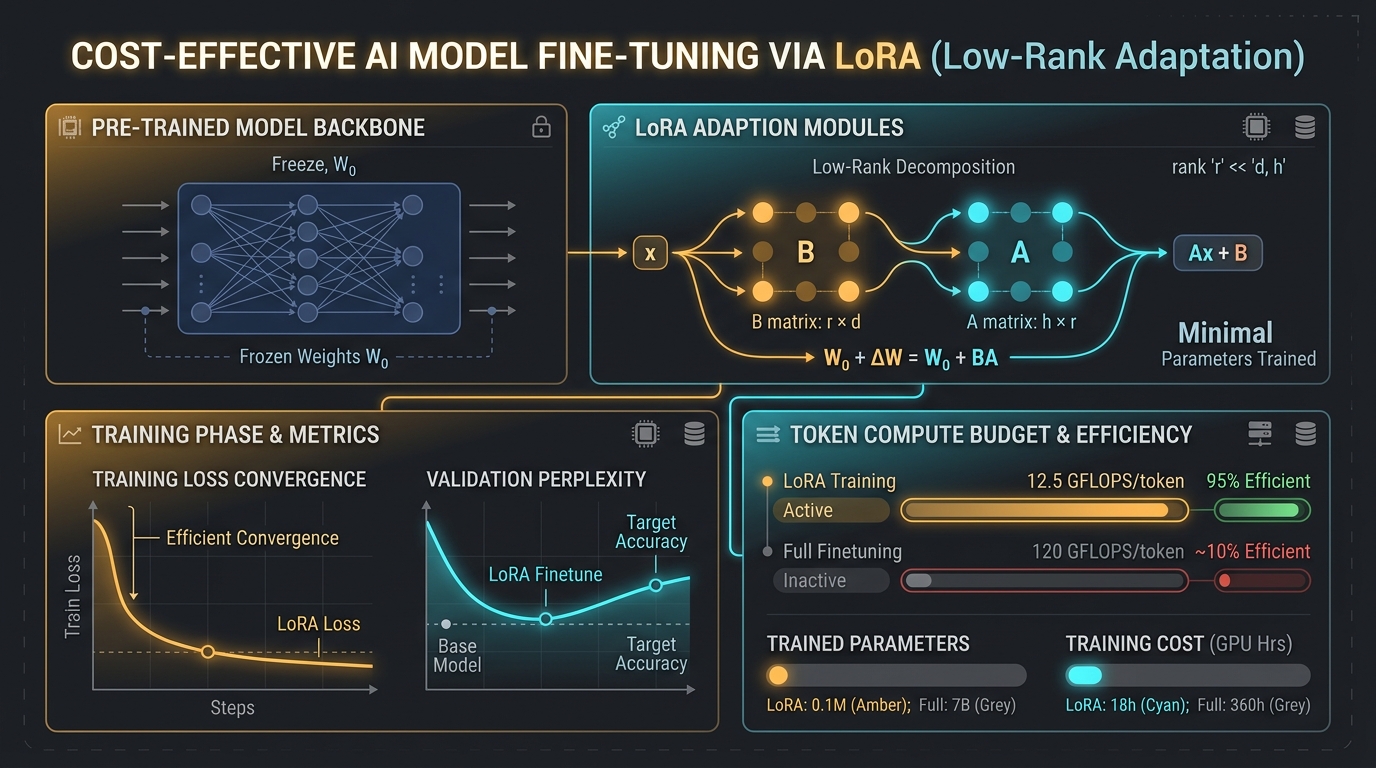
As enterprises transition from flashy generative AI prototypes to production-grade applications, they inevitably run into the wall of AI unit economics.
In my time leading Core ML infrastructure metrics at Google and now as Chief AI Officer at The Zebra, I’ve watched organizations consistently make the same costly mistake: attempting to solve highly specific, deterministic business tasks by throwing massive, raw frontier models (like GPT-4) at the problem via complex, high-latency few-shot prompts.
While prompt engineering and Retrieval-Augmented Generation (RAG) are excellent for exploration, relying on them for high-volume, specialized operations is incredibly inefficient. It leads to ballooning token costs, unpredictable API latency, and "hallucination management" overhead.
The alternative? Targeted fine-tuning of smaller, open-weights models (such as Llama 3 8B or Mistral 7B).
Historically, fine-tuning was viewed as a luxury reserved for tech giants with millions of dollars in compute budgets. Today, by leveraging parameter-efficient techniques, rigorous dataset curation, and optimized inference serving, you can fine-tune and deploy a specialized model that outperforms frontier models on your specific task for less than $100 in training costs.
Here is the engineering and economic blueprint for running cost-effective fine-tuning for specialized business tasks.
1. The Economics of Specialization: Prompting vs. Fine-Tuning
Before writing a single line of training code, you must understand the cost inflection point where fine-tuning beats prompt engineering.
When you pass a 5-step system prompt with three detailed few-shot examples to a model, you might be appending 1,500 to 2,000 "overhead tokens" to every single API call. If you run 100,000 transactions a day, those overhead tokens translate to thousands of dollars in waste.
[ daniel-herrington-ai-unit-economics.jpg ]
*Figure 1: The economic crossover point. While prompting has zero upfront cost, its variable cost scale is linear and steep. Fine-tuning has a small upfront training cost but a vastly lower marginal cost per transaction, leading to rapid ROI at scale.*
By fine-tuning a smaller model (e.g., 8 billion parameters instead of 70+ billion parameters), you permanently bake those instructions, guardrails, and behavioral patterns directly into the model’s weights. Your active prompt size drops from 2,000 tokens to 100 tokens.
The Math:
- Prompting (Frontier API): $0.0015 per 1,000 input tokens $\times$ 2,000 tokens per call = $0.003 per call.
- Fine-tuned OSS Model (Self-hosted or Serverless): $0.00015 per 1,000 input tokens $\times$ 150 tokens per call = $0.0000225 per call.
At 1,000,000 transactions, the prompting route costs $3,000, while the fine-tuned route costs $22.50 in variable token usage. The amortized cost of a $50 training run is recovered almost instantly.
2. Parameter-Efficient Fine-Tuning (PEFT) and QLoRA
To keep compute costs low, you should almost never perform a full parameter fine-tuning of a model. Modifying all weights in a 13B parameter model requires updating and storing billions of 16-bit floating-point numbers, requiring massive clusters of A100 or H100 GPUs.
Instead, the industry standard for cost-effective optimization is QLoRA (Quantized Low-Rank Adaptation).
How QLoRA Works
QLoRA optimizes memory consumption through three core breakthroughs:
- NF4 (NormalFloat 4-bit) Quantization: The base model weights are compressed to a highly efficient 4-bit representation without degrading model performance.
- Double Quantization (DQ): Quantization constants are themselves quantized, saving an additional 0.37 bits per parameter.
- Paged Optimizers: This prevents memory spikes during backward passes by leveraging CPU-to-GPU memory paging, allowing you to train large models on consumer-grade or mid-tier enterprise GPUs (e.g., a single RTX 4090 or a single 24GB A10G) without running into Out-Of-Memory (OOM) errors.
[ daniel-herrington-qlora-memory-footprint.jpg ]
*Figure 2: Memory footprint comparison of Full Parameter Fine-Tuning vs. LoRA vs. QLoRA. QLoRA reduces active VRAM requirements by up to 75%, allowing training on cheap, single-GPU hardware instances.*
By freezing the quantized base model and only training a tiny fraction of parameter adapters (the "LoRA adapters"), your training memory footprint drops dramatically. You can train an 8B parameter model on a single instance costing less than $1.50 per hour on platforms like RunPod, Vast.ai, or Lambda Labs.
3. The "Quality-Over-Quantity" Data Strategy
The most expensive part of machine learning projects is no longer the silicon; it is the human labeler pipeline.
Many engineering teams assume they need hundreds of thousands of examples to fine-tune a model. This is false. For specialized, deterministic tasks (such as structured JSON extraction, specific API tool calling, or domain-specific sentiment analysis), 1,000 meticulously curated, high-quality examples outperform 100,000 noisy, web-scraped examples.
The Data Distillation Pipeline
To build a highly effective training dataset on a budget, use a technique called Model Distillation:
- Synthesize with Frontier Models: Use a state-of-the-art model (like Claude 3.5 Sonnet or GPT-4o) to generate a raw batch of 5,000 inputs and outputs based on your custom schema or task.
- Programmatic Validation: Run validation scripts to ensure the generated synthetic outputs perfectly match your target schema (e.g., verifying valid JSON, checking schema keys, or running deterministic tests). Reject any malformed examples.
- Human-in-the-Loop (HITL) Pruning: Have a domain expert review a random subset of 500 records to identify edge cases, biases, or formatting issues. Refine your generation prompt based on these insights.
- Format for Training: Convert the validated data into the standard conversational template required by your base model (e.g., Llama-3 Chat template).
This curated approach guarantees that the model learns the exact structure of your task without picking up the noisy background variations common in massive datasets.
4. Architectural Comparison: Finding Your Fine-Tuning Strategy
The table below breaks down the technical and financial trade-offs of the dominant fine-tuning and adaptation strategies currently available to enterprise engineering teams.
| Strategy | Memory Footprint | Est. Training Cost (per 1M tokens) | Hardware Requirements | Downstream Latency | Best Suited For |
|---|---|---|---|---|---|
| Full Parameter Fine-Tuning | Extremely High (requires >8x GPU memory) | $500 – $5,000+ | Multi-GPU Clusters (8x A100/H100) | Ultra-low (no adapter overhead) | Domain-specific base language learning (e.g., medical, legal pre-training). |
| LoRA (Low-Rank Adaptation) | Medium (keeps base model at FP16/BF16) | $50 – $200 | 1x or 2x A100 (40GB/80GB) | Low | General behavior modifications, high-performance style transfer. |
| QLoRA (Quantized LoRA) | Very Low (4-bit base model quantization) | $10 – $50 | 1x Consumer GPU (RTX 4090 / A10G 24GB) | Low to Medium (minimal quantization overhead) | Highly cost-effective task specialization, structured data generation. |
| Prompt Engineering / RAG | None (Zero training compute) | $0 (Upfront) / High (Opex per run) | None (SaaS API) | High (due to long context processing) | Real-time knowledge retrieval, dynamic context queries, rapid prototyping. |
5. Serving Your Fine-Tuned Model: The Secret to True Cost Savings
The cost equation doesn't end when training finishes. Serving your fine-tuned model is where the real long-term operational costs reside.
If you spin up an active, dedicated GPU instance running a model 24/7 just to handle sporadic requests, your unit economics will collapse. To prevent this, implement the following optimizations:
A. Leverage High-Throughput Serving Frameworks
Never run raw Hugging Face transformers code in production. Use inference serving engines like vLLM, TGI (Text Generation Inference), or TensorRT-LLM. These frameworks utilize:
- PagedAttention: Eliminates KV cache memory fragmentation, allowing you to scale batch sizes up by 10x without running out of memory.
- Continuous Batching: Groups incoming requests dynamically at the token level, rather than waiting for an entire batch to finish, boosting hardware utilization to nearly 100%.
B. Multi-Tenant Adapter Hot-Swapping
If you have multiple specialized business tasks (e.g., one model for support email classification, another for invoice extraction, and a third for customer sentiment), do not host three separate models on three separate GPUs.
Using frameworks like vLLM, you can host a single base model instance and hot-swap the lightweight LoRA adapters dynamically at runtime based on the incoming request header.
# Conceptual example of dynamic adapter calling in vLLM
from vllm import LLM, SamplingParams
from vllm.lora.request import LoRARequest

llm = LLM(model="meta-llama/Meta-Llama-3-8B-Instruct", enable_lora=True)

# Querying the invoice extraction adapter
invoice_output = llm.generate(
    "Extract total from invoice...",
    lora_request=LoRARequest("invoice_adapter", 1, "path/to/invoice_lora")
)

# Querying the sentiment adapter on the exact same GPU instance
sentiment_output = llm.generate(
    "Analyze sentiment...",
    lora_request=LoRARequest("sentiment_adapter", 2, "path/to/sentiment_lora")
)
This single-instance strategy slashes hardware overhead by up to 300%, since you only pay for the idle memory of a single base model.
FAQ: Cost-Effective Fine-Tuning in Production
How do I calculate the exact ROI of fine-tuning vs. prompt engineering?
To calculate your break-even point, use this formula:
$$\text{Break-Even Transactions} = \frac{\text{Upfront Training Cost}}{\text{Prompt Token Cost per Request} - \text{Fine-tuned Token Cost per Request}}$$
If your upfront training cost is $100, your average prompt-engineered request costs $0.005, and your fine-tuned request costs $0.0002, your break-even point is 20,833 requests. If you process more than this amount over the lifetime of your feature, fine-tuning is the more profitable choice.
What is the absolute minimum dataset size needed to see a performance lift?
For highly structured, deterministic tasks (e.g., translating a standard natural language command into a specific JSON schema), you can see substantial performance lifts with as few as 200 to 500 high-quality, hand-verified examples. The key is consistency; if your examples have zero syntax errors and identical structural formats, the model will pick up the pattern rapidly.
Will QLoRA degrade my model's accuracy compared to standard LoRA or full fine-tuning?
Empirical research and our internal tests at The Zebra demonstrate that QLoRA's 4-bit NormalFloat (NF4) quantization, combined with double quantization, results in virtually zero degradation in accuracy compared to 16-bit LoRA. In some cases, the regularization effect of quantization actually prevents overfitting, yielding slightly better generalization on out-of-distribution test sets.
How do I handle fine-tuning if my data is highly sensitive or subject to compliance (like HIPAA or GDPR)?
Because open-weights models like Llama 3 or Mistral can be fine-tuned on your local private infrastructure, you do not need to send sensitive customer data to third-party APIs. You can lease dedicated, secure, HIPAA-compliant instances on cloud providers like AWS (using SageMaker) or Azure, or run the training completely in-house on private hardware, ensuring your training data never leaves your security perimeter.
{
  "@context": "https://schema.org",
  "@type": "TechArticle",
  "headline": "How to Run Cost-Effective Fine-Tuning for Specialized Business Tasks",
  "description": "A comprehensive engineering guide on reducing LLM fine-tuning costs, leveraging QLoRA, dataset curation, and optimized inference architectures to build high-performance, domain-specific AI models.",
  "image": [
    "https://danielherrington.com/images/daniel-herrington-ai-unit-economics.jpg",
    "https://danielherrington.com/images/daniel-herrington-qlora-memory-footprint.jpg"
  ],
  "author": {
    "@type": "Person",
    "name": "Daniel Herrington",
    "jobTitle": "Chief AI Officer",
    "worksFor": {
      "@type": "Organization",
      "name": "The Zebra"
    }
  },
  "publisher": {
    "@type": "Person",
    "name": "Daniel Herrington"
  },
  "mainEntity": {
    "@type": "FAQPage",
    "mainEntity": [
      {
        "@type": "Question",
        "name": "How do I calculate the exact ROI of fine-tuning vs. prompt engineering?",
        "acceptedAnswer": {
          "@type": "Answer",
          "text": "Calculate the break-even point by dividing the upfront training cost by the difference in token costs between prompting and fine-tuning. If training costs $100, prompting costs $0.005 per run, and fine-tuning costs $0.0002 per run, your break-even point is 20,833 transactions."
        }
      },
      {
        "@type": "Question",
        "name": "What is the absolute minimum dataset size needed to see a performance lift?",
        "acceptedAnswer": {
          "@type": "Answer",
          "text": "For highly structured tasks, 200 to 500 meticulously validated, high-quality examples can yield significant performance increases. Quality and structural consistency are far more important than sheer dataset volume."
        }
      },
      {
        "@type": "Question",
        "name": "Will QLoRA degrade my model's accuracy compared to standard LoRA or full fine-tuning?",
        "acceptedAnswer": {
          "@type": "Answer",
          "text": "Empirical data shows that QLoRA's 4-bit NormalFloat (NF4) quantization results in virtually zero performance degradation compared to 16-bit LoRA, while reducing memory overhead by up to 75%."
        }
      }
    ]
  }
}