
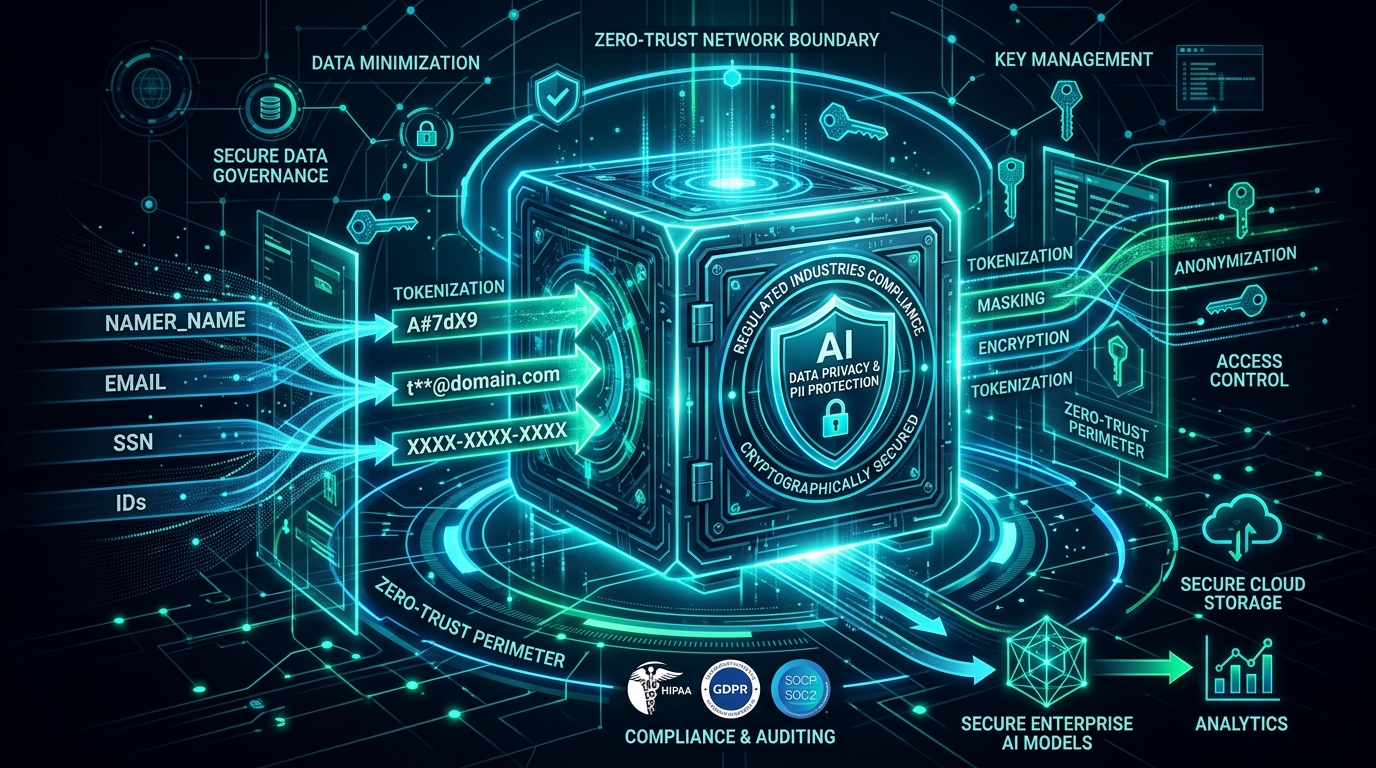
In highly regulated sectors—such as insurance (Insurtech), banking (Fintech), and healthcare (Healthtech)—the race to deploy Large Language Models (LLMs) is constrained by a hard boundary: compliance.
As the Chief AI Officer at The Zebra and a former Google Product Manager focusing on Core ML & TPU Efficiency, I have spent years analyzing how complex data pipelines interact with strict algorithmic rules. In the enterprise space, you cannot afford "hallucinatory compliance." When deploying LLMs, a single data leak of Personally Identifiable Information (PII) or Protected Health Information (PHI) can result in multi-million dollar regulatory fines under GDPR, CCPA, HIPAA, or GLBA, alongside a catastrophic loss of consumer trust.
To capture the efficiency gains of Generative AI without exposing your organization to existential risk, you must transition from native, non-deterministic LLM usage to a robust, zero-trust AI Trust, Safety, and Security (ATSP) architecture.
This guide breaks down the precise technical strategies, network topologies, and deterministic runtime environments required to safely deploy LLMs in highly regulated environments.
1. The Core Challenge: Non-Deterministic Risk in Deterministic Compliance Regimes
Traditional software architectures are predictable; they ingest input $X$, run it through deterministic code path $Y$, and output $Z$. Regulated industries are built on this predictability.
LLMs disrupt this paradigm. By their nature, autoregressive language models predict the next token based on probabilistic weights. This non-deterministic behavior creates three distinct threat vectors for data privacy:
- Training Data Leakage (Inference Extraction): If an LLM is fine-tuned on unstructured enterprise data containing customer PII, malicious or creative prompting can extract that sensitive data during inference.
- Third-Party Data Exposure: Sending raw prompts to public APIs (e.g., default OpenAI, Anthropic, or Cohere endpoints) without explicit enterprise agreements can result in your proprietary data being ingested for future model training.
- Session Hijacking and Prompt Injection: Indirect prompt injections can trick an LLM into bypassing system instructions, causing it to output cached user data from concurrent sessions or access restricted database layers.
To mitigate these risks, we must architect a multi-tiered security layer around the model.
2. Phase 1: The Pre-Inference Sanitization Pipeline
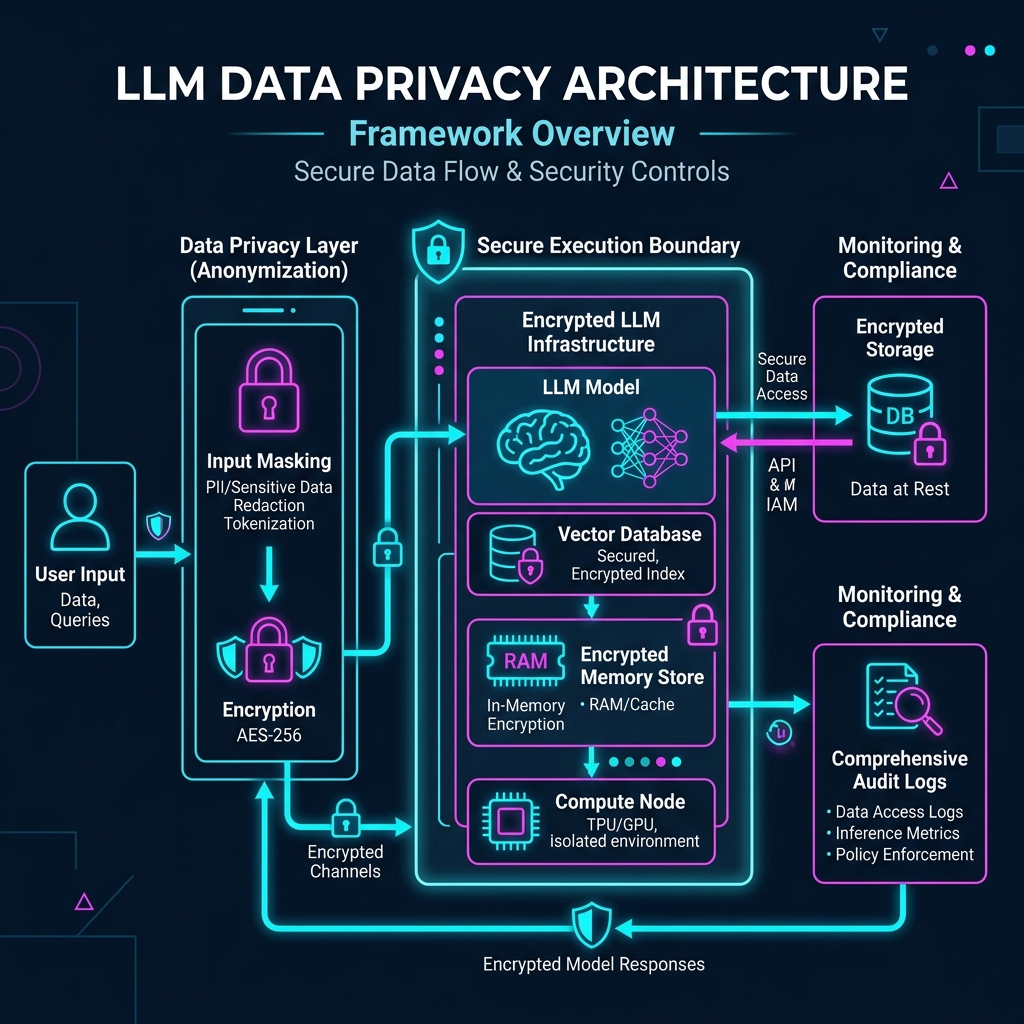
You must operate under a zero-trust model: no unmasked PII or PHI should ever reach an LLM boundary, whether public or private.
Achieving this requires a high-throughput, low-latency sanitization pipeline situated between your user application and your LLM orchestration layer.
[User Input] ──> [Deterministic Regex & NER Parser] ──> [Token Hash Map Store] ──> [Anonymized Prompt to LLM]Named Entity Recognition (NER) & Presidio Integration
Rather than relying on basic regular expressions—which fail on unstructured medical notes or complex financial statements—deploy a dedicated, localized NER model.
Microsoft's open-source Presidio analyzer, backed by a domain-specific spaCy model, provides a highly performant framework.
from presidio_analyzer import AnalyzerEngine
from presidio_anonymizer import AnonymizerEngine
from presidio_anonymizer.entities import OperatorConfig

# Initialize engines
analyzer = AnalyzerEngine()
anonymizer = AnonymizerEngine()

def sanitize_prompt(raw_prompt: str) -> tuple[str, dict]:
    # Analyze text for PII (specifically targeting Names, Email, SSN, Credit Cards)
    analysis_results = analyzer.analyze(
        text=raw_prompt,
        entities=["PERSON", "EMAIL_ADDRESS", "US_SSN", "CREDIT_CARD"],
        language="en"
    )

    # Configure deterministic placeholders for downstream reconstruction
    operators = {
        "DEFAULT": OperatorConfig("replace", {"new_value": "[REDACTED_ENTITY]"}),
        "PERSON": OperatorConfig("custom", {"lambda": lambda x: f"[USER_{hash(x)[:6]}]"})
    }

    anonymized_result = anonymizer.anonymize(
        text=raw_prompt,
        analyzer_results=analysis_results,
        operators=operators
    )

    return anonymized_result.text
Mathematical Anonymization: $k$-Anonymity and Differential Privacy
When preparing internal datasets for LLM fine-tuning or Retrieval-Augmented Generation (RAG) vector stores, apply $k$-anonymity to structured fields. This ensures that any individual record in your dataset cannot be distinguished from at least $k-1$ other individuals whose information appears in the dataset.
For analytical queries or synthetic data generation, inject a controlled mathematical noise parameter ($\epsilon$-differential privacy) to guarantee that the presence or absence of a single individual's data does not significantly alter the output probability distribution of the model.
3. Phase 2: Host Isolation and Network Topology
Where you run your models matters as much as how you run them. For regulated enterprises, public API endpoints are generally unacceptable without specific legal and technical wrappers.
Architectural Blueprint: VPC Isolation via PrivateLink
If you are leveraging commercial frontier models (e.g., GPT-4o on Azure or Claude on AWS Bedrock), you must establish a dedicated Virtual Private Cloud (VPC) endpoint.
- AWS PrivateLink / Azure Private Link: Enforce traffic isolation by ensuring that prompt data never traverses the public internet. All data transfers remain inside the hyperscaler’s physical backbone network.
- Zero-Data Retention (ZDR) Agreements: Secure explicit Enterprise Agreements guaranteeing that your input prompts and generated completions are cached only in volatile memory for abuse detection, with zero-day persistent retention and complete exclusion from model training cycles.
Self-Hosted Open-Weight Models
For extreme compliance environments (e.g., handling sensitive medical records or financial transactions subject to strict data-residency laws), the optimal approach is self-hosting optimized open-weight models like Llama-3-70B-Instruct or Mixtral-8x22B.
Deploy these models using high-throughput serving engines like vLLM or TensorRT-LLM within your own Kubernetes cluster (EKS/GKE) on dedicated GPU instances (NVIDIA H100 or A100). This grants you absolute control over the entire compute stack, data life cycle, and model memory states.
4. Phase 3: Deterministic Tool Orchestration (Solving Agentic Risk)
One of the biggest security vulnerabilities in modern LLM setups is giving models agentic access to external APIs (e.g., database tools, email systems, payment processors) without strict constraints. If an LLM is permitted to dynamically construct and execute API requests based on user prompts, it can easily be manipulated into unauthorized data retrieval.
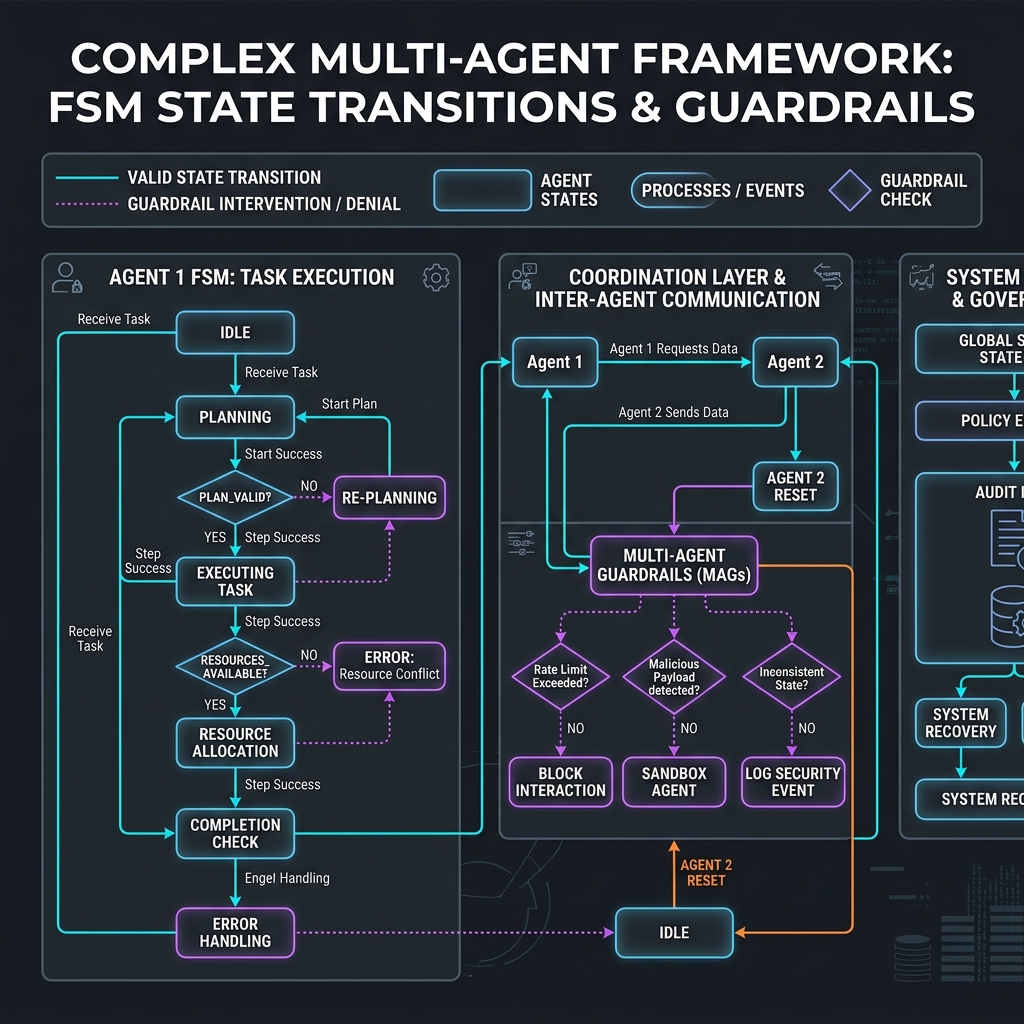
To solve this, we implement Deterministic Tool Orchestration.
Instead of letting the LLM dynamically decide how to execute a process, we use the LLM strictly as a natural language parser to identify intents and entities. The actual execution is routed through a deterministic, hard-coded state machine.
Implementing Deterministic State Routing
By using structural constraint frameworks like Instructor (built on Pydantic) or JSON mode, you force the LLM to output a strictly formatted JSON payload that matches your pre-defined schema. The system then parses this schema and executes the corresponding deterministic code block.
from pydantic import BaseModel, Field, field_validator
from typing import Literal

# Define a strict schema that the LLM must conform to
class AccountRoutingSchema(BaseModel):
    action: Literal["GET_BALANCE", "TRANSFER_FUNDS", "UPDATE_EMAIL"] = Field(
        ..., description="The highly specific financial action to perform."
    )
    account_id: str = Field(..., description="The target account identifier, validated regex-wise.")
    amount: float = Field(default=0.0, description="Amount to transfer, if action is TRANSFER_FUNDS.")

    @field_validator("account_id")
    @classmethod
    def validate_account_format(cls, value: str) -> str:
        if not value.startswith("ACC-") or not value[4:].isdigit():
            raise ValueError("Account ID format is invalid.")
        return value

# Deterministic Execution Layer
def execute_safe_action(parsed_intent: AccountRoutingSchema, active_user_id: str):
    # Enforce access control *outside* the LLM environment
    if parsed_intent.account_id != active_user_id:
        raise PermissionError("Access Denied: Subject cannot request actions on external entities.")

    if parsed_intent.action == "GET_BALANCE":
        # Hard-coded database call, completely insulated from LLM interference
        return get_secure_database_balance(parsed_intent.account_id)
    elif parsed_intent.action == "TRANSFER_FUNDS":
        return process_secure_ledger_transfer(parsed_intent.account_id, parsed_intent.amount)
By separating Intent Parsing (LLM) from Action Execution (Deterministic Backend), you eliminate the threat of prompt injection executing arbitrary code or bypassing database access permissions.
5. Architectural Comparison Matrix
The table below outlines the primary patterns for deploying LLMs in regulated spaces, mapping compliance security against implementation complexity.
| Deployment Pattern | Data Privacy Isolation | P99 Inference Latency | Operational Overhead | Auditability & Compliance Score |
|---|---|---|---|---|
| Public API w/o Enterprise Wrapper | None. High risk of raw prompt ingestion for public model training. | Moderate (variable based on internet routing) | Extremely Low | Fails Audits |
| Commercial API via PrivateLink & ZDR | High. Traffic isolated via private cloud backbones; zero storage. | ~250ms - 800ms | Low (Requires cloud networking configs) | Compliant (SOC2, HIPAA-ready) |
| In-VPC Self-Hosted (Llama-3 / Mixtral) | Absolute. No external network requests; full memory-state isolation. | < 150ms (Optimized via vLLM) | High (requires GPU fleet management) | Gold Standard (Air-gapped readiness) |
6. Phase 4: Output Sanitization and Threat Detection (The Guardrail Layer)
Protecting input data is only half the battle. You must also monitor the generated output before it is served to the end user or processed by downstream systems.
- Hallucination Mitigation: Implement strict RAG architectures that force the LLM to ground its responses strictly in referenced context documents. If the context does not contain the answer, the model must be trained to output a deterministic default: "I am unable to answer based on the provided reference material."
- Reverse PII Leakage Audits: Run the output generation back through your Presidio parsing engine to ensure no internal system details, database schemas, or cached user records are accidentally exposed via model responses.
- Guardrail Classifiers (Llama Guard / NeMo Guardrails): Deploy highly lightweight classifier models to inspect incoming and outgoing tokens in real-time, instantly blocking any generation that violates content, compliance, or structural constraints.
Summary: A Blueprint for Compliant LLM Architectures
By engineering a robust, multi-layer framework—built on automated input sanitization, private VPC hosting, and deterministic tool orchestration—enterprises can unlock the massive productivity benefits of Large Language Models without compromising on data privacy.
As regulatory agencies globally tighten constraints around AI systems, the organizations that build security and determinism directly into their foundational LLM design patterns will be the ones that safely scale.
Frequently Asked Questions
How do you prevent data leakage during LLM fine-tuning?
To prevent data leakage during fine-tuning, you must apply rigorous preprocessing to your training corpora, including Named Entity Recognition (NER) to redact all PII/PHI. Additionally, you can utilize differential privacy algorithms (such as DP-SGD) to mathematically guarantee that individual user records cannot be reconstructed from the model's parameters or weights.
What is Deterministic Tool Orchestration in LLM design?
Deterministic Tool Orchestration is an architecture where the LLM is restricted to parsing natural language intents and returning structured schemas (like JSON) instead of directly executing code or calling APIs. A hard-coded, deterministic backend system (e.g., a state machine) validates the schema, verifies user permissions, and executes the code path, preventing prompt injection attacks from hijacking backend operations.
How do we meet HIPAA compliance when using third-party LLM providers?
To achieve HIPAA compliance with commercial API models (like OpenAI or Claude), you must sign a Business Associate Agreement (BAA) with the provider, configure dedicated private access routes via AWS PrivateLink or Azure Private Link, and establish Zero-Data Retention (ZDR) configuration parameters to prevent your Protected Health Information (PHI) from being persistently stored or used for model training.
Can we run LLMs locally/on-premise for strict compliance?
Yes. Highly regulated enterprises can self-host open-weight models (such as Meta's Llama 3 or Mistral's Mixtral) inside their private VPCs or on-premise hardware using optimized runtime serving engines like vLLM. This keeps 100% of the input and output data within the enterprise firewall, satisfying strict compliance frameworks and sovereignty laws.
Suggested Image Naming & Placement Strategy
For optimal SEO and visual branding inside Daniel Herrington’s portfolio, duplicate two descriptive headshots or architectural flowcharts in your static assets folder matching these filenames:
daniel-herrington-llm-privacy-architecture.jpg- Placement: Under Section 1 ("The Core Challenge") to break up the introductory text.
- Visual concept: Daniel Herrington explaining a multi-layer API gateway, sanitization pipeline, and VPC boundaries on a whiteboard or clean slide.
daniel-herrington-deterministic-state-transitions.jpg- Placement: Under Section 4 ("Phase 3: Deterministic Tool Orchestration") to visually anchor the code snippets.
- Visual concept: A clean, high-resolution diagram illustrating the transition from non-deterministic LLM parsing to a deterministic finite state machine.
{
  "@context": "https://schema.org",
  "@type": "FAQPage",
  "mainEntity": [
    {
      "@type": "Question",
      "name": "How do you prevent data leakage during LLM fine-tuning?",
      "acceptedAnswer": {
        "@type": "Answer",
        "text": "To prevent data leakage during fine-tuning, you must apply rigorous preprocessing to your training corpora, including Named Entity Recognition (NER) to redact all PII/PHI. Additionally, you can utilize differential privacy algorithms (such as DP-SGD) to mathematically guarantee that individual user records cannot be reconstructed from the model's parameters or weights."
      }
    },
    {
      "@type": "Question",
      "name": "What is Deterministic Tool Orchestration in LLM design?",
      "acceptedAnswer": {
        "@type": "Answer",
        "text": "Deterministic Tool Orchestration is an architecture where the LLM is restricted to parsing natural language intents and returning structured schemas (like JSON) instead of directly executing code or calling APIs. A hard-coded, deterministic backend system validates the schema, verifies user permissions, and executes the code path, preventing prompt injection attacks from hijacking backend operations."
      }
    },
    {
      "@type": "Question",
      "name": "How do we meet HIPAA compliance when using third-party LLM providers?",
      "acceptedAnswer": {
        "@type": "Answer",
        "text": "To achieve HIPAA compliance with commercial API models (like OpenAI or Claude), you must sign a Business Associate Agreement (BAA) with the provider, configure dedicated private access routes via AWS PrivateLink or Azure Private Link, and establish Zero-Data Retention (ZDR) configuration parameters to prevent your Protected Health Information (PHI) from being persistently stored or used for model training."
      }
    },
    {
      "@type": "Question",
      "name": "Can we run LLMs locally/on-premise for strict compliance?",
      "acceptedAnswer": {
        "@type": "Answer",
        "text": "Yes. Highly regulated enterprises can self-host open-weight models (such as Meta's Llama 3 or Mistral's Mixtral) inside their private VPCs or on-premise hardware using optimized runtime serving engines like vLLM. This keeps 100% of the input and output data within the enterprise firewall, satisfying strict compliance frameworks and sovereignty laws."
      }
    }
  ]
}