
For over two decades, the currency of the web was the click. As a former Product Manager on the Core ML (AI2) team at Google, my world revolved around parsing CTR curves, optimizing position-based distributions, and understanding how users navigated the classic blue links.
Today, as the Chief AI Officer at The Zebra, I am watching that paradigm dissolve.
With the deployment of Google’s AI Overviews (formerly SGE) and the rise of conversational answer engines like Perplexity, Claude, and OpenAI’s SearchGPT, the traditional search engine results page (SERP) is no longer just a directory of destinations. It has become an execution environment. Search engines are transitioning from retrieval systems to reasoning engines that orchestrate tools, synthesize documents, and generate direct, inline assertions.
If your brand is not cited, synthesized, or recommended within the generative canvas of these AI Overviews, you do not exist to the user.
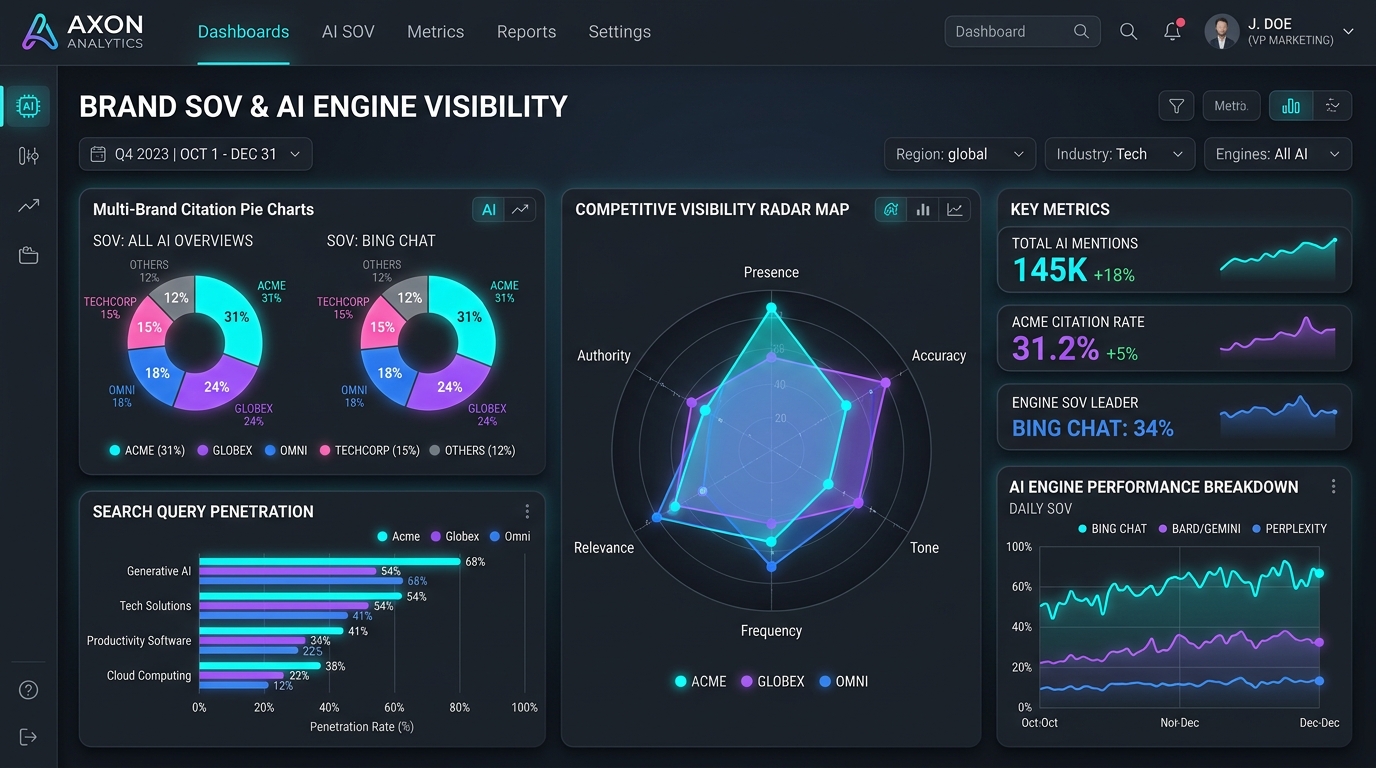
Measuring your organic footprint is no longer a matter of tracking ranks 1 through 10. We must transition from traditional Share of Voice (SOV) to Generative Share of Voice (gSOV). This article outlines the exact deterministic frameworks, mathematical formulas, and programmatic architectures required to measure and dominate your brand’s Share of Voice inside LLM-driven search engines.
1. The Physics of Generative Search: How AI Overviews Build Responses
To measure what is inside an AI Overview (AIO), we must first understand the deterministic pipeline Google uses to generate one.
Google does not simply pass a user’s query directly to Gemini and print the output. That would lead to unacceptable latency, hallucination rates, and structural costs. Instead, Google utilizes a highly sophisticated Retrieval-Augmented Generation (RAG) pipeline integrated with Deterministic Tool Orchestration.
[ User Query ] ──> [ Query Expansion & Intent Classification ]
                          │
                          ▼
             [ Classic Search Index Retrieval ] (Top 50 Docs)
                          │
                          ▼
             [ Information Extraction & Chunking ]
                          │
                          ▼
             [ Cross-Encoder Re-ranking (RankNet/BERT) ]
                          │
                          ▼
             [ Gemini LLM Synthesis (Context Window) ]
                          │
                          ▼
    [ Attribution & Citation Mapping Engine (Assertion Matching) ]
                          │
                          ▼
               [ Generated AI Overview ]
The Generation Pipeline:
- Query Expansion & Intent Classification: The search engine determines if the query triggers an AI Overview. If yes, it runs parallel sub-queries to gather a broad corpus.
- Retrieval: Traditional organic retrieval algorithms pull the top ~50 highly relevant document passages.
- Synthesis & Grounding (RAG): These passages are fed into a context window of a fine-tuned Gemini model as "ground truth" context.
- Attribution Mapping (The Crucial Step): Before outputting, a post-processing alignment engine correlates every assertion made by the LLM back to the source document chunks using semantic similarity. If an assertion cannot be mapped to a source URL with high confidence, it is pruned to prevent hallucination.
- UI Rendering: The response is rendered with inline cards, carousel links, and dropdown sources.
Your gSOV is determined by your brand's presence within this Attribution Mapping phase.
2. From Click to Citation: The Three Pillars of Generative SOV (gSOV)
Traditional SEO measured rank. Generative Engine Optimization (GEO) measures semantic integration. To calculate your brand's true presence within AI Overviews, we track three distinct, quantifiable pillars:
I. Citation Share (Direct Attribution)
This is the percentage of total interactive links, cards, or carousels within an AI Overview that point to your owned domains.
- Why it matters: These are the primary click-through vectors in an AIO.
II. Entity Share of Voice (Brand Mention)
This tracks whether your brand or product name is explicitly synthesized in the text of the overview (e.g., "For car insurance, platforms like The Zebra allow users to compare..."), regardless of whether they link directly to you.
- Why it matters: This builds brand equity and drives downstream navigational searches.
III. Semantic Sentiment & Alignment (Brand Affinity)
It is not enough to be mentioned; you must be mentioned in the correct context. We use vector distance to measure how closely the LLM's generated description of your brand aligns with your target strategic positioning.
- Why it matters: If the LLM mentions your brand but characterizes your product as "expensive" when your positioning is "budget-friendly," your semantic alignment is low.
3. The Mathematics of Generative Share of Voice (gSOV)
To operationalize this, we must move away from soft metrics. We use a weighted formula to calculate Generative Share of Voice (gSOV) across a defined keyword corpus ($Q$):
$$\text{gSOV}i = \frac{\sum{q \in Q} \left( \mathbf{A}_{iq} \cdot w_q \cdot \left[ \alpha \cdot \text{CS}{iq} + \beta \cdot \text{ES}{iq} \right] \right)}{\sum_{q \in Q} w_q}$$
Where:
- $i$ = Your target brand.
- $q$ = A specific query in the keyword corpus $Q$.
- $w_q$ = The search volume weight of query $q$.
- $\text{CS}_{iq}$ = Citation Share of brand $i$ for query $q$ (Number of links pointing to brand $i$ divided by total links in the AIO).
- $\text{ES}_{iq}$ = Entity Share (Binary: $1$ if brand is mentioned in the text, $0$ if not).
- $\mathbf{A}_{iq}$ = Semantic Alignment Score ($[-1, 1]$ representing sentiment and attribute alignment derived via cosine similarity of embeddings).
- $\alpha, \beta$ = Tuning weights where $\alpha + \beta = 1$ (typically weighted $\alpha = 0.7$ for direct conversion intent and $\beta = 0.3$).
4. Architectural Deep Dive: Programmatically Extracting gSOV
Measuring gSOV at enterprise scale requires a programmatic pipeline that bypasses standard SERP scrapers, which often fail to render dynamic, asynchronous Web Components like Google’s AI Overviews.
Below is an enterprise-grade architectural blueprint for a deterministic gSOV extraction engine.
┌────────────────────────────────────────────────────────┐
│               1. Query Agent Queue                     │
│  - Playwright/Puppeteer Cluster                        │
│  - High-reputation Residential Proxies                 │
│  - Dynamic Wait-for-Selector (CSS: [data-attribute])   │
└───────────────────────────┬────────────────────────────┘
                            │
                            ▼
┌────────────────────────────────────────────────────────┐
│               2. DOM Parser & Extraction               │
│  - Isolates AI Overview container (.dfx-aio-canvas)    │
│  - Extracts Raw Text Assertions                        │
│  - Maps UI Carousel Cards to Source Anchor Tags        │
└───────────────────────────┬────────────────────────────┘
                            │
                            ▼
┌────────────────────────────────────────────────────────┐
│             3. NLP & Semantic Processing               │
│  - Entity Extraction (SpaCy/GLiNER)                    │
│  - Vector Embedding of Text Assertions (text-embedding)│
│  - Cosine Similarity vs. Target Brand Vectors          │
└───────────────────────────┬────────────────────────────┘
                            │
                            ▼
┌────────────────────────────────────────────────────────┐
│             4. Analytics Store & Dashboard             │
│  - PostgreSQL (gSOV database)                          │
│  - BI Layer: gSOV vs. Competitors by Intent Category   │
└────────────────────────────────────────────────────────┘
Reference Implementation: Parsing SGE Metrics programmatically
The following Python script illustrates how to parse an exported SERP HTML containing an AI Overview to calculate a brand's Citation Share:
import re
from bs4 import BeautifulSoup
from urllib.parse import urlparse

def calculate_citation_share(html_content: str, target_domain: str) -> dict:
    """
    Parses a rendered Google SERP HTML containing an AI Overview
    to extract citations and calculate Direct Citation Share.
    """
    soup = BeautifulSoup(html_content, 'html.parser')

    # Target Google's dynamic AIO container class (subject to change; target semantic wrappers)
    aio_container = soup.find('div', {'class': re.compile(r'(google-src-attribution|aio-container|sge-layout)')})

    if not aio_container:
        return {"error": "No AI Overview container detected.", "citation_share": 0.0}

    # Extract all outbound links within the generative canvas
    links = aio_container.find_all('a', href=True)
    all_urls = [link['href'] for link in links]

    # Clean and filter unique root domains
    resolved_domains = [urlparse(url).netloc.replace('www.', '') for url in all_urls if url.startswith('http')]
    unique_domains = list(set(resolved_domains))

    if not unique_domains:
        return {"total_citations": 0, "brand_citations": 0, "citation_share": 0.0}

    target_clean = target_domain.replace('www.', '').lower()
    brand_citations_count = sum(1 for domain in resolved_domains if target_clean in domain)

    citation_share = (brand_citations_count / len(resolved_domains)) if resolved_domains else 0.0

    return {
        "total_citations": len(resolved_domains),
        "unique_domains": list(set(resolved_domains)),
        "brand_citations": brand_citations_count,
        "citation_share": round(citation_share, 4)
    }

# Example usage:
# print(calculate_citation_share(raw_serp_html, "thezebra.com"))
5. Orchestration and Measurement Strategies Compared
When building your tracking engine, there are trade-offs between speed, cost, and analytical depth. The table below outlines the core methodologies for capturing and auditing your brand's presence in LLM-driven environments.
| Measurement Strategy | Technical Complexity | Core Metrics Tracked | Pros | Cons |
|---|---|---|---|---|
| Moderate | Citation Share (CS), Domain Extraction, Link Counts | Highly accurate; mirrors the precise links presented to the user. | Brittle; fragile to Google’s constant UI/class renaming tests. | |
| High | Semantic Alignment Score (SAS), Brand Sentiment, Attribute Mapping | Measures context and nuance (e.g., is the mention positive or negative?). | High API operational cost; introduces potential LLM bias. | |
| High | Cosine Similarity between Generated Output and Brand Corpus | Completely programmatic; doesn't rely on sentiment heuristics. | Requires running a constant embedding pipeline on all scrape outputs. | |
| Low | Presence of AI Overview block (Binary), Rank Positions | Low overhead; cheap to scale across millions of keywords. | Often misses complex dynamic lazy-loaded carousel assets. |
6. The GEO Playbook: How to Optimize Your gSOV
Once you can measure your gSOV, you must optimize for it. In my experience scaling organic channels and building complex search architectures, you cannot force an LLM to cite you through keyword density. Instead, you must optimize for the mechanics of LLM Retrieval.
1. Structure Information for Information Extraction (IE)
LLMs are trained to parse highly structured data. If your site's information is trapped in unstructured, poetic prose, the RAG parser will drop it. Use clean HTML, explicit tables, and clear semantic headers (H2, H3). Ensure your assertions are written in a declarative, fact-dense format:
- Bad: "We offer a highly optimized approach to comparing rates that is lightning fast."
- Good: "The Zebra compares car insurance quotes from 100+ national providers in under three minutes."
2. Implement Semantic Schema Markup
Provide the LLM’s crawler with deterministic definitions of your entities. Implement rich JSON-LD markup detailing your Organization, Product, FAQ, and Dataset properties. This reduces the cognitive load on the LLM’s information extractor.
3. Build a Diverse Entity Co-occurrence Network
Google’s RAG pipeline validates facts by looking for cross-domain consensus. If your brand is only mentioned on your own site, Gemini's attribution mapping engine will treat it as a low-confidence source. You must build an off-site footprint (PR, reviews, citations, academic papers, and independent comparisons) where your brand entity consistently co-occurs with your target keyword entities.
Conclusion: The New Search Strategy
The shift from blue links to generated answers is not an incremental update—it is an architectural rewrite of how humans access knowledge. If your organic strategy is still based on tracking rank positions and raw click volume, you are steering by the stars of a galaxy that has already collapsed.
By implementing Generative Share of Voice (gSOV) as your primary organic KPI, you align your measurement framework with the reality of generative engines. You move from speculative SEO to deterministic, semantic engineering.
The brands that survive this transition will be those that realize the LLM is not just a competitor to their traffic—it is the new operating system of the internet.
Frequently Asked Questions
What is the difference between classic Share of Voice (SOV) and Generative Share of Voice (gSOV)?
Classic SOV is based on keyword rank positions weighted by CTR curves (e.g., Rank 1 gets ~30% of search volume). Generative SOV (gSOV) measures the percentage of links, citations, and explicit brand mentions inside AI-generated overviews, weighted by semantic sentiment. gSOV accounts for the fact that a user may get all the information they need inside the search engine interface without ever clicking through to a website.
How often does Google update the sources inside AI Overviews?
Our tracking at The Zebra indicates that Google's RAG pipeline operates on a hybrid refresh cycle. While the baseline model (Gemini) relies on pre-trained weights, the RAG retrieval layer queries the live search index. This means that if you update a piece of high-authority content and it is indexed, it can be pulled into an AI Overview's citation graph in near real-time (often within hours to days).
Will optimizing for Generative Engine Optimization (GEO) hurt my traditional organic rankings?
No. GEO and classic SEO are highly synergistic. The primary inputs for Google's AI Overview retrieval pipeline are the top-ranking documents in the classic search index. Improving your site's authority, load speeds, information structure, and semantic schema helps both classic rankings and your likelihood of being synthesized in AI Overviews.
Schema Markup
{
  "@context": "https://schema.org",
  "@graph": [
    {
      "@type": "TechArticle",
      "@id": "https://danielherrington.com/measuring-brand-share-of-voice-ai-overviews/#article",
      "isPartOf": {
        "@type": "WebPage",
        "@id": "https://danielherrington.com/measuring-brand-share-of-voice-ai-overviews/"
      },
      "headline": "Measuring Brand Share of Voice (SOV) in AI Overviews",
      "description": "A comprehensive framework for tracking and optimizing your brand's footprint in Google's AI Overviews and generative search systems.",
      "inLanguage": "en-US",
      "mainEntityOfPage": "https://danielherrington.com/measuring-brand-share-of-voice-ai-overviews/",
      "author": {
        "@type": "Person",
        "name": "Daniel Herrington",
        "jobTitle": "Chief AI Officer",
        "worksFor": {
          "@type": "Organization",
          "name": "The Zebra"
        }
      },
      "publisher": {
        "@type": "Person",
        "name": "Daniel Herrington"
      }
    },
    {
      "@type": "FAQPage",
      "@id": "https://danielherrington.com/measuring-brand-share-of-voice-ai-overviews/#faq",
      "mainEntity": [
        {
          "@type": "Question",
          "name": "What is the difference between classic Share of Voice (SOV) and Generative Share of Voice (gSOV)?",
          "acceptedAnswer": {
            "@type": "Answer",
            "text": "Classic SOV relies on CTR curves tied to organic search ranking positions. Generative Share of Voice (gSOV) tracks domain link presence, brand mentions, and semantic sentiment inside AI-synthesized responses. gSOV factors in zero-click behavior by analyzing the generative canvas itself."
          }
        },
        {
          "@type": "Question",
          "name": "How often does Google update the sources inside AI Overviews?",
          "acceptedAnswer": {
            "@type": "Answer",
            "text": "Google's RAG pipeline pulls context directly from the live search index. This means your citations can update dynamically as search results change. High-authority updates are often reflected within hours to days."
          }
        },
        {
          "@type": "Question",
          "name": "Will optimizing for Generative Engine Optimization (GEO) hurt my traditional organic rankings?",
          "acceptedAnswer": {
            "@type": "Answer",
            "text": "No. Because Google's RAG pipeline relies heavily on high-ranking traditional index sources, optimizing for technical authority and clean information structures benefits both systems simultaneously."
          }
        }
      ]
    }
  ]
}
Suggested Image Naming Strategy
To optimize this page for Google Image Search and visual context extraction:
images/daniel-herrington-ai-overviews-sov-framework.jpg- Placement: Immediately below the main introduction.
- Caption: Daniel Herrington's architecture for parsing dynamic SGE components and measuring generative brand footprint.
images/daniel-herrington-sge-rag-pipeline.jpg- Placement: Within Section 1, alongside the explanation of Retrieval-Augmented Generation physics.
- Caption: How Google utilizes a real-time retrieval-augmented generation engine to synthesize search facts.