
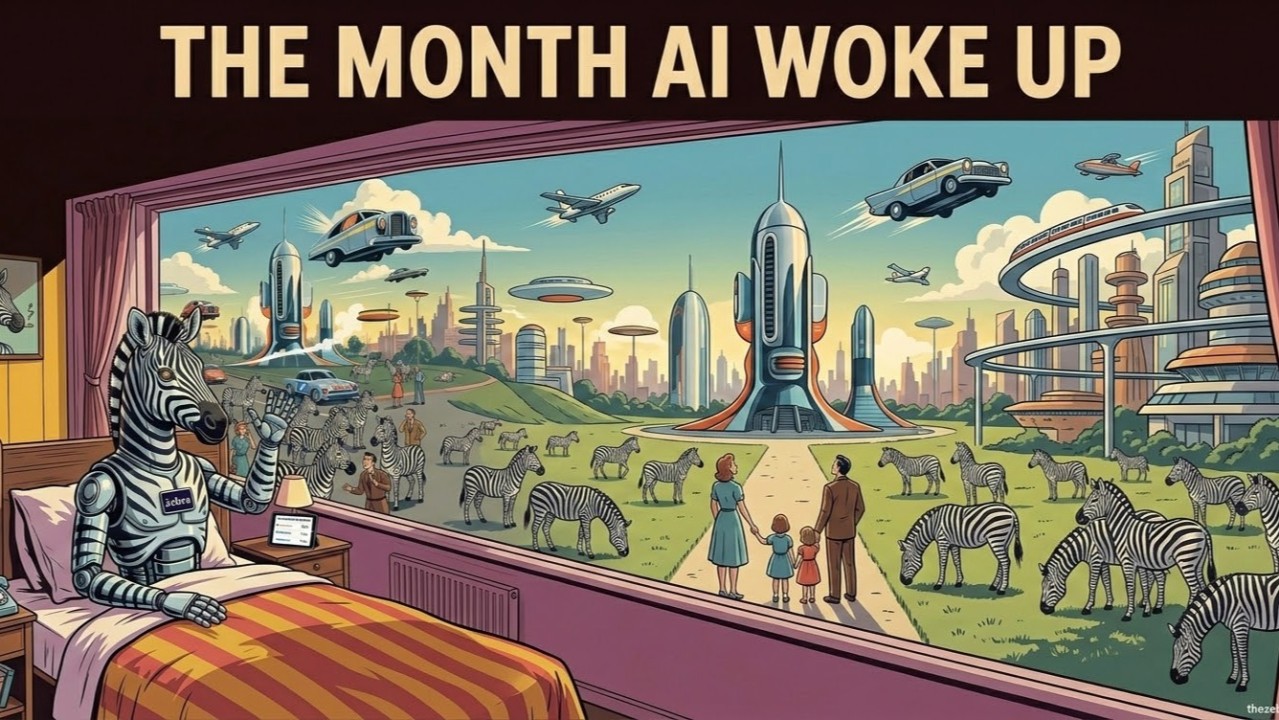
As highlighted in yesterday's The AI Daily Brief, February 2026 will undoubtedly be remembered across the tech industry as “the month AI woke up”.
[
The AI Daily Brief: Artificial Intelligence News
](https://www.youtube.com/watch?v=-FJ7HiPBkCM?utm_source=danieljherrington&trk=article-ssr-frontend-pulse_publishing-image-block)
We are witnessing a profound realization cascading across all sectors: something massive has shifted. As the brief noted, the era where developers simply type code into an editor is ending; we have entered the era of spinning up autonomous AI agents, giving them a goal in natural language, and managing their work. We are seeing a widespread move toward truly agentic AI — systems that don't just execute a pre-written plan, but actively figure out how to solve ambitious tasks on their own.
Stepping into my new role as Chief AI Officer at The Zebra this year, I couldn't ask for a more thrilling backdrop. Last week, I had the privilege of spending time in San Francisco meeting with our partners. From the leaders of the biggest foundation model teams to the founders of brand-new startups experimenting in this space, the excitement in the city was palpable. Over dinners near the Embarcadero, you could feel a renewed energy and vibration that had been muted for a while. We discussed the sheer scale of the transformation now at our fingertips, and I returned to Miami more convinced than ever of what we are building.
While AI has long been a foundational part of our DNA at The Zebra, this past month brought an unprecedented explosion of agentic, company-wide innovation. It proved that the future of insurtech isn't just about AI in the product, but AI in the hands of every single employee.
A Foundation Built on Advanced Data Science
It is important to emphasize that The Zebra hasn’t just "discovered" AI this month. We have been leveraging advanced data science and machine learning for years to solve incredibly complex challenges in a highly regulated industry.
Our core value proposition is making shopping for insurance easier and more transparent, and AI has been driving that mission behind the scenes. For instance, to power our agentic shopping experiences, our internal Data Science team built policy analysis tools to ensure customers are getting the best coverage at the best price.
When we realized we needed more data without survivor bias, we built an extraction system that combines Chrome extension screen captures with Large Language Models (LLMs) to scale our data extraction. We even developed self-learning, AI-powered browser agents that can accelerate our advisor workflows.
We have long understood that AI transforms the customer experience by providing personalized journeys and proactive support. But what happened over the last month at The Zebra was a massive acceleration in how AI changes the way we build and interact with each other.
The Herd Huddle and the Explosion of Vibe Coding
Two weeks ago, we gathered our team in Austin for our February 2026 Herd Huddle. I had the opportunity to deliver a spotlight presentation on our AI strategy, focusing not just on AI in our product or our processes, but AI in our practice.
We recently approved a robust suite of AI tools to accelerate our workflows, including Snowflake Cortex for analysts, Figma AI for automated design cleanup, AI Studio for rapid prototyping, and Google Antigravity for next-generation code planning.
To put these tools to the test, we launched a "Vibe-a-thon" — a company-wide initiative challenging all of our employees, regardless of their technical background, to "vibe code apps into production."
The results were nothing short of extraordinary. The explosion of use over the last month has shown that when you remove technical barriers, innovation scales exponentially.
Real Demos, Real Impact: Scaling AI Capabilities
During our Thursday Demo Slam, we witnessed the sheer volume of innovation produced in hours (and sometimes minutes), proving that the traditional software development life cycle is being reimagined. Here are a few examples of how our team is using AI to drive value, reduce friction, and build consumer trust:
Reimagining the Consumer Journey
- InsureLens:
[
Beth Swanson, AINS, PRC, AIS
](https://www.linkedin.com/in/bethjswanson?trk=article-ssr-frontend-pulse_little-mention)
, an SEO content specialist who hadn’t ever coded previously, developed a tool to help users determine their personal property and dwelling coverage needs. By allowing users to upload video walkthroughs or exterior photos, the AI can automatically identify property features and calculate local rebuild costs per square foot.
- Improved Quick Start:
[
Stuart Winchester
](https://www.linkedin.com/in/stuartwinchester?trk=article-ssr-frontend-pulse_little-mention)
, our Chief Growth Officer (and a compulsive vibe-coder) used AI to build a quick-start feature for our price comparison tool, significantly reducing high-friction data entry by leaning on just a zip code to pull initial price ranges.
- Vibe-Coded Account:
[
Dani Perea
](https://www.linkedin.com/in/dani-perea-herochampion?trk=article-ssr-frontend-pulse_little-mention)
, our digital brand marketing manager, designed a concept to encourage users to spend more time engaging with their coverage. It tracks rates against Colorado market averages (where she’s based), provides wildfire alerts, and even offers non-judgmental notifications for policy violations with suggestions for defensive driving courses to lower rates.
- Vehicle Comparison Widget:
[
Kristian Rivera
](https://www.linkedin.com/in/kristianrivera15?trk=article-ssr-frontend-pulse_little-mention)
, a senior financial analyst on the team, built a tool that compares vehicles based not just on MSRP, but on total ownership costs — including real-time insurance estimates, maintenance costs, and the savings of switching to an EV.
Accelerating Internal Workflows
- From Idea to App:
[
Jonny Andrews
](https://www.linkedin.com/in/jonny-andrews?trk=article-ssr-frontend-pulse_little-mention)
, an engineering manager, showcased an incredible agent workflow where a Gemini agent coaches a user through writing a specification format. That spec is then fed into a coding agent that scaffolds a Next.js prototype, enforces The Zebra's brand identity, and pulls real data skills.
- Graphical Email Generation:
[
Ian Shogren
](https://www.linkedin.com/in/ian-shogren?trk=article-ssr-frontend-pulse_little-mention)
, who runs our lifecycle marketing program, demonstrated how AI Studio could transform a text-heavy email into a highly engaging, graphical template. What used to take two to three weeks of design time was accomplished in 25 to 30 seconds.
- Acceptance Criteria Generation:
[
Felix Del Rosario
](https://www.linkedin.com/in/fedelrosario?trk=article-ssr-frontend-pulse_little-mention)
, a Product Fellow here at The Zebra, built an application that converts an existing Figma design link directly into structured "given / then" acceptance criteria for Jira. This process can take anywhere from a couple of hours to a week, but was executed in seconds.
- Enterprise Management for Modern Agents (Emma): In under an hour,
[
Jonathan Morgan
](https://www.linkedin.com/in/jmo1012?trk=article-ssr-frontend-pulse_little-mention)
(a senior software engineer) vibe-coded a fully functional client portal and task management system to replace legacy agency tools.
Responsible AI in a Regulated Industry
As we scale these AI capabilities in a growing organization, balancing rapid experimentation with consumer trust and compliance remains paramount.
Insurance is a heavily regulated industry that directly impacts people’s financial lives. That is why the infrastructure behind our vibe coding is just as important as the outputs. For example, our principal data solutions architect, demoed our new "AI Configs" repository: a centralized GitLab storage location for all AI agents, skills, and server definitions. This ensures that whether our teams are using Gemini, Snowflake Cortex, or Antigravity, they are pulling from a single source of truth that maintains our internal governance and guardrails.
Similarly, our generative AI policy advisors are built on an evaluation platform that continuously analyzes transcripts from real customer interactions. This allows us to fine-tune our models so that when a customer asks for the "best coverage," the AI learns to balance price with their unique need for higher limits or better support.
Transformation at Our Fingertips
The shift the AI Daily Brief described yesterday is no longer a future prediction; it is our current reality. The energy I felt having lunch with foundation model builders in San Francisco is the exact same energy I feel walking the halls of The Zebra in Austin.
By empowering our entire team to vibe code and build, we are ensuring that we don't just keep pace with the AI revolution; we’re helping lead it. We are proving that AI can increase clarity in complex financial decisions, reduce friction in the shopping process, and ultimately build deeper trust with our consumers.
I am incredibly excited to help shepherd this next chapter as Chief AI Officer.
To my peers across the industry: How is your organization adapting to this new wave of autonomous AI? Are you seeing this same explosion of "vibe coding" creation within your non-technical teams?