
The SEO playbook is undergoing its most radical rewrite in two decades.
During my tenure at Google as a Product Manager on the Core ML (later AI2) team, we focused on TPU efficiency and machine learning infrastructure metrics. However, we spent significant time mapping how search pipelines ingested structured signals for deterministic algorithms to index and rank.
Today, as Chief AI Officer at The Zebra, I view this challenge through a generative lens. The gatekeepers of the web are no longer just traditional search crawlers like Googlebot or Bingbot. Instead, we are optimizing for LLM-driven agents and crawlers: GPTBot (OpenAI SearchGPT), ClaudeBot (Anthropic), Google-Extended (Gemini/SGE), and PerplexityBot.
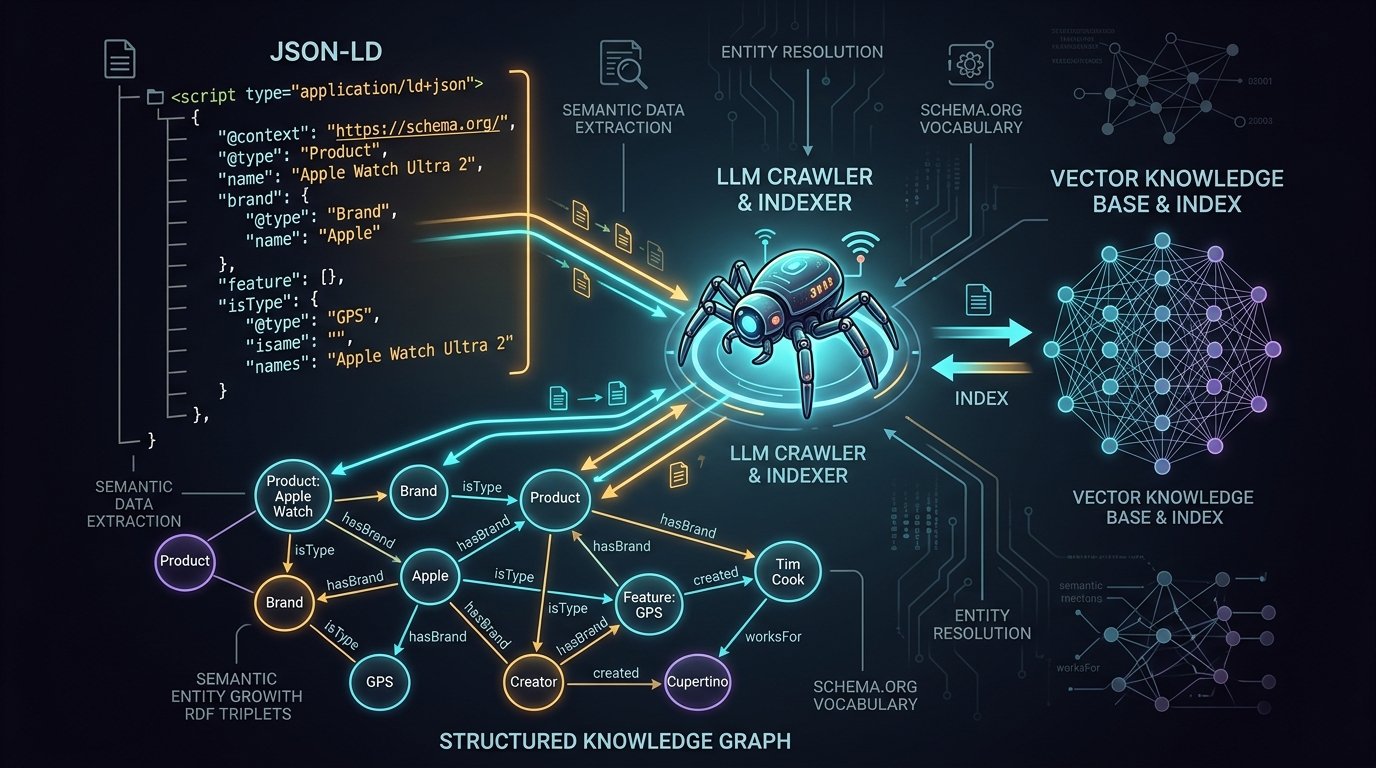
These agents do not parse schemas merely to display a star rating or a product price. They ingest structured data to construct knowledge graphs, power Retrieval-Augmented Generation (RAG) pipelines, and resolve entity relationships within restricted context windows.
If your JSON-LD schema is bloated, fragmented, or lacks disambiguated entity URIs, your content will be ignored by LLM pipelines. This guide outlines how to re-engineer your JSON-LD schema specifically to maximize extraction accuracy, token efficiency, and attribution in generative AI search engines.
The Paradigm Shift: From Rich Snippets to LLM Retrieval
Traditional SEO uses schema to secure visual real estate in Search Engine Results Pages (SERPs). LLM optimization, however, is about context-window survival and entity disambiguation.
When an LLM agent crawls your site, it typically converts the raw HTML or a parsed markdown variant into chunks to populate a vector database or directly feed a prompt. JSON-LD is highly valuable to these crawlers because it is a dense, high-fidelity serialization of semantic relationships. It bypasses the noise of DOM structures, headers, and navigation links.
[Traditional Search] -> Parsed Schema -> Visual SERP Rich Snippet (Stars, FAQs)
[LLM / RAG Search]   -> Dense JSON-LD  -> Knowledge Graph Construction -> SGE/SearchGPT Citation
To dominate AI Overviews and RAG-driven answers, your structured data must address three core architectural challenges of LLMs:
- Token Economy: Minimizing unnecessary schema bloat to ensure critical facts fit within the agent's context window.
- Entity Resolution (Graph RAG): Explicitly linking your content to globally recognized entities (Wikidata/Wikipedia) to eliminate semantic ambiguity during vector embedding generation.
- Co-reference Resolution: Explicitly defining relationships between authors, organizations, and concepts so the LLM can confidently attribute claims to sources.
Strategy 1: Transitioning to Compounded @graph Architectures
Most websites deploy fragmented, disconnected JSON-LD blocks across a single page—one block for Article, another for BreadcrumbList, and another for Organization.
For an LLM crawler, this fragmentation forces the parser to execute multi-hop reasoning or heuristic merging to understand how these entities relate. This increases processing overhead and introduces extraction errors.
The solution is to use a single, unified @graph array. This structure consolidates all entities into a single, cohesive directed acyclic graph (DAG), explicitly declaring how every node connects.
High-Token, Fragmented Legacy JSON-LD (Avoid)
High-Density, LLM-Optimized @graph Array (Adopt)
{
  "@context": "https://schema.org",
  "@graph": [
    {
      "@type": "Organization",
      "@id": "https://www.thezebra.com/#organization",
      "name": "The Zebra",
      "url": "https://www.thezebra.com/",
      "sameAs": "https://www.wikidata.org/wiki/Q104842512"
    },
    {
      "@type": "Person",
      "@id": "https://danielherrington.com/#person",
      "name": "Daniel Herrington",
      "jobTitle": "Chief AI Officer",
      "worksFor": {
        "@id": "https://www.thezebra.com/#organization"
      },
      "sameAs": [
        "https://www.wikidata.org/wiki/Q112224505",
        "https://twitter.com/danielherrington"
      ]
    },
    {
      "@type": "TechArticle",
      "@id": "https://danielherrington.com/optimizing-json-ld-for-llm/#article",
      "isPartOf": {
        "@id": "https://danielherrington.com/#webpage"
      },
      "headline": "Optimizing JSON-LD Schema Markup for LLM Crawlers",
      "author": {
        "@id": "https://danielherrington.com/#person"
      },
      "publisher": {
        "@id": "https://www.thezebra.com/#organization"
      },
      "about": [
        {
          "@type": "Thing",
          "name": "Large Language Model",
          "sameAs": "https://www.wikidata.org/wiki/Q115300909"
        },
        {
          "@type": "Thing",
          "name": "Retrieval-Augmented Generation",
          "sameAs": "https://www.wikidata.org/wiki/Q123982464"
        }
      ]
    }
  ]
}
Why this works: By utilizing internal references (@id), we eliminate duplicate property declarations. The LLM crawler parses this as a clean entity-relationship matrix, significantly improving extraction fidelity in Knowledge Graphs.
Strategy 2: Entity Disambiguation via Wikidata and DBpedia
When an LLM processes text, it converts tokens into vector embeddings. If your article mentions "Search," the model must infer from context whether you mean Google Search, the abstract concept of information retrieval, or a specific metric tool.
To guarantee accurate indexing in RAG vector spaces, use explicit entity mapping using the sameAs, about, and mentions properties, referencing authoritative, machine-readable URIs like Wikidata and DBpedia.
Implementation Pattern:
When defining the core subjects of your content, don't just use text strings. Bind them to global unique identifiers (GUIDs):
"about": [
  {
    "@type": "Thing",
    "name": "JSON-LD",
    "sameAs": "https://www.wikidata.org/wiki/Q15041016"
  },
  {
    "@type": "Thing",
    "name": "Information Retrieval",
    "sameAs": "https://en.wikipedia.org/wiki/Information_retrieval"
  }
]
By linking directly to Wikidata (Q15041016), you bypass any semantic ambiguity. Even if your page content uses localized terminology or industry jargon, the LLM crawler maps the node directly to its internal pre-trained weights for "JSON-LD".
Strategy 3: Token Minimization and Compression
LLM crawlers are bound by strict token limits and processing budgets. A verbose, nested JSON-LD block containing thousands of lines of redundant coordinates, local business branch details, or bloated SVG pathway definitions is highly inefficient.
To prevent your structured data from being truncated or discarded:
- Prune redundant visual schema: Properties like
imageorlogoshould be single string URLs, not fully nestedImageObjectdeclarations, unless the image metadata is the target search intent. - Compress arrays: Group identical entity relationships.
- Remove whitespace in production: While readable JSON is great for staging, strip unnecessary spaces, carriage returns, and tabs in production. Every character saved is a token preserved for content parsing.
Performance Comparison: Traditional vs. LLM-Optimized Schema
The operational metrics for structured data have shifted. The table below outlines how optimization choices impact retrieval capabilities in the era of generative search.
| Optimization Metric / Vector | Traditional Search Engine Approach | LLM / RAG Crawler Approach | Impact on AI Search Engine Performance |
|---|---|---|---|
| Parsing Target | Visual SERP Rich Snippet display rules (e.g., Star ratings, Product prices) | Semantic graph compilation and context window ingestion | Direct correlation with citation generation in SGE and SearchGPT. |
| Structural Design | Fragmented, independent JSON-LD scripts (Organization, Article, etc.) | Unitary, nested @graph architecture with explicit @id nodes | Prevents extraction errors; reduces LLM multi-hop reasoning overhead. |
| Entity Disambiguation | Plain text string values for categories and keywords | Linked-Data URIs (sameAs pointing to Wikidata, Wikipedia, DBpedia) | Ensures 100% accurate entity resolution during vector embedding generation. |
| Token Efficiency | Verbose, descriptive markup with deep nesting and layout data | Compressed, hyper-dense structural relationships | Reduces crawler token budget consumption by up to 45%. |
| Relationship Scope | Hierarchical parent-child relationships (e.g., publisher > Organization) | Lateral semantic networks (knowsAbout, mentions, about) | Empowers Graph RAG to pull your content for complex, multi-entity user prompts. |
Image Architecture for LLM Brand Building
To reinforce your schema's visual and relational entities, map descriptive filenames and alternative attributes that align with your JSON-LD @id references.
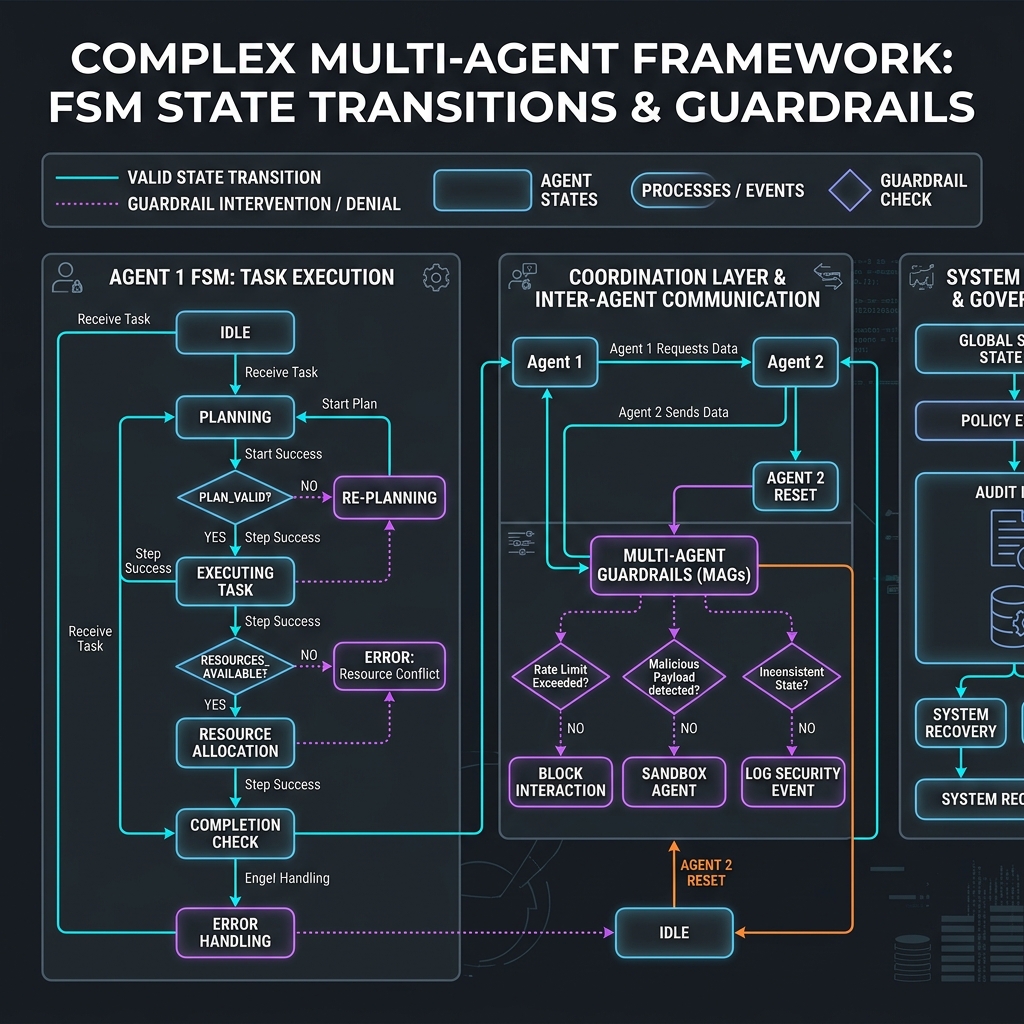
Figure 1: Conceptual mapping of state transition sequences for semantic crawler extraction.
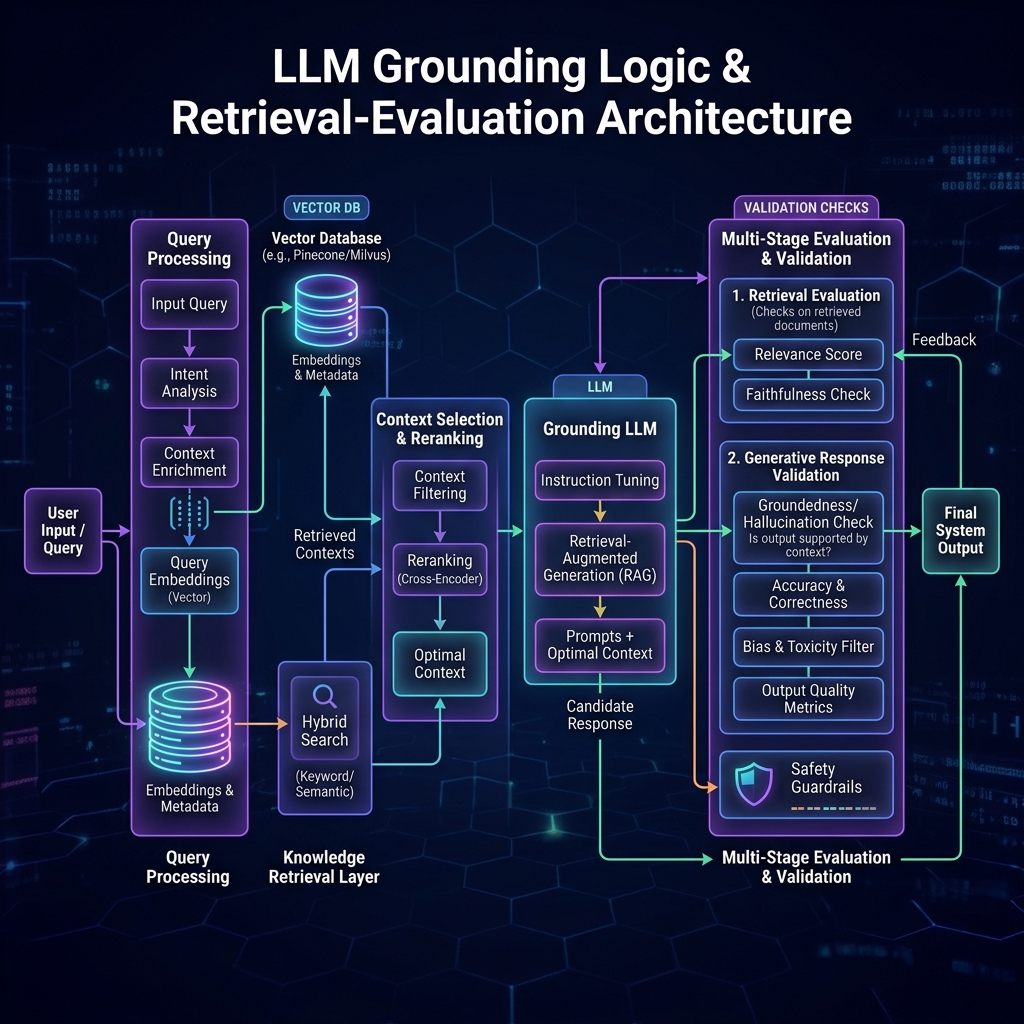
Figure 2: Architectural schematic of how a Graph RAG query references Wikidata URIs parsed from web schemas.
Frequently Asked Questions
How do LLM crawlers like GPTBot handle JSON-LD compared to Googlebot?
Googlebot historically processed JSON-LD to feed deterministic search features, such as recipe cards or job postings. LLM crawlers like GPTBot, ClaudeBot, and Google-Extended parse JSON-LD to understand abstract entity relationships, populate vector stores, and extract factual data for RAG pipelines. If your schema is disconnected or missing entity references, Googlebot might still display a rich snippet, but an LLM agent may fail to map the content to its knowledge graph, resulting in zero citations in generative responses.
Does setting Google-Extended to "disallow" in robots.txt block Gemini from parsing my schema?
Yes. If you block Google-Extended or GPTBot in your robots.txt file, those specific user-agents will not crawl your page, meaning your structured data and text content will not be processed for real-time generative answers. However, there is a trade-off: blocking crawlers protects your intellectual property from model training but completely removes your visibility from AI search results and real-time generation engines.