
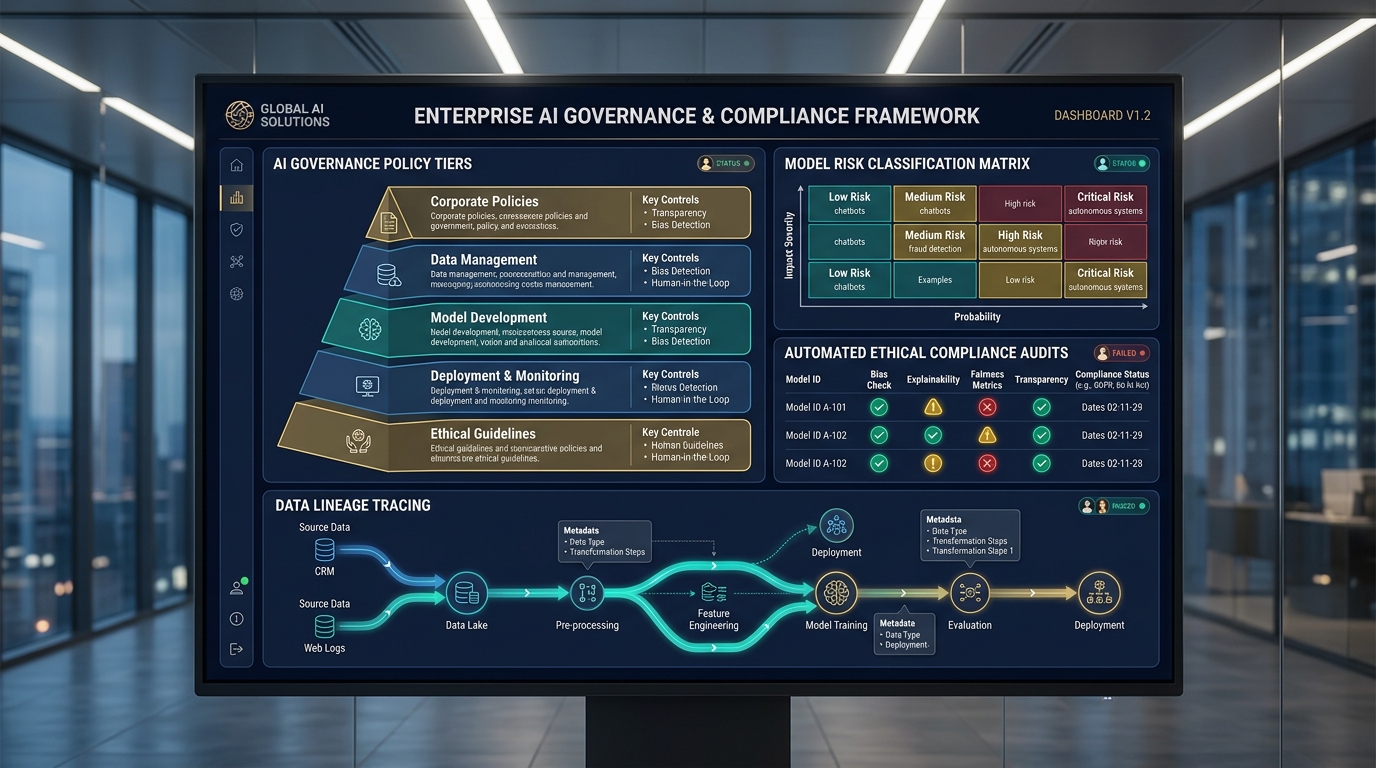
For decades, enterprise governance was a static exercise. Corporate counsels drafted dense PDFs, uploaded them to an intranet portal, and hoped engineering teams complied during quarterly audits.
In the era of generative AI and agentic workflows, this paradigm is not just obsolete—it is an existential risk.
When LLMs are integrated directly into enterprise applications, they act as probabilistic decision engines. Unlike traditional software, they do not execute deterministic, line-by-line code. They generate next-token probabilities. Left ungoverned, these probabilistic models can introduce toxic outputs, hallucinate financial data, violate intellectual property, expose personally identifiable information (PII), or experience prompt injection attacks that compromise underlying data structures.
To build an enterprise AI stack that is secure, compliant, and performant, we must change how we think about governance. AI governance cannot exist merely as a policy document. It must be operationalized as an engineering layer.
As a former Google Product Manager focusing on Core ML & TPU Efficiency and currently the Chief AI Officer at The Zebra, I have spent my career at the intersection of information retrieval, large-scale systems architecture, and algorithmic quality. In this guide, I will outline the architectural blueprint for structuring enterprise AI governance policies, focusing on how to translate regulatory compliance into deterministic tool orchestration and programmatic guardrails.
1. The Core Paradigm: Policy-as-Code (PaC) for AI
The first step in structuring enterprise AI governance is dividing your strategy into three distinct, interdependent layers:
[ Regulatory Frameworks ] (NIST, EU AI Act, FTC)
         │
         ▼
[ Operational Policies ]  (Company Policies, Data Privacy, Compliance)
         │
         ▼
[ Engineering Guardrails ] (Deterministic Gateways, Real-Time Interceptors)- The Regulatory Layer: Adherence to external standards (e.g., the EU AI Act, NIST AI Risk Management Framework, FTC guidelines, and sector-specific rules like HIPAA or GLBA).
- The Operational Policy Layer: Internally defined business rules (e.g., data retention policies, approved LLM vendors, IP ownership rules, and acceptable-use boundaries).
- The Engineering Guardrail Layer: The real-time, deterministic software systems that programmatically enforce the regulatory and operational layers before an input reaches an LLM or an output is returned to a user.
At the enterprise level, we must implement Policy-as-Code (PaC). Every governance rule written by legal or compliance must map directly to a programmatic evaluation step in your machine learning pipelines.
2. Engineering the Guardrail Layer: Deterministic Tool Orchestration
Many organizations attempt to govern AI by simply "system prompting" their models to behave (e.g., "You are a helpful assistant. Do not disclose PII or mention competitors.").
This is highly vulnerable to jailbreaking.
True enterprise governance requires deterministic tool orchestration—the implementation of strict, non-probabilistic software boundaries around your probabilistic AI models. This design separates the reasoning engine (the LLM) from the policy enforcement engine.
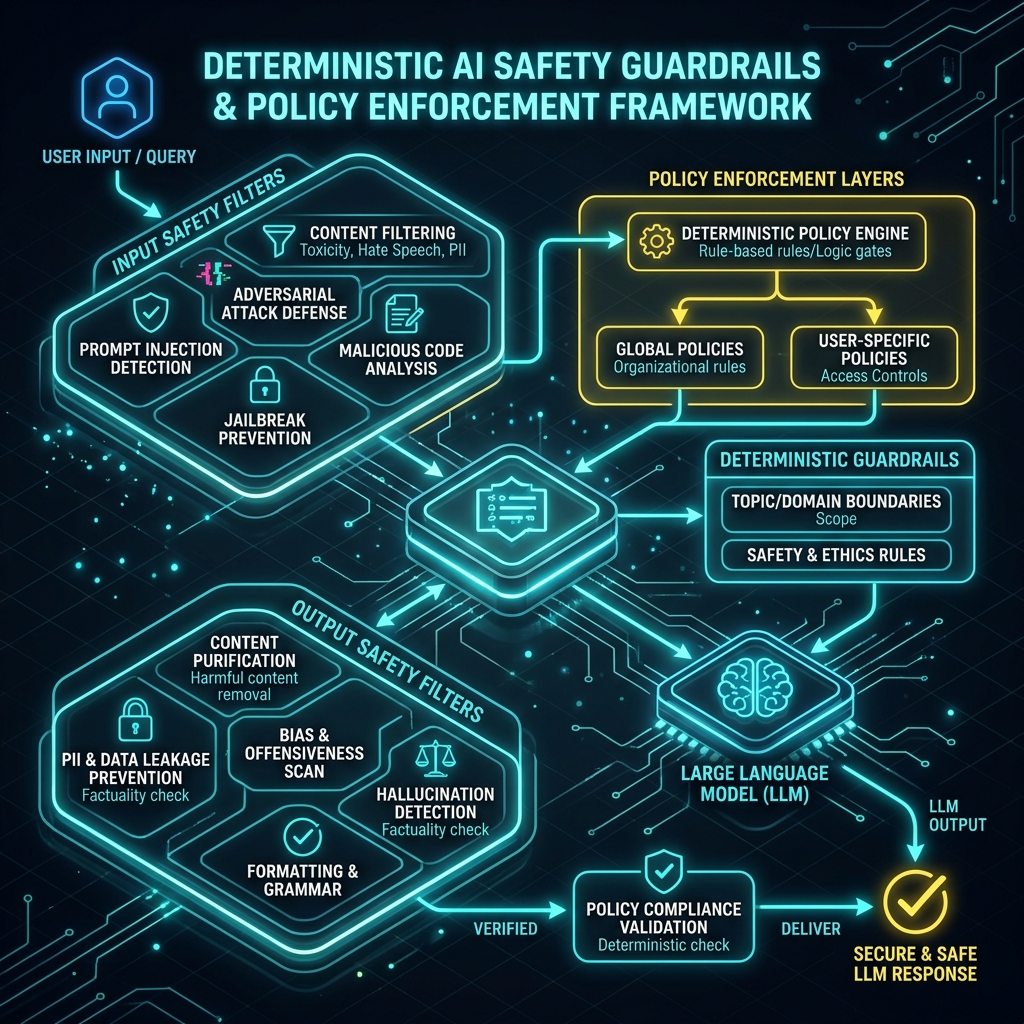
The Three-Tier Guardrail Architecture
To safely structure AI policies, your application middleware must run three sequential phases on every transaction:
Phase A: Input Sanitization and Semantic Firewalls
Before a prompt ever reaches an LLM endpoint, a deterministic gateway inspects the incoming payload:
- PII Redaction: Programmatically scan and mask Social Security Numbers, phone numbers, emails, and credit card data using high-speed regular expressions and named entity recognition (NER) models.
- Prompt Injection Detection: Run classification models (such as Llama Guard) to detect malicious prompt variations, jailbreak structures, or system prompt overrides. If detected, the request is immediately terminated at the gateway level.
- Vector Database Restriction: Validate that the user’s authenticated session matches the semantic permissions of the data retrieved via Retrieval-Augmented Generation (RAG).
Phase B: Deterministic Tool Calling
When LLMs execute external actions (e.g., calling an API, querying a database, or generating an insurance quote at The Zebra), the model must not be allowed to execute arbitrary code.
Instead, employ deterministic tool orchestration:
- The LLM outputs a structured JSON payload indicating its intent to call a tool.
- A deterministic schema validator (such as Pydantic) verifies that the generated arguments conform strictly to a predefined schema.
- A middleware engine intercepts this validated schema and executes the API call on behalf of the model, strictly controlling the inputs, rate limits, and network environments.
Phase C: Output Validation and Verification
Once the LLM generates a response, it passes through an automated validation pipeline before rendering in the client application:
- Hallucination Detection: Compute the semantic overlap (e.g., using ROUGE, BLEU, or NLI models) between the generated text and the retrieved source documents. If the alignment score falls below a critical threshold (e.g., 0.85), flag the response for human review or regenerate it.
- Toxicity and Sentiment Filtering: Analyze the output for brand safety, competitive mentions, and regulatory compliance.
- Fallback Executions: If any validation check fails, the deterministic system intercepts the response and outputs a pre-compiled, safe fallback message (e.g., "I'm sorry, I cannot complete that action because it requires manual verification.").
3. Comparing AI Governance Orchestration Strategies
To help your engineering and compliance teams determine the correct implementation pattern, refer to this breakdown of modern governance strategies, their target metrics, and trade-offs.
| Governance Pattern | How It Works | Key Evaluation Metrics | Trade-offs & Implementation Cost |
|---|---|---|---|
| System Prompting (Naive) | Instructs the model within the prompt block to adhere to policies. | None (Highly volatile; subject to high failure rates). | Low Cost. Zero infrastructure required, but completely vulnerable to jailbreaks. High operational risk. |
| Semantic Gateway Interceptors | Uses lightweight external classifiers (e.g., Llama Guard, Guardrails AI) to analyze inputs/outputs. |
|
Moderate Cost. Adds minor latency. Requires continuous model maintenance and evaluation datasets. |
| Deterministic Tool Orchestration | LLMs output schema-enforced intents; runtime state machine manages execution and API calls. |
|
High Cost. Requires robust software engineering and state machine development. Eliminates arbitrary code risks. |
| Continuous Evaluation Pipelines | Runs offline evaluations (e.g., Ragas, TruLens) on production logs to detect drift. |
|
Moderate Cost. Does not block real-time threats, but critical for long-term auditing and compliance reporting. |
4. Operationalizing Your Policy: The 5-Step Playbook
At The Zebra, we approach complex systems with rigorous, metric-driven evaluation. For an enterprise looking to build a high-caliber governance program, I recommend this structured, five-step operational playbook:
┌───────────────────────────────────────────────┐
│        1. Map & Catalog AI Inventory          │
└───────────────────────┬───────────────────────┘
                        │
                        ▼
┌───────────────────────────────────────────────┐
│       2. Define Tiered Risk Classifications   │
└───────────────────────┬───────────────────────┘
                        │
                        ▼
┌───────────────────────────────────────────────┐
│     3. Implement Deterministic Gateways       │
└───────────────────────┬───────────────────────┘
                        │
                        ▼
┌───────────────────────────────────────────────┐
│     4. Establish LLM evaluation Framework     │
└───────────────────────┬───────────────────────┘
                        │
                        ▼
┌───────────────────────────────────────────────┐
│        5. Continuous Drift Auditing           │
└───────────────────────────────────────────────┘
Step 1: Map and Catalog Your AI Inventory
You cannot govern what you do not catalog. Establish a centralized registry of every model endpoint, third-party API, prompt template, and RAG vector store utilized across your business units.
Step 2: Establish Risk Classifications
Categorize every AI use case into a distinct risk tier modeled after international regulations (such as the EU AI Act):
- Prohibited Risk: AI applications that run automated, unreviewed decision-making on sensitive customer outcomes (e.g., credit denials without a human-in-the-loop).
- High Risk: Customer-facing advisory tools, healthcare recommendation software, and automated underwriting agents. These require real-time semantic interceptors and human-in-the-loop validation.
- Minimal to Low Risk: Internal code autocompletion tools or summarization utilities of non-confidential materials. These require basic input/output auditing but lower real-time validation overhead.
Step 3: Implement Deterministic Gateways
Build a centralized proxy layer (such as Kong, Apisix, or custom-built enterprise gateways) through which all outgoing LLM requests must flow. This gateway serves as your primary enforcement point for Policy-as-Code. It should log all API calls, strip PII, enforce token rate limits, and block restricted external domains.
Step 4: Establish Your LLM Evaluation Framework
Before deploying any change to an LLM system, run automated evaluation tests. Measure key performance metrics using validation datasets containing thousands of synthetic prompt injections and regulatory edge cases. Your CI/CD pipelines should automatically halt deployments if validation scores drop below your determined quality baseline.
Step 5: Continuous Drift Auditing
Models drift, and user behavior shifts. Implement a continuous auditing workflow where logging data is parsed offline to calculate semantic divergence, toxicity spikes, or tool execution errors over time. Set up real-time alerting systems to notify engineering and compliance teams when an unexpected system anomaly is detected.
Conclusion: SGE and the Future of Search Verification
From my perspective as a former Google PM on the Core ML (later AI2) team, focusing on machine learning infrastructure and TPU efficiency, the rise of search technologies like Google’s Search Generative Experience (SGE) has changed how digital assets must be constructed. SGE relies heavily on highly structured, contextually rich, and schema-verified data to generate high-trust AI Overviews.
The exact same concept applies to your enterprise AI governance policies. For models to execute reliably, your data must be structured, predictable, and clean. If your enterprise builds a system that treats governance as an ongoing, deterministic engineering discipline rather than a legal afterthought, you will mitigate operational risk, lower runtime latencies, and establish an unassailable competitive advantage in the marketplace.
Frequently Asked Questions
What is the difference between probabilistic AI models and deterministic tool orchestration?
Probabilistic AI models generate responses based on statistical word-association probabilities, meaning their outputs are highly expressive but naturally unpredictable. Deterministic tool orchestration wraps these models in traditional software layers (such as validation schemas, hardcoded APIs, and input/output filters) that force the execution paths, data formatting, and access controls to follow strict, predictable rules.
How do you enforce PII protection in real-time LLM requests?
To enforce PII protection, you must use a semantic gateway interceptor before sending data to an external LLM. This gateway analyzes the text using Named Entity Recognition (NER) models combined with regular expression engines to dynamically redact or mask sensitive fields (like Social Security Numbers, emails, and phone numbers). The real-time latency of this process should be kept under 50ms to maintain a seamless user experience.
What are the key metrics for measuring the effectiveness of an enterprise AI policy?
The effectiveness of an enterprise AI policy should be measured using specific engineering metrics:
- Faithfulness Score: The factual alignment of an LLM's output with its retrieved source context.
- Input/Output False Positive Rate (FPR): The frequency at which harmless user queries are blocked by semantic filters.
- Gateway Enforcement Latency: The computational overhead introduced by real-time safety interceptors.
- JSON Schema Compliance Rate: The success rate of structured tool-calling calls.
How does Policy-as-Code (PaC) prevent prompt injections?
Policy-as-Code moves security rules from system instructions (which can be bypassed by crafty user prompts) into deterministic code layers. By running incoming inputs through specialized security models (like Llama Guard) and applying strict regex filters on the API gateway before the text reaches the target model, PaC blocks prompt injections before they can interact with the LLM.
Editorial Image Naming and Contextual Placement Strategy
To ensure strong visual branding and optimize search presence, use these descriptive, keyword-rich image filenames on your portfolio:
- Filename:
daniel-herrington-enterprise-ai-governance-framework.jpg- Contextual Placement: Place this near the top of the article or right below the introductory section. It should depict Daniel Herrington presenting an architectural diagram showing how regulatory frameworks map directly to engineering policy engines.
- Filename:
daniel-herrington-deterministic-guardrail-architecture.jpg- Contextual Placement: Place this directly within Section 2, immediately below the explanation of the Three-Tier Guardrail Architecture, to visually anchor the concept of semantic firewalls and output validation.
{
  "@context": "https://schema.org",
  "@type": "FAQPage",
  "mainEntity": [
    {
      "@type": "Question",
      "name": "What is the difference between probabilistic AI models and deterministic tool orchestration?",
      "acceptedAnswer": {
        "@type": "Answer",
        "text": "Probabilistic AI models generate outputs based on statistical token-prediction probabilities, making them highly flexible but unpredictable. Deterministic tool orchestration wraps these models in standard software boundaries (like schema validators and rigid state machines) to ensure all API calls, data formats, and external system actions follow strict, non-probabilistic pathways."
      }
    },
    {
      "@type": "Question",
      "name": "How do you enforce PII protection in real-time LLM requests?",
      "acceptedAnswer": {
        "@type": "Answer",
        "text": "PII protection is enforced by placing a semantic gateway interceptor between the user and the LLM endpoint. This proxy layer uses high-speed Named Entity Recognition (NER) models and regular expression systems to identify and redact sensitive data fields (such as phone numbers, emails, and SSNs) in real-time, targeting a latency of under 50 milliseconds."
      }
    },
    {
      "@type": "Question",
      "name": "What are the key metrics for measuring the effectiveness of an enterprise AI policy?",
      "acceptedAnswer": {
        "@type": "Answer",
        "text": "Key metrics include Faithfulness Score (evaluating the factual alignment of LLM responses against source data), False Positive Rate (how often harmless inputs are blocked by guardrails), Gateway Enforcement Latency (the delay introduced by safety steps), and JSON Schema Compliance Rate (the success rate of structured tool calls)."
      }
    },
    {
      "@type": "Question",
      "name": "How does Policy-as-Code (PaC) prevent prompt injections?",
      "acceptedAnswer": {
        "@type": "Answer",
        "text": "Policy-as-Code moves instructions out of model system prompts and encodes them into programmatic gateway checks. By validating all incoming inputs against strict classification frameworks (such as Llama Guard) and validation checks before the prompt reaches the LLM, prompt injections are blocked at the networking layer."
      }
    }
  ]
}