
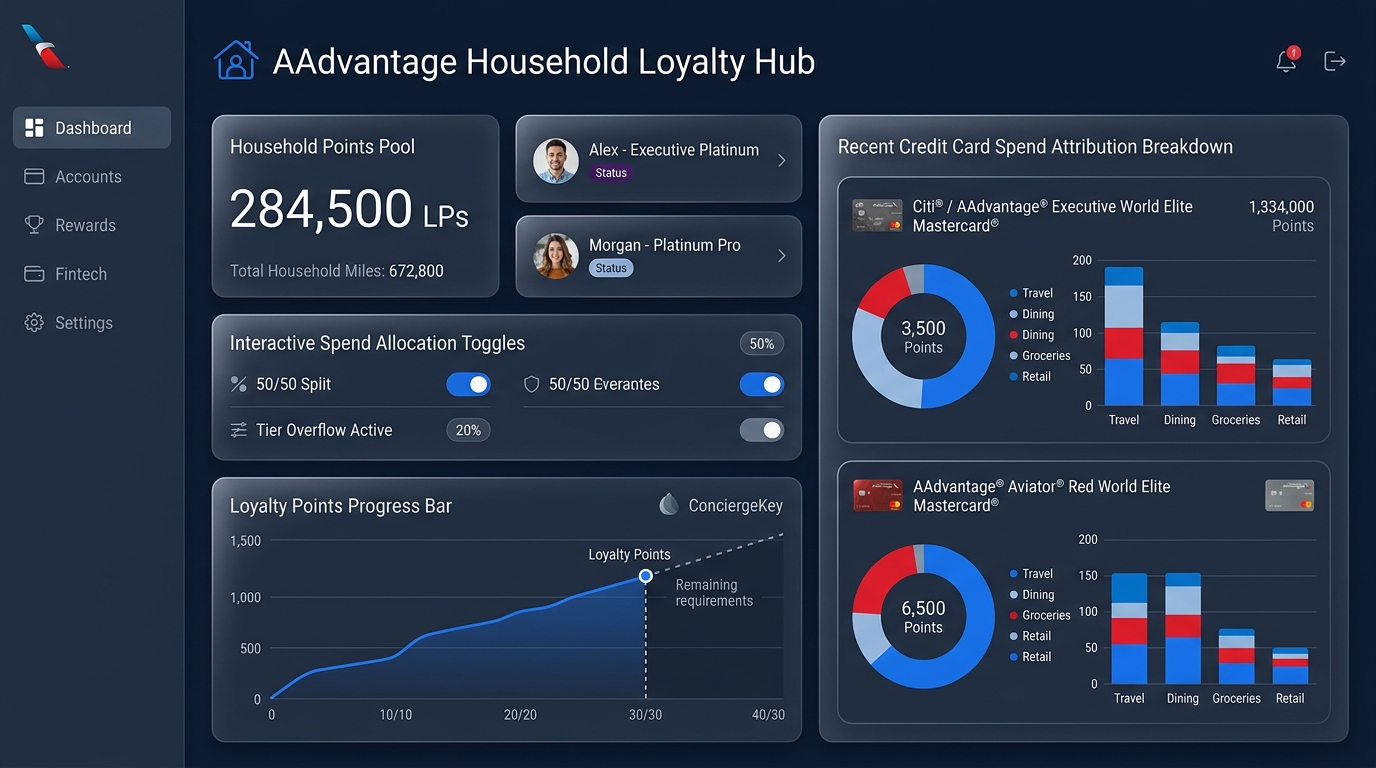
A product strategy and Critical User Journey (CUJ) addressing the single-earner bias in spend-based airline loyalty programs, creating equitable status and recognition for dual-earner, co-managing households.
The Problem Space
Context
American Airlines redesigned the AAdvantage program around Loyalty Points (LPs). Status is no longer primarily earned by miles flown in the air, but through everyday dollar spend—predominantly routed through co-branded airline credit cards (Citi / Barclays) and shopping portals.
In modern dual-earner households, both partners often travel frequently for work and personal commitments, while pooling all shared household expenses (groceries, utilities, travel, childcare, dining) onto a single primary airline rewards credit card to maximize points.
The Core Friction
Loyalty programs and credit card issuers operate on a legacy, single-primary-earner paradigm:
- 100% Attribution to Primary: All credit card base spend and category bonus Loyalty Points are credited exclusively to the primary cardholder's AAdvantage number.
- Zero Attribution to Authorized Users: The secondary cardholder (authorized user) generates substantial household spend and drives brand loyalty, but earns 0 Loyalty Points from credit card purchases.
- The Asymmetric Status & Experience Gap:
- At year-end, the primary cardholder over-qualifies (e.g., earning 250k+ LPs, far beyond Executive Platinum threshold).
- The partner/spouse barely reaches the entry tier (Gold/Platinum), despite the household generating the collective spend and flight revenue of a top-tier customer.
- When the partner travels alone for business or leisure, they are stripped of priority check-in, Group 1–4 boarding, complimentary seat selection/upgrades, and baggage allowances.
- Spend Leakage for the Airline: Once the primary hits their target status tier, the household has an active economic incentive to divert all remaining $40k–$80k+ annual spend to flexible bank currencies (Chase Sapphire, Amex Platinum, Capital One) or split flights across competing airlines.
Critical User Journeys (CUJs)
CUJ 1: Equitable Status for Independent Partner Travel
- Statement: I want to attribute our pooled household credit card spend and loyalty points across both of our AAdvantage accounts while avoiding the single-cardholder accumulation bottleneck so that my partner receives the same elite status, comfort, and priority benefits when traveling solo as I do.
- User Scenario: Alex and Morgan share a Citi AAdvantage Executive card. Alex is the primary account holder; Morgan is the authorized user who manages most household purchasing. Morgan books a cross-country flight alone for a high-stakes client presentation. Because the household spend is recognized equitably, Morgan boards in Group 2, accesses preferred seating, and receives complimentary upgrades rather than sitting in basic economy without priority support.
CUJ 2: Frictionless Household Spend Maximization
- Statement: I want to keep 100% of our annual family purchasing on our American Airlines co-branded card while avoiding the need to manage multiple separate primary credit card accounts or pay redundant annual fees so that every household dollar spent actively advances both partners toward meaningful status milestones.
- User Scenario: In August, Alex checks the family loyalty dashboard. Alex has already secured Executive Platinum for next year. Instead of moving all remaining spend to a competitor's card, Alex enables "Household Allocation / Status Overflow" so that the next $35,000 in autumn family expenses automatically routes LPs to Morgan's account, boosting Morgan directly to Platinum Pro.
The Ideal Flows
Flow 1: Household Linkage & Spend Allocation Rule Configuration
- Trigger: Primary cardholder invites partner/spouse via the AAdvantage mobile app or web portal to create a Household Loyalty Unit.
- Action: Both partners verify the connection (matching billing address, shared authorized user status, or mutual two-factor consent).
- Automated Response: The loyalty engine establishes a linked profile and presents flexible LP distribution rules:
- Rule A (50/50 Parity Split): All credit card spend LPs are evenly distributed each billing cycle.
- Rule B (Per-Card Attribution): Card ending in
-1001deposits LPs to Alex; authorized user card ending in-2002deposits LPs to Morgan. - Rule C (Target Tier Overflow): 100% of LPs deposit to the primary until a defined tier is achieved (e.g., 125,000 LPs for Platinum Pro), after which 100% of subsequent card LPs route to the partner.
- Resolution: Future monthly statement spend seamlessly populates both individual accounts according to the chosen rule.
Flow 2: Independent Travel & Elite Recognition Payoff
- Trigger: Morgan books an individual flight on aa.com or a corporate booking tool (Concur) using Morgan's personal AAdvantage number.
- Action: Morgan checks in for the flight.
- Automated Response: The system identifies Morgan's earned tier (achieved through a combination of individual flights + allocated household spend) and grants full tier benefits: complimentary Main Cabin Extra seat selection, priority check-in, Group 2 boarding, Admirals Club access (if applicable), and priority waitlist position.
- Resolution: Morgan travels with dignity and recognition reflecting the family's annual investment in American Airlines.
The Solution: AAdvantage Household Loyalty Architecture
graph TD
    subgraph Household Financial Input
        A1["Primary Card Spend (Alex)"] --> CC["Co-Branded Card Statement ($10,000/mo)"]
        A2["Authorized User Spend (Morgan)"] --> CC
    end

    subgraph AAdvantage Loyalty Processing
        CC --> LE["Household Allocation Engine"]
        Rules["Configured Rule: 50/50 Split, Per-Card, or Tier Overflow"] --> LE

        LE -->|5,000 LPs| P1["Alex AAdvantage Profile"]
        LE -->|5,000 LPs| P2["Morgan AAdvantage Profile"]

        F1["Alex Flown Miles / Flights"] --> P1
        F2["Morgan Flown Miles / Flights"] --> P2
    end

    subgraph Outcome
        P1 --> S1["Executive Platinum Status (Solo Perks)"]
        P2 --> S2["Platinum Pro Status (Solo Perks)"]
    end
Loyalty Logic & Business Value
1. Loyalty Point Allocation Mechanisms
- Authorized User Card Accrual (Card-Level Mapping): Secondary credit cards are bound directly to the authorized user's individual AAdvantage number at issuance. Purchases on that physical/virtual card automatically accrue LPs directly to the authorized user.
- Household LP Gifting / Rebalancing: Introducing milestone-based transferability allowing households to shift up to 50,000–100,000 LPs annually to a linked co-habitant without predatory transfer fees.
- Tier Qualification Aggregation: Calculating qualification against a combined household threshold (e.g., Household Platinum Pro = 250,000 combined LPs across 2 linked members).
2. Commercial Win-Win for American Airlines
- Prevents Card Churn & Spend Leakage: Eliminates the mid-year cliff where high-spending families redirect $30k–$60k to Chase Sapphire Reserve or Amex Gold once the primary maxes out their status.
- Fierce Dual-Flyer Retention: When both partners hold status, neither has an incentive to book competing airlines (Delta, United) when traveling separately for work.
- Modernized Brand Sentiment: Replaces an outdated single-earner, patriarchal loyalty structure with an equitable, family-first customer experience.