
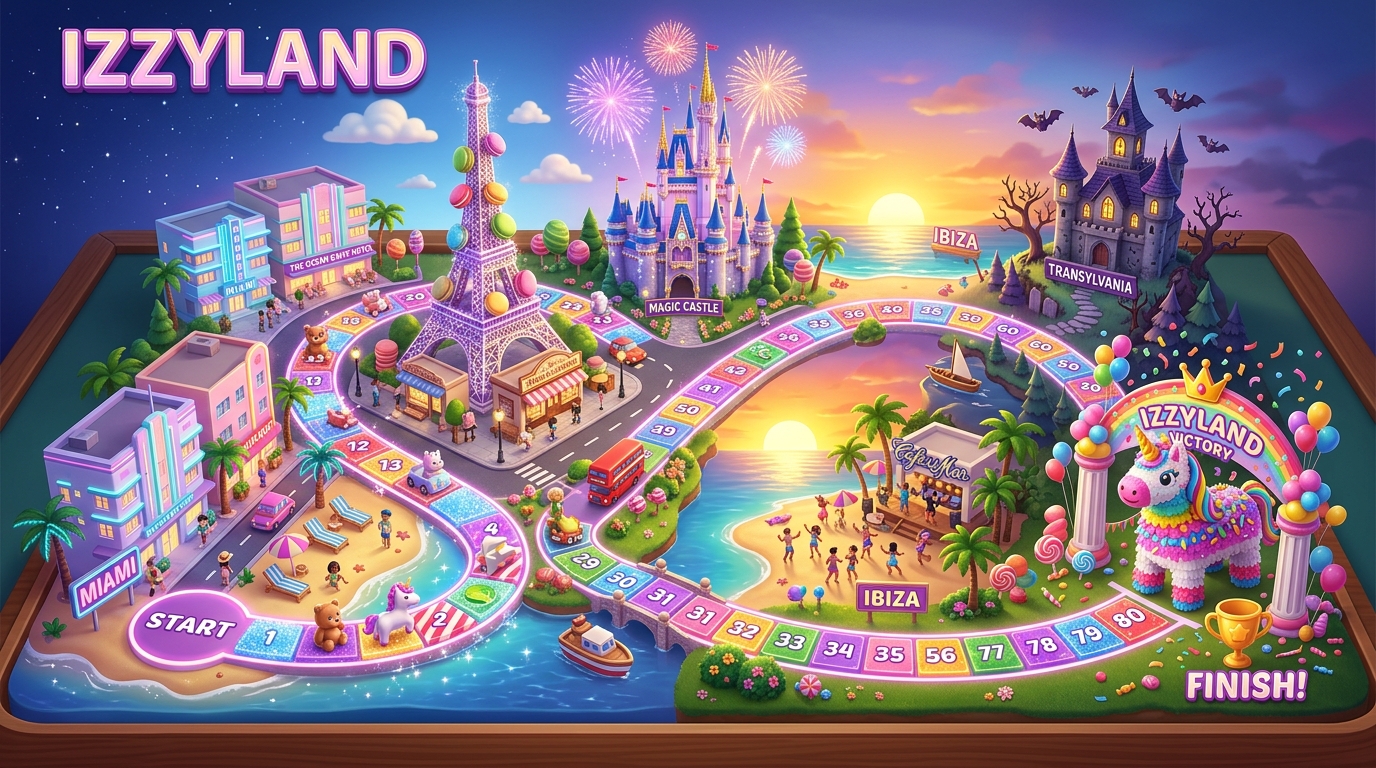
A Critical User Journey (CUJ) case study exploring how multimodal AI models (Google Gemini video), modern web game architecture (React 19 + Vite + Web Audio API), and rapid prototyping collapse the gap between a child's imagination and a production-grade interactive game in a single afternoon.
The Problem Space
Context
On a summer afternoon in 2026, sitting poolside in Florida, a father and his young daughter (Izzy) were discussing classic color-matching board games like Candy Land. Like many kids, Izzy loved the intuitive turn-based mechanics, but found the static legacy themes (Peppermint Forest, Gumdrop Mountain) disconnected from her real-life adventures and creative daydreams.
She asked an imaginative question:
"Why does Candyland only have Peppermint Forests? What if we had a game where we went to Miami with rollerblades, ate giant macarons under the Eiffel Tower in Paris, danced to DJ music on the beach in Ibiza—and what if Moe the dog got the zoomies?"
The Core Friction
- The Creative Consumption Trap: Traditional media and video games position children as passive consumers of pre-rendered content. When a child has a spark of imaginative storytelling, there is no accessible bridge to turn that narrative into interactive software in real time.
- The High Barrier to Game Prototyping: Historically, building a multi-scene animated game with custom video cutscenes, spatial audio, and interactive physics required weeks of specialized game engine work (Unity/Unreal), 3D asset modeling, audio engineering, and app store deployment overhead. By the time a traditional prototype could be built, the child's moment of inspiration had long passed.
- Static, Repetitive Mechanics & Anti-Climactic Finales: Classic children's board games suffer from repetitive loops, lack of dynamic surprises, and anti-climactic endings (a static "You Win" screen). There is no tactile payoff or physical agency when crossing the finish line.
Critical User Journeys (CUJs)
CUJ 1: Real-Time Collaborative Co-Creation (Child as Creative Director)
- Statement: I want to turn my child's imaginative daydream into an interactive, playable digital game in real time while avoiding the weeks of complex game engine programming, 3D asset modeling, and animation rendering so that my child experiences the empowering agency of directing and immediately playing within her own fantasy world.
- User Scenario: Sitting poolside with an iPad and laptop, Izzy describes her dream world—rollerblading past neon palms in Miami, collecting alfajor truffles in Buenos Aires, dodging a hungry green T-Rex, and watching their family dog Moe sprint across the board. Her dad pairs with multimodal generative AI (Google Gemini video models) to synthesize 8 cinematic video cutscenes, write the deterministic game rules, and deploy a responsive web game before sunset.
CUJ 2: Frictionless, High-Engagement Cross-Device Family Play
- Statement: I want to launch and play an engaging board game with my family instantly on any iPad or phone with zero app store downloads or logins while avoiding boring repetitive turns and static game-over screens so that players of all ages stay immersed with dynamic video landmarks, playful chaos events, and an interactive unicorn piñata finale.
- User Scenario: Izzy and her dad open a web link on their iPad. They take turns drawing color-coded cards, traveling across 64 pastel candy tiles, enjoying Gemini video cutscenes at landmarks, harvesting regional chocolates to cast freeze spells, laughing when dog Moe triggers a zoomies board scramble, and finally equipping the Golden Mega Bat to smash a physics-based unicorn piñata into a multi-stage fireworks confetti celebration.
The Ideal Flows
Flow 1: Rapid Multimodal Generative Pipeline (Poolside Co-Creation)
- Trigger: Child brainstorms a unique landmark theme and dynamic hazard (e.g. Ibiza Sunset Beach Club + Moe's Zoomies).
- Action: Parent prompts Google Gemini video models with specific mood, pastel palette, and animation directives while drafting React game state.
- Automated Response: Generative video pipeline renders high-energy landmark cutscenes and sound cues; Vite HMR instantly reloads the game board state.
- Resolution: Within 3 hours, a 64-tile interactive web game with 8 full video cutscenes and regional treat mechanics is deployed live to Firebase Hosting.
Flow 2: Live Gameplay & Interactive Piñata Mini-Game Finale
- Trigger: Player draws a card and lands on Tile 63 (Izzy's Sparkling Castle Gate).
- Action: The game switches from board navigation to the interactive Unicorn Piñata Finale Mini-Game.
- Automated Response: The Web Audio engine ramps up celebration fanfare; a floating 3D unicorn piñata appears with dynamic wobble physics and a reactive health bar.
- Resolution: The player repeatedly taps/clicks using the Golden Mega Bat to land progressive-damage hits until the piñata explodes into confetti bursts, awarding jackpot chocolates and triggering the victory celebration.
The Solution: Izzyland System Architecture
graph TD
    subgraph Creative & Generative Input
        Izzy[Creative Director: Izzy\nNarrative & Landmark Lore] --> Prompts[Multimodal Prompts]
        Prompts --> Gemini[Google Gemini AI Video Engine\n8 Landmark Cutscenes]
    end

    subgraph Izzyland Game Engine
        Gemini --> Assets[Video & Audio Asset Bundle]
        Deck[Deterministic Card Deck Engine\nSingle/Double Colors & Landmarks] --> State[React 19 Game State Machine]
        Assets --> State

        State --> Board[64-Tile Candy World Map]
        State --> Economy[Regional Chocolate & Berry Economy]
        State --> Chaos[Chaos Engine: Moe Zoomies & Dino Hazard]
    end

    subgraph Interactive Payoff
        Board --> Tile63{Land on Tile 63?}
        Tile63 -->|Yes| Pinata[Interactive Piñata Mini-Game\nWobble Physics & Mega Bat]
        Pinata --> Confetti[Canvas Confetti Multi-Cannon Storm & Victory Fanfare]
    end
Under the Hood (Code & Game Logic)
1. Deterministic Card & Navigation Engine
- Approach: Pure deterministic card deck model that supports standard color advancement (Pink, Lavender, Cyan, Lime, Gold, Peach), double-step cards, express transit shortcuts (Lisbon Tram, NY Elevator), and landmark warps.
- Key Mechanics:
drawCard(): Calculates target tile index based on the next occurrence of drawn color or landmark destination.handleShortcut(): Smoothly animates player token through express transit paths bypassing up to 9 tiles.
2. Generative Multimodal Video & Landmark Integration
- Approach: Pre-cached Google Gemini video cutscenes tied to landmark tiles (Miami Art Deco, Buenos Aires Tango Plaza, Paris Macaron Walk, Ibiza Beach Club, Transylvania Castle, Disney Magic Kingdom).
- Key Mechanics:
- Modal overlay triggers responsive
element on landmark entry with auto-play, custom audio sync, and regional chocolate award dispatch (awardChocolate(landmarkId)).
- Modal overlay triggers responsive
3. Dynamic Chaos Engine (Moe's Zoomies & Dino Patrol)
- Approach: Randomized turn events that disrupt deterministic board progression with physical/sound feedback.
- Key Mechanics:
- Moe's Zoomies: Family dog animation triggers audio barking and shifts player positions randomly by $\pm 3$ tiles.
- Berry Freeze: Players spend collected blueberries/strawberries to lock opponents for 1 turn.
4. Interactive Piñata Mini-Game & Particle Finale
- Approach: Real-time canvas physics with progressive damage states and multi-cannon particle bursts.
- Key Mechanics:
hitPinata(damage): Decrements piñata HP, calculates rotational recoil angles, and spawns hit sparks.triggerVictoryConfetti(): Fires multi-origincanvas-confetticannons upon piñata rupture with full Web Audio victory chords.