
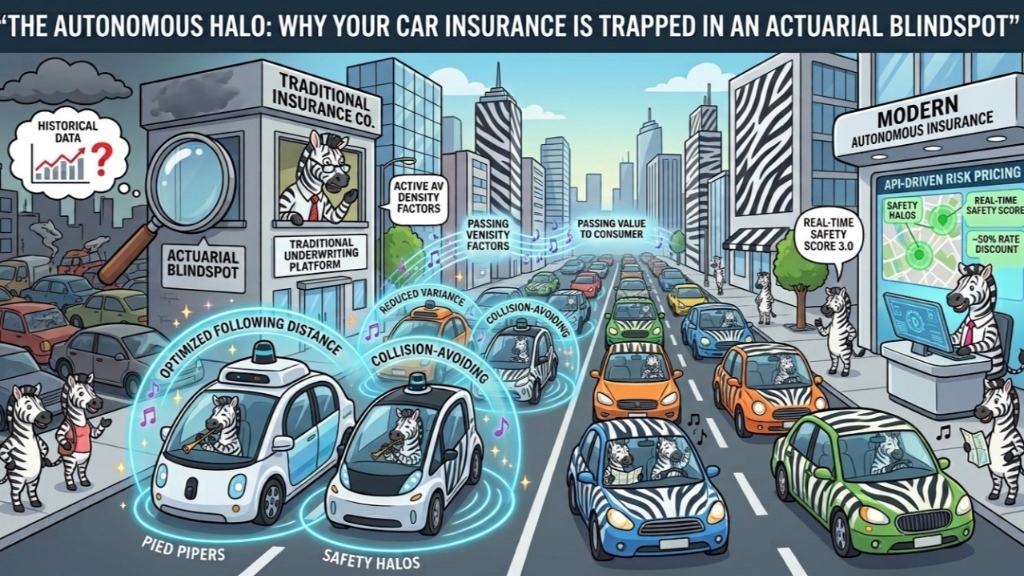
I know I write about Waymo a lot. You’ll have to give me some grace — I do work in car insurance, and during my four years at Google, I spent a lot of time in close proximity to the teams training those exact models. Plus, my day-to-day reality makes it impossible to ignore. I live in Miami, where the density of Waymos feels like it is doubling every single day. The Zebra is headquartered in Austin, Texas, where rider-only robotaxis are fully adopted into the fabric of daily commuting. And when I travel to the Bay Area for partner meetings, it feels like it’s getting hard to find an actual human driving anymore (I’m joking, of course, but the penetration is undeniable).
Back of a Waymo in Austin
Yet, when I was in New York City recently, the streets told a completely different story. Just a few weeks ago, New York opted not to renew Waymo’s testing permits. You don’t see them there. It’s a stark reminder of a thesis the tech analyst Ben Thompson recently popularized: humans will eventually stop fighting the encroachment of "data centers" only when those systems provide undeniable, localized opportunity and value to their daily lives.
Right now, the public treats autonomous vehicles like rolling data centers—intrusive, loud, and conceptually scary. But as an industry, we are sitting on a massive, data-backed mechanism to change that narrative. We have a clear way to pass immense safety savings directly to consumers through modernized, technology-driven underwriting. We just need the legacy insurance industry to step up and stop penalizing human drivers who live inside the autonomous halo.
Gemini: Datacenter on wheels
The Raw Data: Machine vs. Human
For years, establishing a statistically robust safety comparison between human drivers and autonomous vehicles was nearly impossible. Low-severity human collisions frequently go completely unreported to police, while autonomous operators are mandated by federal law to report even the most minor contact events under the National Highway Traffic Safety Administration’s (NHTSA) Standing General Orders (SGO).
To bypass this reporting bias, groundbreaking research conducted in partnership with Swiss Re utilized auto third-party liability insurance claims data as a proxy for at-fault collisions. Because liability claims require a clear financial recovery threshold to be met, they provide an un-skewed, responsibility-calibrated benchmark.
The results from analyzing 25.3 million fully autonomous, rider-only miles driven by Waymo across major municipal environments are staggering:
- Property Damage Liability: An 88% reduction in claims compared to the geographic- and mileage-calibrated human baseline.
- Bodily Injury Liability: A 92% reduction in claims. The autonomous fleet recorded only two bodily injury claims across 25.3 million miles, whereas human drivers under identical spatial conditions would be expected to cause 26.
Even when pitted against a more stringent baseline of newer, technologically advanced human-driven vehicles equipped with Advanced Driver Assistance Systems (ADAS), the autonomous driver still achieved an 86% reduction in property damage claims and a 90% reduction in bodily injury claims.
Furthermore, peer-reviewed data from the NHTSA SGO database confirms that autonomous systems achieve a 95% reduction in airbag deployment rates and 92% fewer pedestrian injury crashes. The machines aren't just avoiding minor fender-benders; they are virtually eliminating high-velocity, life-threatening impacts.
The Safety Spillover Hypothesis: Moving Beyond the Ego Vehicle
When an autonomous vehicle enters an urban grid like Austin or Miami, it does not operate in a vacuum. It actively alters the behavior of every human driver around it. This is known as the Safety Spillover Hypothesis, and it manifests in two distinct ways.
1. Traffic-Smoothing and Variance Dampening
Human driving profiles are notoriously volatile. Small braking events by a lead human driver amplify as they propagate backward through a queue, causing sudden "accordion-effect" stop-and-go waves that trigger standard rear-end collisions.
Car-following experiments demonstrate that vehicles equipped with automated longitudinal control act as a physical filter. Because autonomous systems maintain mathematically consistent, optimized following distances and possess sensor-driven reaction times, they absorb speed fluctuations. By decreasing overall lane-velocity variance, a handful of autonomous vehicles can stabilize traffic flow for hundreds of surrounding human motorists, lowering the probability of multi-car pileups.
Gemini: Safety Spillover Hypothesis
2. Physical Infrastructure Upgrades
Autonomous vehicle sensor suites require high-contrast, predictable, and physically standardized inputs to construct an accurate real-time map of the environment. To support autonomous deployment, forward-thinking municipalities are undergoing systematic physical and digital transformations that benefit everyone:
- Enhanced Lane Visibility: Upgrading faded lane lines to six-inch-wide, highly retroreflective markings, vastly improving night and wet-weather visibility for human eyes and machine vision alike.
- Predictive Maintenance: Municipalities are utilizing automated vehicle camera feeds to build high-definition road inventories, proactively repairing potholes and damaged signage before they escalate into human safety hazards.
The Actuarial Blindspot and the ADAS Paradox
If the data is this definitive, why are average annual full-coverage premiums in heavily penetrated cities still skyrocketing? Why aren't human drivers who share the road with these hyper-safe fleets seeing their rates drop?
The answer lies in the structural inertia of the traditional insurance industry, which remains trapped in a retrospective, "cost-plus" underwriting model.
Traditional carriers pool all losses within a given territory to calculate rates. The localized risk-reduction effect of sharing the road with safe, non-accident-causing robotaxis is entirely diluted by general urban loss trends like vehicle theft, localized vandalism, and rising litigation costs.
Compounding this is what actuaries call the ADAS Paradox. While advanced safety features demonstrably reduce collision frequency, they simultaneously trigger a drastic explosion in claim severity when an accident does occur.
A low-speed bumper impact that historically cost $500 to patch now routinely costs $4,000. Front bumpers, fenders, and side-view mirrors are now packed with delicate, highly exposed cameras, radar units, and ultrasonic sensors. Replacing these parts requires specialized diagnostic software, expensive proprietary alignment systems, and hours of high-rate technical labor to calibrate the hardware to the vehicle's central computer.
Furthermore, the proliferation of Electric Vehicles (EVs) in autonomous fleets introduces battery casing risks. A minor undercarriage impact can force actuaries to mandate a complete high-voltage battery replacement to mitigate thermal runaway fire risks, instantly turning a moderate repair into a $20,000 total loss payout.
The Mathematical Trap of Credibility Modeling
To be fair to enterprise actuaries, the hesitation to lower premiums is also a function of rigid mathematical guardrails established by the Casualty Actuarial Society (CAS).
When evaluating an autonomous fleet or an advanced driver platform, actuaries adjust the standard commercial auto loss severity using a multi-variable structural adjustment factor (S). This formulation directly targets tech-specific risks:
Structural Adjustment Factor Formula
Where V represents the velocity adjustment factor, C is the regulatory coverage limit factor, F is the vehicle form factor, O is the operational design domain (ODD) constraint, N is the occupant exposure, and A represents the autonomous behavior index (the mathematical elimination of distracted or impaired driving).
The breakdown occurs when attempting to apply Classical Credibility standards to determine if this adjusted data is statistically reliable. Advanced frameworks utilize the Mayerson, Jones, and Bowers Formula:
Mayerson, Jones, and Bowers Formula
Under real-world commercial liability parameters, this formula dictates that a fleet must log an astronomical number of claims to be deemed fully credible for independent ratemaking.
But here is the catch: both classical and Mayerson credibility formulas assume a stationary environment. In software-defined vehicles, this assumption is fundamentally broken. The moment an autonomous operator pushes an over-the-air (OTA) firmware update, the historical loss experience of "Version 1.0" becomes completely non-predictive of the safety performance of "Version 2.0." Legacy models are structurally incapable of handling code that evolves faster than the claims cycle.
The Shifting Frontier: API-Driven Risk Pricing
While legacy carriers remain paralyzed by the credibility trap, tech-forward insurance platforms are staging a direct, data-driven rebellion by integrating directly with vehicle APIs. Instead of pricing the driver’s demographics, they are pricing the software’s real-time operational state.
Tesla Real-Time Insurance amp; Safety Score 3.0
Tesla’s in-house insurance program bypasses traditional variables like credit scores or gender entirely. By utilizing the vehicle's native connectivity, Tesla calculates monthly premiums based on real-time telemetry—including hard braking, aggressive turning, and forward collision warnings.
To aggressively incentivize autonomous adoption, Tesla’s Safety Score 3.0 automatically assigns a perfect safety score of 100 to every single mile logged with Full Self-Driving (Supervised) actively engaged. The monthly premium is dynamically calculated using a mileage-weighted average of manual and autonomous miles, directly lowering the customer’s out-of-pocket costs for the subsequent 30-day period.
Lemonade Autonomous Car Insurance
In an even more direct challenge to legacy underwriting, Lemonade’s Autonomous Car insurance platform utilizes direct cloud-to-cloud integration with the Tesla Fleet API to price risk at the individual mile level.
Lemonade Underwriting Approach
By slashing the per-mile insurance rate by roughly 50% the exact second a driver engages autonomy, the platform aligns the financial incentive directly with empirical safety metrics.
The Road Forward: Regulated Reform of Territorial Rating
The physical reality of our urban centers has changed, but our regulatory frameworks are lagging behind. The safety dividend generated by autonomous vehicles and advanced driver platforms is currently being pocketed by traditional carriers to offset unrelated urban losses or inflate margins.
Safe human drivers and neighboring residents are being structurally penalized simply because they live in high-density zip codes, completely hiding the positive risk externalities that automated vehicles exert on the surrounding human driving population.
To resolve this inequity, state insurance commissioners should mandate that insurers incorporate AV Density Factors into their territorial rating algorithms. Under a reformed underwriting framework, the market penetration rate of autonomous vehicles within a metropolitan grid—verified via public fleet telemetry and aggregated telematics data—should trigger a mandatory premium credit for all policyholders garaged in that territory.
We must force traditional underwriting models to acknowledge that a human driver surrounded by predictable, non-distracted, collision-avoiding autonomous fleets is inherently insulated from risk.
If cities like New York are turning robotaxis away due to urban friction, the easiest way to regain public favor is to make the economic benefit undeniable. When sharing the road with an autonomous fleet directly lowers your monthly insurance premium, public resistance will evaporate. The "autonomous halo" is real, it is measurable, and it is time for the insurance industry to finally pass that value back to the consumer.
Thanks
As some bonus content for making it all the way through this math. Here’s a shot I took several years ago at the Computer History Museum in Palo Alto near the Googleplex of one of the first Waymo prototypes on the road.
Waymo: Computer History Museum