
The era of the "hands-off" executive is over.
As I wrote earlier this year in The Month AI Woke Up, we have entered a phase where the distance between an idea and a functioning prototype has effectively collapsed to zero. In this new agentic world, "vibe coding" — the act of using natural language to direct AI agents to build software — is no longer a niche hobby for early adopters. It is a core competency for any organization that intends to survive the next five years.
At The Zebra, we didn’t want to just talk about this shift. We wanted to institutionalize it.
That is why we launched Zebra Labs.
www.thezebra.com
Zebra Labs is our internal and external laboratory for AI experimentation. It is a space where we have invited every member of our "herd" — from senior software engineers to licensed insurance advisors — to stop being passive consumers of AI and start becoming builders.
The primary goal of Zebra Labs isn't to find immediate product-market fit or to shave 5% off our operating costs. It is to cultivate a "tinker culture." We believe that the companies that win in the AI era will be the ones that give their employees the space, the tools, and the permission to take things apart and see how they work.
The Lego Philosophy: Building a Tinker Culture
To understand why we are so obsessed with AI agents at The Zebra, you first have to understand our obsession with Legos.
Walk through our offices or join a virtual all-hands, and you’ll see them everywhere. Our CTO,
[
Gemma Ros
](https://www.linkedin.com/in/gemmaros?trk=article-ssr-frontend-pulse_little-mention)
, has a collection that would make a master builder jealous. Our VP of Engineering,
[
Brian Cronin
](https://www.linkedin.com/in/briancronin1?trk=article-ssr-frontend-pulse_little-mention)
, is the same. But it’s not just the leadership team; it is part of our cultural DNA. When someone does something truly exceptional at The Zebra, we don’t just send an email; we often commemorate the achievement with a Lego set.
During our all-hands meetings, it’s not uncommon to see a room full of people clicking bricks together while discussing our quarterly goals.
On the surface, it’s a fun perk. But at a deeper level, it’s a physical manifestation of the "tinker mindset." Legos teach you that complex systems are just a collection of small, well-defined parts. They teach you that if you follow a logic but allow for creative "remixing," you can build something far greater than the sum of its parts.
When we launched Zebra Labs, we realized that vibe coding with AI agents is essentially "digital Legos." You are snapping together prompts, APIs, and models to create something functional. If you can build a Lego Technic Porsche, you have the foundational logic to build an AI agent that triages security alerts.
By fostering a culture that celebrates the "tinker," we’ve made the transition to AI development feel less like a daunting technical hurdle and more like a natural extension of how we already work.
Zebra Labs: The Two-Sided Sandbox
We structured Zebra Labs into two distinct environments to ensure our experiments had both internal utility and external feedback.
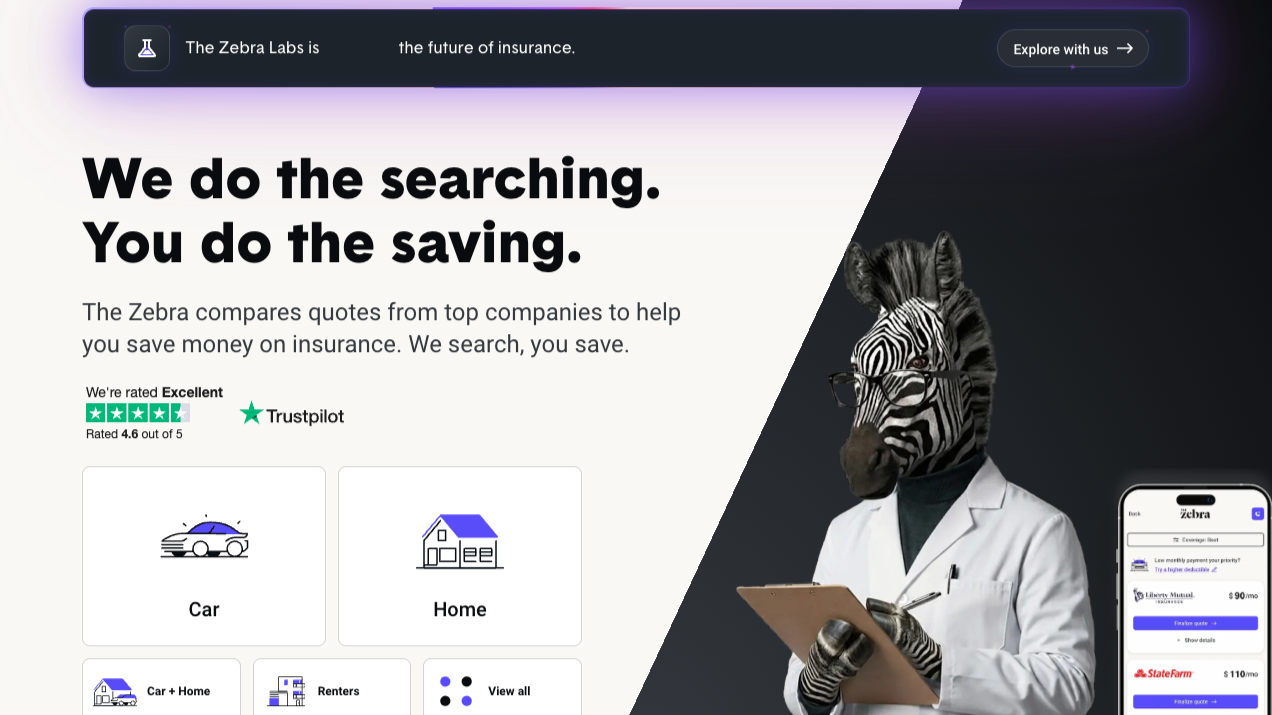
- The External Lab (labs.thezebra.com) If you visit our homepage today, you might find yourself part of a test group that sees a zebra in a lab coat. This is your invitation to explore our public-facing experiments. Here, we deploy tools designed to help customers navigate the often-confusing world of insurance. Whether it’s a tool to demystify policy jargon or a helper to organize a home inventory, these are "ephemeral" apps. They exist to help us learn what customers actually want from an AI-driven insurance marketplace.
labs.thezebra.com
- The Internal Lab This is where the real "vibe coding" revolution is happening. We’ve opened the gates to every employee to build tools that solve their own friction points.
To jumpstart this, we launched the Zebra Labs Prototype Incentive: a 90-day sprint where any employee can build and submit up to five solutions. If the Labs Executive Review Group approves the prototype, the creator receives a $1,000 bonus.
We are currently in Cohort 4, and the results have exceeded our wildest expectations.
What Happens When You Empower the Non-Coders?
The most profound realization of Zebra Labs is that the "technical barrier" was often just a gatekeeper for creativity. When we gave our non-technical teams access to vibe-coding tools, they built things that solved problems we didn't even realize were slowing us down.
The Agency’s Synthetic Training Tool
The Zebra is a marketplace, but we are also an agency. We have a massive team of licensed insurance advisors who talk to customers every day. Historically, training a new advisor meant shadowing live calls or using static scripts.
Our agency managers used Zebra Labs to build a Synthetic Chat Experience. Using AI agents, they created a "training bot" that simulates an upset or confused customer. New advisors can practice their de-escalation skills and policy explanations in a safe environment that feels incredibly real. This wasn't built by a product team in a six-month roadmap; it was built by the agency for the agency.
Compliance Guardian
In a regulated industry, compliance is often seen as the "brakes" on innovation. Our compliance team decided to turn that on its head. They built "Compliance Guardian," a tool that ingests the massive amounts of documentation required when we onboard new vendors. It rapidly flags risks and gets our teams up to speed in a fraction of the time. Two years ago, this would have been a standalone SaaS startup. Today, it’s a Labs project built by our internal team.
The Architecture of the Lab: How We Govern the "Vibe"
"Vibe coding" sounds chaotic, but to make it work at an enterprise level, you need a rigorous (but invisible) governance structure. We lean heavily on Google AI Studio and Gemini for our prototyping, but we’ve added our own "Zebra " flavor to the deployment.
1. The Skill Files
To ensure every project — no matter who builds it — is compliant, we use "Skill Files." Before an app is deployed to our Labs site via Firebase, we pull in a standardized skill file that:
- Automatically appends our Terms of Service and Privacy Policy to the footer.
- Ensures all logos and branding adhere to our design copyright standards.
- Tracks engagement using FullStory so our creators can watch how people actually use their tools.
2. The Lottery Test
We evaluate every submission against what we call the "Lottery Test" (others call it the "Hit by a Bus" test). If the creator wins the lottery tomorrow and leaves to travel the world, can another team member pick up the tool and use it? This ensures we aren't just building "spaghetti code" but creating repeatable, documented value.
3. Hard Rules on Data
In the insurance world, PII (Personally Identifiable Information) is sacred. Our governance rule for Labs is simple: everything in the external lab is ephemeral. Data must die when the session dies. This allows us to experiment with user experiences without the immediate overhead of long-term data storage and the PII conversations that come with it.
A Call for Help: The Version Control Challenge
I want to be transparent about where we are struggling. While vibe coding has accelerated our creation speed, it has challenged our versioning logic.
Right now, much of our agentic development lives in Google Drive and AI Studio rather than traditional Git repositories. It’s "remixable," but it isn't yet "versionable" in the way a traditional CTO would want.
If any of my former Google PM colleagues or industry peers have figured out a seamless way to maintain version control in a high-volume, agentic, "remix-first" environment, I’d love to hear from you. We are pushing the limits of what Google Drive can handle as a codebase, and we know there’s a better solution on the horizon.
The Executive Takeaway: Learning is the ROI
If you are an executive trying to figure out how to drive AI adoption, my advice is simple: Give them the space to tinker.
The natural curiosity that makes someone love taking apart a car engine or building a 4,000-piece Lego Star Destroyer exists in far more of your employees than you think. When you give them access to tools like AI Studio and Claude Code, and you back it up with a culture that rewards experimentation (and even failure), you don't just get new tools.
You get an organization that is no longer afraid of the future.
We aren't building Zebra Labs to find our next billion-dollar product (though we might). We are building it to ensure that when the next wave of AI transformation hits, our entire herd is already standing on the surfboard.