
Last week, I found myself operating at the absolute center of an industry crossover that likely contained a single person. My calendar was a chaotic mix of developer meetups at
, executive panels at the
conference, and casual evening happy hours during New York Fashion Market Week. To be completely clear, I am not a fashion executive; I was in town entirely to support my wife,
[
Lucila Tijman
](https://www.linkedin.com/in/lucila-tijman-073b2117?trk=article-ssr-frontend-pulse_little-mention)
, who has been a fashion buyer for over 15 years and is currently driving incredible work integrating AI into her buying strategies at
, which I admittedly know little about.
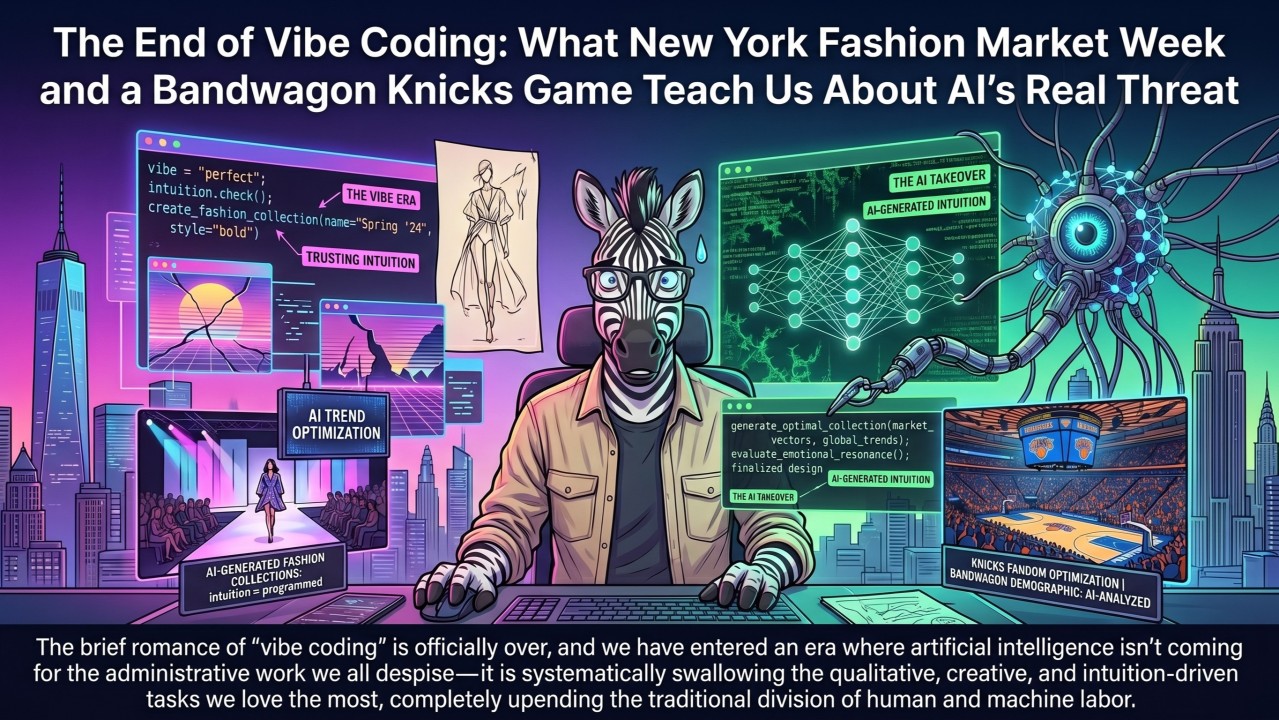
Floating between these completely disparate environments exposed a massive, industry-wide delusion. While insurance executives spent the week comforting themselves with the idea that AI is merely a back-office tool built to automate our most mundane, repetitive tasks, the reality unfolding across the technology frontier is far more radical. The brief romance of vibe coding is officially over, and we have entered an era where artificial intelligence isn't coming for the administrative work we all despise—it is systematically swallowing the qualitative, creative, and intuition-driven tasks we love the most, completely upending the traditional division of human and machine labor.
##
The Illusion of the Intuition Moat
At the ITI conference, a comforting consensus echoed through almost every conference room and panel: AI is an exceptional tool for processing the mundane, but insurance is ultimately a relationship business built on human connection. The prevailing executive view was that while an algorithm can process a basic claim, parse a carrier filing, or automate a spreadsheet, it can never replicate the trust, empathy, and qualitative judgment required to manage risk and build partnerships.
Insurtech Insights
But during the casual happy hours for New York Fashion Market Week, as I listened to my wife's colleagues discuss the retail landscape, I watched a parallel industry leaning on the exact same psychological security blanket. The fashion world has long treated taste as its unassailable human moat. A buyer’s entire career is defined by their qualitative, intuitive ability to look at a collection, predict what will be trendy six months from now, and figure out what their specific customers are going to like. Yet, as my wife's role at Shopbop demonstrates, advanced AI models are no longer just looking at static inventory spreadsheets. They are being utilized to analyze aesthetic patterns, parse complex visual data streams, and actively augment the buying process.
SoHo NYC
The disconnect between these two worlds is striking. While insurtech leaders treat qualitative judgment and relationship-building as a permanent shield against automation, fields governed by pure taste and trend-casting are already watching the machine encroach on their territory. It forced me to look closely at our own workflows and wonder where the real line between human intuition and machine capability actually sits.
##
Declaring the End of Vibe Coding
To understand why the industry's consensus is flawed, we have to look honestly at how AI is changing the actual practice of building software. Earlier this year, the tech world was captivated by the concept of vibe coding—the brief, magical honeymoon phase where non-technical employees and senior engineers alike could spin up functional applications simply by typing natural language goals into an LLM and managing the output. During our February 2026 Herd Huddle at The Zebra, we celebrated this explosion of creation, watching our teams build localized prototypes ranging from video-based property analysis apps to automated data extraction systems.
But as we look at the reality of software development today, the novelty has completely evaporated, and the phrase vibe coding no longer carries the weight it did. The era of simply chatting with a model to generate a localized prototype is over. We have transitioned past the phase of single, generalized conversational chatbots and have entered a highly disciplined reality governed by fully autonomous, interconnected agent ecosystems that execute complex engineering workflows from end to end. The uncomfortable truth about this shift is that AI did not take the boring parts of our jobs first. It took the parts we liked the most.
In our internal engineering workflows at The Zebra, we have realized that generative models excel at the initial creation phase—the deeply satisfying, creative process of writing fresh logic, structuring a codebase, and watching a new feature work for the first time. According to the landmark technical paper When AI builds itself Anthropic, this is no longer a localized trend. As of May 2026, more than 80% of the code merged into Anthropic’s production codebase is authored entirely by Claude.
NanoBanana 2.0. Source: Operational development shifts documented across frontier AI development loops
Look closely at what that leaves behind for the human professional. In engineering, it doesn't leave the joy of pure, creative authorship. It leaves the grueling, manual task of code review—sitting in front of a monitor for hours, reading through thousands of lines of machine-generated text, checking for edge-case security flaws, and ensuring compliance with rigid repository governance. The machine took the creative creation; the human inherited the administrative audit trail. We see the exact same pattern for analysts working in complex data sheets. Using modern systems like Snowflake Cortex, the AI instantly handles the formula creation and basic data joining—the parts of the job that feel like solving a satisfying puzzle. The human is left, at least in the medium term, with the far more difficult, grinding task of drawing localized business insights and manually auditing those automated outputs to ensure no hallucinated trends have corrupted the underlying operational strategy.
##
The Runaway Trajectory of Autonomy
The sheer velocity of this transformation hit me on a deeply visceral level during my time in New York. I got the opportunity to become a pseudo-Knicks fan for a night, standing outside Yankee Stadium directly underneath the elevated tracks of the 4 train. I was huddled together with a massive crowd of Bronx locals and baseball fans, standing on the pavement and screaming at a TV screen as we cheered on a thrilling Game 1 bandwagon victory over the Spurs.
Meta Ray-Bans: Knicks Game 1 in the Bronx
It was an experience of raw, unadulterated human connection—the exact kind of relationship-driven community moment that insurtech executives insist is the core of our business. Yet, at the exact same time, our industry received a massive wake-up call in the form of a public warning paper from Anthropic. The paper urged a serious global discussion around creating verification mechanisms to temporarily pause the development of frontier models because self-recursive improvement was unlocking entirely unexpected capabilities at a speed that Anthropic feels human institutions are utterly unprepared to control.
According to data within When AI builds itself by Anthropic, the length and complexity of tasks these models can reliably complete on their own has been doubling roughly every four months. In early 2024, a model could handle a software task that took a human four minutes; by today, they are managing 12-hour complex engineering tasks completely autonomously. Standard evaluation benchmarks like SWE-bench (real-world software engineering bugs) and CORE-Bench (scientific research replication) have been completely saturated by frontier systems in under two years.
NanoBanana 2.0: When AI Builds Itself
Even the argument that AI cannot replicate qualitative taste or operational judgment is actively being proven wrong. When tested on open-ended investigative research sessions where a human scientist took a wrong detour, Anthropic's Mythos Preview model suggested a superior next-step direction 64% of the time.
This creates a stark juxtaposition. On one hand, the traditional insurance industry claims AI only matters in places that are not relationship-driven. On the other hand, the front-runners of technology are proving that AI is rapidly automating both the mundane infrastructure and the high-level qualitative judgment we thought belonged exclusively to us. I find myself standing in a new kind of Venn diagram here: the middle who believes that AI is both world-changing and deeply disruptive to the human collaboration we value most. When work is completely automated, we risk losing the gift economy of small favors that builds corporate culture—the simple act of asking a peer for help with a script or a spreadsheet, which historically created a little mutual awareness, trust, and shared debt.
##
Adapt, Migrate, or Die: The Regulated Frontier
So, how do we operate in an environment where the doing—the writing of code, the creating of formulas, the running of experiments—now costs virtually nothing in human time?During a panel at the ITI conference,
[
Jennifer Linton
](https://www.linkedin.com/in/lintonjen?trk=article-ssr-frontend-pulse_little-mention)
the CEO of
dropped a biological truth that perfectly captured this moment. She drew on her past history of studying biology and stated flatly that our industry is currently in a technological climate where organizations are going to be forced to adapt, migrate, or die—yet so many leaders are actively refusing to recognize the shift. In that moment, listening to her speak, I realized I wasn't entirely alone in my perspective.
NanoBanana 2.0
At The Zebra, we are choosing to adapt by completely compressing and re-engineering the second half of our execution pipeline. We aren’t running away from the end of vibe coding; we are moving toward a highly structured architecture of specialized agentic networks and strict regulatory guardrails.
1. Self-Driving Guardrails
Because insurance is a heavily regulated market that directly impacts peoples financial lives, our autonomous network cannot be let loose without absolute oversight. We partner with specialized evaluation platforms to wrap our conversational models in an explicit agent harness. Before an AI agent ever interacts with a customer, it must survive an exhaustive gauntlet of thousands of procedurally generated compliance scenarios, graded across three non-negotiable metrics:
- Factuality: Verifying that explanations of complex policy terms—like actual cash value versus replacement cost—are correct.
- Compliance: Steering consumers to help them understand options without ever crossing the hard legal line into making an unlicensed, binding policy recommendation.
- Accuracy: Confirming that agents pull data exclusively from a single source of truth, like our centralized GitLab AI Configs repository, to eliminate hallucinations.
2. My Herd Orchestration (Auto Shop for Policy)
To completely demystify these agentic capabilities for our consumers, our design teams are structuring an approachable, mobile-first user experience where a customer can continuously have their policy, rate filings, and market offerings monitored to ensure their needs are being met.nbsp; At the top of the interface, a card features a real, licensed human advisor, reinforcing our clear operational philosophy: the agents act autonomously to scout the market, but the licensed professional holds ultimate accountability for the final execution.
3. Transitioning to True Generative UX
Once our backend agents handle the heavy lifting of data intake via Agent to Agent and policy demystification under strict guardrails, our front-end experience transitions entirely to Generative UX. We are moving away from static forms and moving toward interfaces that dynamically construct themselves in real time based on a users unique context. If a user needs a visual histogram to understand rate variance, the AI will generate it instantly; if they state they are standing outside looking at a new car, the interface will surface a camera tool to capture the license plate rather than demanding a manual 17-character VIN entry.
##
The New Horizon of Human Accountability
By handing the execution loops over to a secure, evaluated system of specialized agents, we dont diminish the human role—we elevate it. Our licensed advisors no longer need to spend their days on repetitive data entry or baseline terminology education. By the time a customer is seamlessly handed off to a licensed human expert at The Zebra, the knowledge gaps are mapped, the data is verified, and the advisor can focus entirely on applying true licensed expertise to deliver a trusted, compliant recommendation.
The companies that will survive and thrive in this post-vibe-coding world are the ones that refuse to hide behind the comfortable myth of an unassailable human moat. The technological climate has shifted permanently. The perspiration of knowledge work is being automated, and our success will be dictated entirely by our willingness to build rigorous, continuously evaluated systems that elevate human direction while protecting absolute human accountability.