
Warning: This post is a bit more technical than some of my others.
I spent last week in San Francisco with four of my teammates, navigating the familiar, high-vibration energy of the Valley. Between meetings with foundation model teams at Google and OpenAI and a quick stop at Y Combinator, we managed to catch a Giants game at Oracle Park. There’s something deeply satisfying about the math of baseball — the raw velocity of a pitcher's arm meeting the intricate design of the catcher’s framing and the defensive strategy behind it. As we sat in the stands, it struck me that we are currently watching a similar game play out in the AI industry: a battle between the raw power of the "engine" and the intricate design of the "frame" that holds it all together.
In my recent conversations with previous colleagues over happy hours near the Embarcadero, one topic kept rising to the surface: the model harness. We are moving past the era where a bare model inference is enough to provide value. Today, every major player is racing to wrap their models in increasingly sophisticated agentic layers. Anthropic has one; OpenAI has one; Google has one.
Langchain: The Anatomy of an Agent Harness
The prevailing hypothesis in the industry is that in the very near future, foundation models will perform exponentially better when paired with the proprietary harness built by their own creators. If you want to squeeze every drop of performance out of an Opus model, you’ll likely need to run it within an Anthropic-designed harness. This shift represents a fundamental change in how we think about AI architecture, and for organizations like The Zebra, it raises a critical question: how do we build for performance without falling into the trap of absolute vendor lock-in?
The main point is this: To win in the agentic era, organizations must stop obsessing solely over which model "engine" they use and start focusing on the "harness" that directs its power—ensuring they own the durable expertise while leveraging the specialized frames of the model providers.
Defining the Harness: Engine vs. Frame
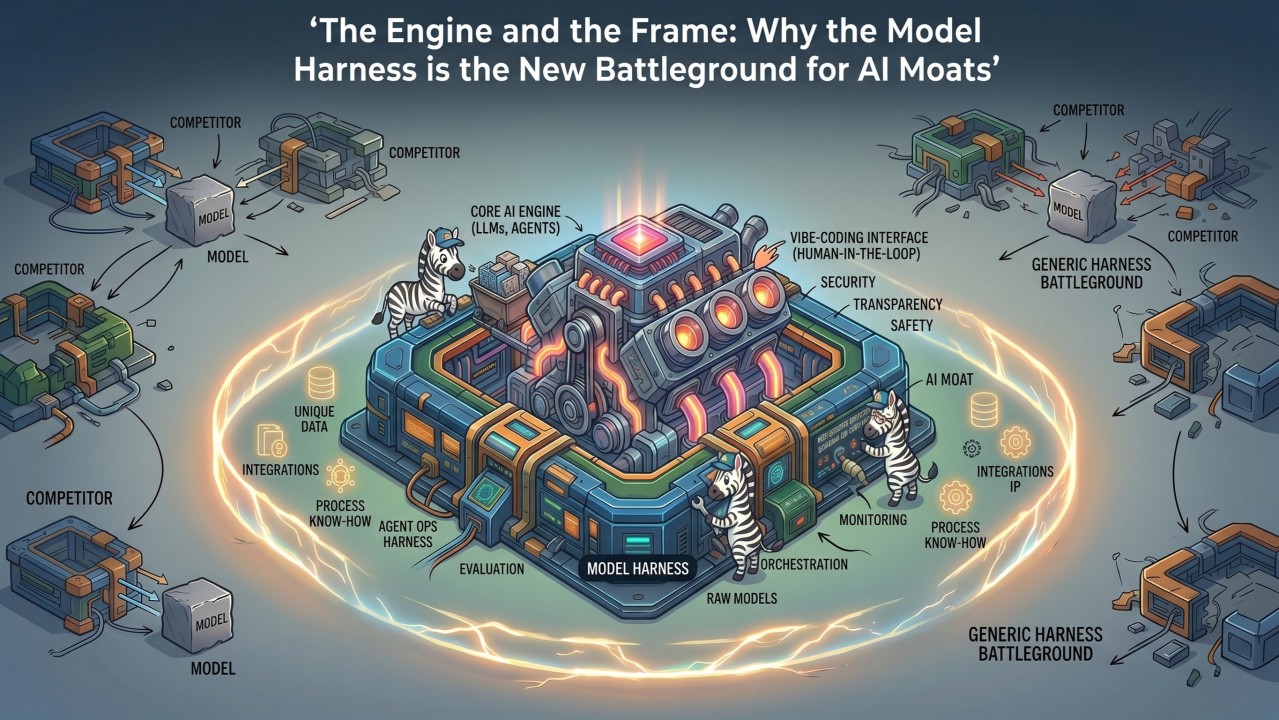
To have this conversation, we first need a shared vocabulary. If the Large Language Model (LLM) is the engine—the raw, internal combustion of tokens and probabilities—then the harness is the frame of the car.
Nano Banana 2
The engine is useless without the chassis, the steering column, the fuel lines, and the dashboard. In AI terms, the harness consists of the system prompts, the retrieval pipelines, the custom agent loops, and the secure sandboxes that allow the model to actually touch the file system or execute code. It is the "hands" that give the "brain" the ability to do real work.
Currently, the industry is witnessing an explosion in the size and complexity of these harnesses. There are rumors circulating in San Francisco that some foundation model companies are now running master system prompts that are upwards of 10,000 lines of code. Whether you consider a massive system prompt to be part of the harness or part of the model itself is a matter of architectural debate, but the trend is clear: the layer of logic "managing" the AI is getting fatter.
The Fat Harness Trap
This brings us to a concept articulated by my close friend and former Google colleague,
[
Ben Mathes
](https://www.linkedin.com/in/benmathes?trk=article-ssr-frontend-pulse_little-mention)
, in his recent piece on the "Fat Harness" trap, "Fat Prompt, Thin Client, Joined Backend". Ben warns that it is a natural temptation to build a "Rube Goldberg machine" of intricate logic to manage an AI’s behavior. These massive harnesses are impressive to demo, but they are incredibly fragile.
Every few months, a new model ships that makes yesterday's hand-engineered workarounds redundant. If you build a fat harness designed to solve for an 8K context window, and the next model release offers a 2-million-token window natively, your intricate logic becomes "dead weight" overnight.
Worse, fat harnesses create a form of "expertise rental." If your organization's business logic is buried in a proprietary vendor’s memory format or a hidden "learnings" directory controlled by a specific tool, you are effectively renting your own domain knowledge back from that vendor. When a 10x better model ships, you can't just move your knowledge with you—you're locked in.
The Zebra’s Big Bets: Nashville Insights
I was in Nashville this week for the Insurance Innovators conference, sitting on a fireside chat panel with Eileen Potter and Inchun Lai. It was a bit of a surreal moment — the spotlight on my face felt more like high school theater than a tech keynote. The audience wanted to know: where is The Zebra placing its bets in this volatile landscape?
Insurance Innovators
From a business perspective, our bets are focused on customer context and advisor supercharging. We are investing heavily in what we call our "personalization agents"—tools that allow our licensed advisors to move faster by surfacing the exact policy data they need at the exact moment they need it. We are analyzing an unprecedented amount of policy data to ensure our customers always have the right policy for their unique risk profile.
But from a technology perspective, our biggest bet is on building our own model harness — and making it significantly robust.
This might seem to run counter to the "Thin Client" philosophy, but there is a nuanced middle ground. While we want our runtime to be high-performance and lightweight (the "hands"), we want our organizational integration to be "thick." We aren't building complex "If/Then" logic that a future model will replace; we are building a unified, canonical backend that knows everything we know.
The Integration Moat: Thick Backends and Synthetic Evals
The true moat isn't in a clever system prompt or a fancy agent loop. It’s in the data. Every organization suffers from the same "disease": data scattered across silos — Salesforce, QuickBooks, Slack, and internal databases — all described in different schemas.
Your AI needs to know what you know. At The Zebra, we are investing in a Thick Backend — a cleaned, integrated infrastructure that presents a unified view of the customer across all those silos. This is the unsexy, essential work that determines if your AI is actually informed or just "YOLO'ing" all its data into a 30MB PDF upload and suffering from context rot.
Coupled with this is our second big technology bet: Synthetic Evaluations. As I’ve discussed in previous posts, we don't just "hope" our agents are compliant. We treat conversational AI with the same rigorous safety standards that engineers apply to self-driving cars. We run our harness through thousands of simulated customer interactions — our industry's equivalent of LiDAR sensors — to see the "stop signs through the trees."
Portable Expertise vs. Integrated Performance
The tension of the next twelve months will be balancing the need for portable expertise with the reality of integrated performance.
We are currently seeing the emergence of Fat Prompts — 2-page design docs or markdown files that describe a high-value skill or business process in raw text that you own. These "fat skills" are the durable assets of your organization. They can survive model migrations and vendor shifts because they live in your version control, not a hidden proprietary directory.
However, we must also acknowledge the "SF Hypothesis": that foundation models will eventually run better inside their own manufacturers' "frames." To navigate this, we are building a harness that is highly modular. It is designed to be the "hands" that can plug into an Anthropic frame today, a Google frame tomorrow, or an OpenAI frame the day after, all while pulling from the same "thick" organizational brain.
Looking Ahead
As the "month AI woke up" transitions into a year of autonomous execution, the distance between an idea and a production-ready tool is now measured in seconds. But speed without stability is just a faster way to hit a wall.
We are entering an era of "Herds of Agents" where the value isn't in a single chatbot, but in the networking between them. The winner won't be the person with the cleverest prompt, but the organization that has built a robust harness capable of coordinating these agents while maintaining human accountability.
We are placing our bets on fat skills, thick backends, and a modular harness that prioritizes transparency and compliance over flashy, fragile logic.
To my peers across the industry: Are you building a Rube Goldberg harness that will be redundant by the end of the year, or are you investing in the durable infrastructure of your organizational knowledge?
What does your current AI harness look like—is it a lightweight runtime for your data, or a complex machine of workarounds?