
Every summer, a group of my fraternity brothers and I pack our bags for an annual trip we affectionately call the "Bear Hunt." Despite the name, no actual wildlife is harmed. It is a golf trip that is, for all practical purposes, everything but a golf trip.
We converge on a buddy’s small cabin tucked away in a quiet town in Mississippi. Somewhere between 15 and 20 grown men crowd into a modest three-bedroom house, sleeping on air mattresses, couches, and whatever floor space is left. We grill, we watch reruns of old football games, we play corn hole, and we spend hours talking about life, careers, and the curveballs adulthood throws at us. Yes, we play a few rounds of golf, but only a handful of us are actually any good. The rest play once a year, and a few guys don't even swing a club, they just ride in the carts. The entire point of the weekend isn't to optimize our handicaps; it is to slow down, drink a beer, and relate to each other.
Bear Hunt Golf Trip 2024
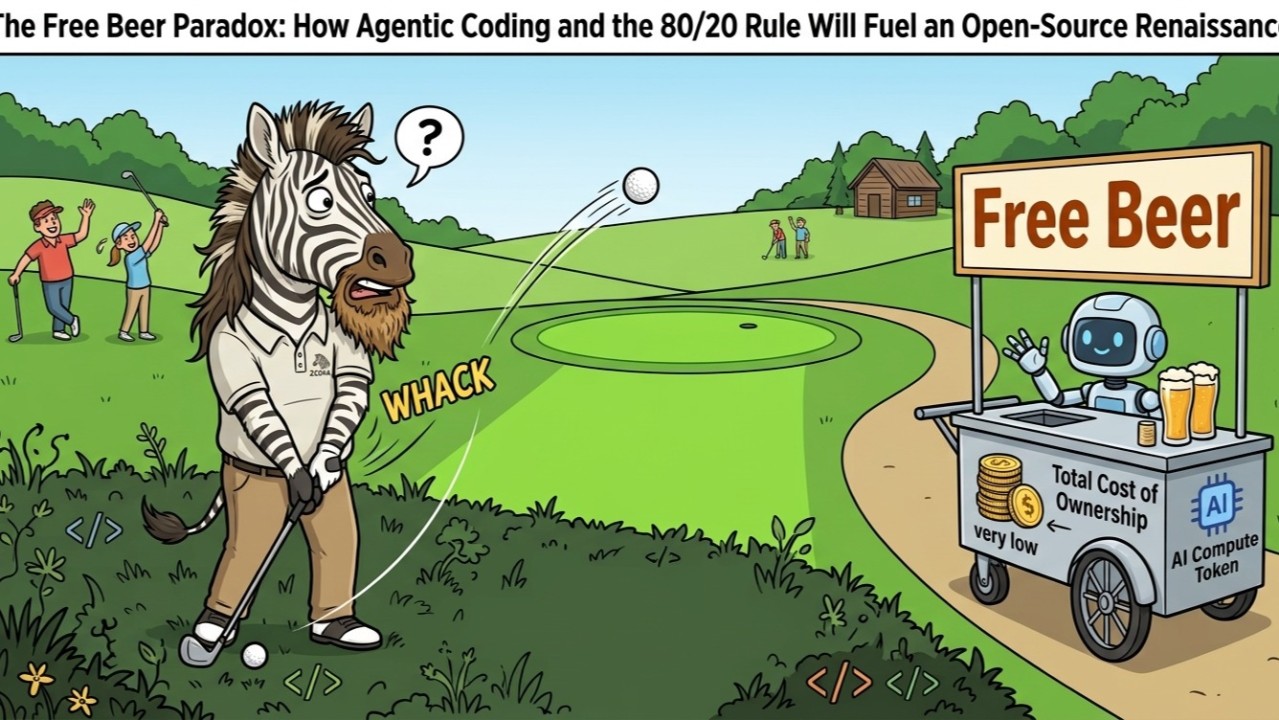
As I prepare for this year’s trip, I find myself thinking about the changing economics of that beer, and how it mirrors a structural shift happening right now in software development. As agentic coding tools turn software generation into a virtually infinite resource, we are moving from an era where software is merely "free as in speech" to one where it is literally "free as in beer." This paradigm shift means roughly 80% of enterprise software will become entirely commoditized open-source infrastructure. To survive, organizations must stop over-optimizing their baseline technology stack and focus entirely on the special 20%—the proprietary customer experience that builds genuine trust and differentiation.
The True Cost of Free Beer
When I was in college, I spent five years earning my degree, four of which lived inside the fraternity house. That timeline should tell you everything you need to know about my academic focus back then. In those days, a case of beer cost exactly $10.35. Surprise: it was never the 35 cents in that equation that was hard to find.
When you are a broke college student, the concept of "free beer" sounds like the ultimate economic utopia. It was during those same college years that I was first introduced to the philosophies of the Free Software Foundation and its founder, Richard Stallman. I know what you’re thinking — the resemblance is striking.
Stallman and the early pioneers of the open-source movement famously established a foundational adage to explain their philosophy: "Free software is a matter of liberty, not price. To understand the concept, you should think of free as in free speech, not as in free beer."
https://www.azquotes.com/quote/867098
For decades, that distinction was an absolute truth. Open-source software gave you the freedom to modify, share, and control the code (free speech), but it wasn't a finite, costless resource (free beer). You still had to hire expensive engineering teams to configure it, maintain it, squash bugs, and scale the infrastructure. The "total cost of ownership" remained incredibly high.
But today, our relationship with agentic coding platforms has shattered that old assumption.
With autonomous AI agents capable of writing, debugging, refactoring, and deploying code from simple natural language prompts, the marginal cost of creating software is plummeting toward zero. Software is no longer a scarce resource bounded by human typing speed or engineering capacity.
Because we can now produce code deterministically and endlessly, the open-source movement is about to experience a massive renaissance. We are entering a world where you get the ideological freedom of open source and the economic reality of free beer.
The Jevons Paradox of Software Abundance
Sitting around the campfire with my fraternity brothers these days, the dynamics are entirely different. The beer has gotten significantly more expensive, and honestly, we don’t drink nearly as much of it as we used to because the hangovers hurt a lot worse than they did in our twenties. However, because we are no longer cash-strapped college students, we have significantly more resources. Relative to our incomes, the cost of that beer has become negligible. It is essentially free for us.
This economic shift forces a fascinating question that economists call the Jevons Paradox.
Originally observed during the Industrial Revolution, the paradox states that as technological progress increases the efficiency with which a resource is used, the total consumption of that resource tends to go up, rather than down. For instance, as steam engines became more fuel-efficient, society didn't burn less coal; we burned exponentially more because efficient coal became viable for thousands of new industries.
Traditional vs Agentic Development
Applying this to our new reality: because software will become incredibly cheap and efficient to produce, will we choose to write exponentially more of it? Will our digital ecosystems explode with bespoke, hyper-localized applications tailored to every micro-task imaginable?
Or, conversely, when software becomes entirely free and ubiquitous, will we lose our collective infatuation with the act of creation itself? When anyone can spin up a functional app in thirty seconds by simply talking to an agent, code loses its novelty. We may find ourselves entering a state of code fatigue, shifting our appreciation away from the software itself and back toward the human problem it is trying to solve.
The 80/20 Trap: Optimizing the Wrong Metrics
In a recent piece by Scott Galloway (Prof G) regarding the concept of optimization, he explored how the classic 80/20 rule governs so much of our lives and businesses. If you try to aggressively optimize 100% of your existence, your relationships, or your company's processes, you inevitably strip away the magic. You end up living a highly transactional, rigid life.
The same trap exists in enterprise technology architecture.
I hypothesize that in this new agentic landscape, 80% of software will become purely commoditized, optimized infrastructure. This is the baseline code that keeps the lights on—the databases, the standard user authentication gates, the basic reporting pipelines. It is highly predictable, repetitive, and entirely non-novel.
If enterprise leaders fall into the trap of spending their valuable human capital trying to custom-build, optimize, and maintain that 80%, they will completely miss out on the remaining 20% where the actual value lies.
In college, my friends and I chased the idea of cheap or free beer because our pockets were empty. But looking back, the actual liquid in the cup didn't matter at all. The real value — the part that crafted lifelong relationships and built the foundational trust we still lean on today — was the 20% of time spent laughing, arguing, and just being present around the table.
In business, the 80% is the beer; the 20% is the relationship. If your engineering teams are drowning in the 80%, your product will suffer.
Bear Hunt Golf Trip 2025
The Business Nobody Wants to Be In
A perfect example of this paradigm played out recently in a conversation I had with the team at
, one of our key vendors at The Zebra specializing in AI-driven transcript and conversation analysis.
We were reviewing our stack, and I asked their GTM lead which telephony systems and Customer Relationship Management (CRM) platforms Cresta natively supported.
He smiled and said, "Daniel, we support all of them. Salesforce, HubSpot, custom legacy setups—you name it."
I pushed him a bit further. "Well, if you guys have deep visibility into how all these systems interact with customer data, when are you going to build your own CRM or your own telephony platform?"
His response was immediate and telling: "Oh, that's completely outside the scope of what we want to do. It’s simply not the business we are trying to get into."
Because I’ve built a relationship with the team, I knew exactly what they meant. But it sparked a deeper realization for me: in a "free beer" world driven by agentic AI, those foundational layers are the businesses that nobody should want to be in.
Why should a company spend millions of dollars licensing a massive, proprietary CRM or building a bespoke internal communication routing system from scratch? That first 80% of functionality is entirely unoriginal. The code required to move a customer record from Column A to Column B, or to route a voice call to an available agent, is a solved problem.
In the very near future, enterprise CRMs and telephony systems should—and likely will—move entirely to community-driven, open-source models managed by autonomous agents. Why? Because that code can be collectively open-sourced, continuously maintained by AI, and shared across industries for free.
The value isn't in the database structure; the value is in what you do with the data.
A vendor like Cresta understands this perfectly. They don't want to build the plumbing (the 80%); they want to build the intelligence layer that sits on top of the plumbing (the 20%). Their special sauce is analyzing the nuanced human interaction within a conversation to help an advisor better serve a customer. That is where differentiation lives.
Gemini: Crumbling Legacy CRM to Open Source
How The Zebra Protects the 20%
At The Zebra, this philosophy directly dictates our AI product roadmap. Our core mission is to bring transparency, simplicity, and clarity to the deeply confusing and highly fragmented world of insurance shopping.
The legacy approach to building an insurtech platform required thousands of engineering hours dedicated strictly to the plumbing: writing custom API connectors for dozens of different carriers, structuring massive data tables to hold insurance rate filings, and building standard form fields to capture user data.
But as agentic tools completely commoditize that baseline data integration, we aren't interested in over-optimizing the plumbing. We want to let the AI handle the "free beer" infrastructure so our team can obsess over the human experience.
Our 20% is the consumer journey. It is about building an experience that doesn't just spit out a random list of numbers, but genuinely helps a user understand their financial security and buy a policy.
- Intelligent Demystification: Utilizing AI not to supplement advisors by gathering deep, structured context so that when a consumer speaks to a licensed professional, the tedious intake work is already done.
- Generative Experiences: Building dynamic interfaces that adapt instantly to how a specific customer processes financial information — whether they need a visual chart, a simple summary, or a deep dive into policy exclusions.
- Deterministic Trust: Ensuring our AI systems operate within a heavily monitored harness of automated evaluations ("evals") so that every interaction remains strictly compliant with state insurance regulations.
By letting the commoditized 80% of our codebase be accelerated and maintained by agentic models, we free up our cognitive capital to focus on building an execution layer that our consumers and insurance partners can trust unconditionally.
Looking Beyond the Horizon
As I pull up to the cabin in Mississippi this week, step out of the car, and see the same familiar faces I’ve known for decades, I’m going to enjoy a very cheap beer. But more importantly, I’m going to enjoy the unstructured, unoptimized, non-novel hours of sitting on a porch talking with my friends. The tech industry needs to embrace a similar willingness to let go of its obsession with proprietary plumbing.
We are standing at the dawn of an open-source renaissance where software abundance will force us to re-evaluate what actually constitutes intellectual property. The companies that thrive in this post-adoption landscape will not be the ones with the largest proprietary codebases or the most optimized internal CRMs.
The winners will be the organizations that recognize code has become a commodity, enthusiastically drink the "free beer" provided by the open-source community, and dedicate every single ounce of their creative energy to perfecting the unique 20% that solves real human problems.