
from Snowflake perfectly captured the excitement of "vibe coding" when he joked that he now has insomnia because he can suddenly build tools without writing code. But it was a comment from
[
Chris Rivers
](https://www.linkedin.com/in/chris-rivers-8b6b1820?trk=article-ssr-frontend-pulse_little-mention)
, Founder of The Autonoma, that really stuck with me. Chris pointed out a critical risk in the agentic AI consensus: we must remember that "autonomous action and autonomous accountability are not the same thing".
That vital distinction — balancing autonomous capabilities with absolute accountability — is exactly what I want to explore today.
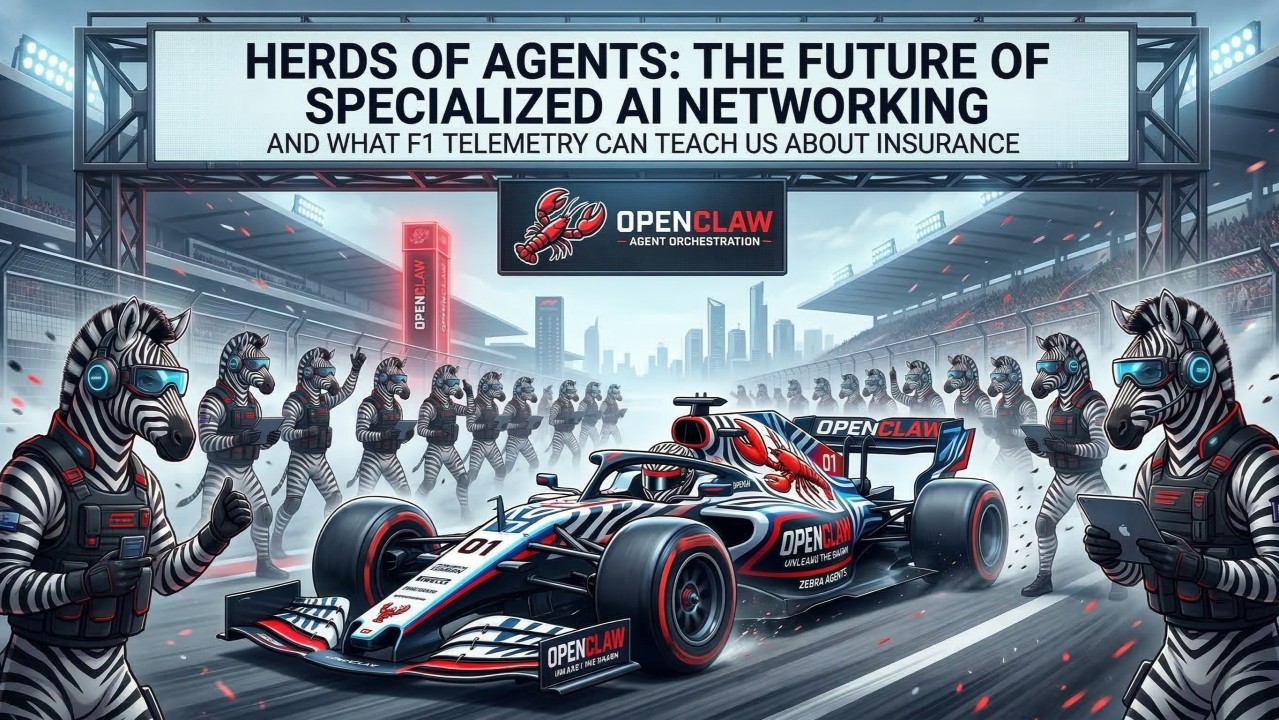
We are moving past the novelty of single, generalized AI chatbots. As evidenced by Meta's fascinating acquisition of Moltbook last week — a platform with absolutely zero human users but 1.5 million AI agent users — the future lies in interconnected ecosystems. We are entering the era of "Herds of Agents," where highly specialized micro-agents interact, learn from one another, and execute complex workflows.
To understand how this specialized agent networking will transform a highly regulated industry like insurance, I’m proposing that we first look at something seemingly unrelated: Formula 1 racing.
The F1 Telemetry Problem: Why General AI Isn't Enough
This past weekend was my seven-year wedding anniversary, and we celebrated with family time. It also happened to be the weekend of the 2026 China Grand Prix, the first time F1 has raced in China in a couple of years. Because the race was broadcast at 3:00 AM my time, watching it live was impossible.
However, trying to watch a replay of a highly publicized sporting event without having the results spoiled is a minefield. You can’t casually browse Reddit or Twitter to see what the community is saying without accidentally discovering the winner. Plus, I didn't want to watch the standard 30-minute abridged recaps that Apple produces now that they own the F1 rights; I wanted to experience the strategic ebb and flow of the actual race, but I didn't have all morning to watch the full broadcast.
To solve this, I turned to "Dom," my personal OpenClaw agent running directly through my Telegram app.
I prompted Dom: "I'm watching the F1 race from China last night. Don't tell me the results as I want to watch it. I'm on lap 26 right now and things are a bit slow, what lap should I fast forward to?".
OpenClaw via Telegram: First Prompts
Initially, the agent failed the precision test. It gave me a generic recommendation to fast-forward to lap 40 or 45, stating that F1 races often get more intense in the later stages due to tire degradation and strategy. I pushed back, asking if this was a generic assumption or specific to the 2026 China Grand Prix. The AI admitted it was a generic response and didn't have the real-time data.
After prompting the agent to conduct targeted web research for the specific 2026 race, it found that a "thrilling battle for the podium positions" occurred and adjusted its recommendation to around lap 35-40 onwards. But when I skipped ahead, I missed a highly interesting wreck involving Colapinto on Lap 34.
OpenClaw via Telegram: Recommendations
This interaction highlighted a massive limitation in generalized AI: when dealing with highly complex, dynamic data, a general-purpose model guessing at an answer is not just unhelpful. Instead, it’s a failure of the use case.
Building a Specialized Data Retrieval Agent
To ensure this never happened again, I decided to build a highly specialized agent whose sole purpose was analyzing race data.
Right there in my Telegram chat, I instructed my OpenClaw agent to create a dedicated context file specifically for F1 recommendations (/.openclaw/workspace/memory/f1-recommendations.md). We established three core rules: No spoilers ever, precision over generality, and learning from feedback.
OpenClaw via Telegram: Scaled Agents
Then, I had the agent switch its backend coding model to Gemini 3.1 to write a Python script (get_f1_race_data.py). This script was designed to autonomously fetch live telemetry and timing data from TracingInsights.com, carefully parse the lap-by-lap data for passes, penalties, and key incidents, and do it entirely without spoilers. We even set up a cron job on my Mac Mini so that at the end of every future race, this data extraction happens automatically.
I now have a deeply specialized, autonomous agent that I can converse with to navigate the complexities of race day.
The Pivot: From Racetracks to Regulated Markets
OK so now you’re probably thinking: "Daniel, this is a cool weekend project, but what does F1 telemetry have to do with being the Chief AI Officer at an insurtech company?"
The answer is everything.
I realize it might feel like a stretch, but race telemetry data is not all that far off from the complexities of tracking dynamic insurance markets. Insurance pricing is an incredibly complex, constantly shifting matrix of risk factors, carrier filings, changing regulations, and consumer life events.
If I can use an agentic platform to build a highly specialized, autonomous tool to parse F1 telemetry and safely guide my viewing experience, imagine the incredible herd of AI tooling agents we can build to help consumers navigate one of the most complex financial decisions of their lives.
Instead of deploying one massive, generalized "Zebra Bot" that might confidently hallucinate a coverage recommendation (much like my agent initially guessed about Lap 40 of the Grand Prix), we are moving toward a specialized network architecture. We want a system of focused micro-agents, each trained on specific streams of data, working in concert.
Designing "My Herd": Balancing Autonomy with Accountability
This concept of specialized AI networking directly addresses Chris Rivers' point from my last article regarding "autonomous accountability." In a heavily regulated industry like insurance, we cannot just let autonomous agents loose without oversight. We must design for trust, safety, and compliance from the ground up.
To execute this, our design teams are already conceptualizing a mobile-first user interface we are internally calling "My Herd." This interface completely demystifies agentic AI by giving users clear visibility and control over specialized tasks.
My Herd: Nano Banana 2.0
Here is how we are structuring this responsible AI experience:
- The Herd Manager (Human Oversight): At the top of the interface, the user doesn't just see code; they see a reassuring card featuring a real, licensed human advisor (e.g., "Sarah, Your Dedicated Advisor"). The copy reinforces accountability: "Your herd is out scouting the market. I'm right here monitoring their findings to help you get great coverage." The AI acts autonomously, but the licensed professional is accountable for the final execution.
- The Scouting Post (Pre-Built Specialists): Instead of a blank prompt box that leaves users guessing, we offer pre-defined, highly specialized agent templates. Users can deploy "The Deal Hunter" to track specific pricing for their exact coverage, "The Timekeeper" to alert them a month before a policy expires, or "The Rate Sentinel" to monitor their specific carrier for newly filed rate changes.
- Custom Agent Builder: For power users, we provide a natural language OpenClaw-style prompt interface to build custom parameters, allowing the AI to mold to their unique risk profile.
- Active Herd Monitoring: Users can view their deployed agents as a visually engaging carousel of stylized zebra icons, glowing to indicate when an agent is actively "scouting" or has found an "alert," with simple toggles to pause or retire them.
Ok, I’ll admit — I haven’t run these designs by our product designers, so don’t hold me to these visualizations! But you get the idea.
By wrapping these powerful agentic capabilities in our signature bold black and white branding with electric blue and neon green accents, we make the abstract concept of AI approachable, engaging, and above all, safe.
The Future is Interconnected Agent Networking
This brings us back to last week's news about Meta acquiring Moltbook and its 1.5 million AI agent users. The true power of the "My Herd" concept is not just that a user has multiple agents working for them, but that these agents can securely communicate with other agents across the digital ecosystem.
Imagine a future where you are shopping for a new vehicle. You might utilize an autonomous AI agent to negotiate the purchase price with a dealership. Because of specialized data networking, your car-buying agent could securely pass this context — the exact make, model, VIN, and your financing structure — directly to your specialized "Zebra Rate Sentinel" agent.
Our agents would instantly cross-reference that vehicle data against millions of rate permutations, calculate proposed coverage limits based on your unique financial profile, and present a fully bindable policy to your human Herd Manager for final review.
There is zero friction. There are no massive forms to fill out. The agents learn from each other, share secure context, and execute the heavy lifting, completely removing the traditional roadblocks of the consumer journey.
Looking Ahead
The transition from single conversational chatbots to specialized, interconnected "Herds of Agents" will redefine our digital lives. Whether it’s tracking the telemetry of a Formula 1 race to optimize your Sunday morning or tracking the intricacies of auto insurance carrier filings to assist your monthly budget, agentic networking is the ultimate equalizer.
At The Zebra, we are committed to building these specialized tools in a way that prioritizes transparency, regulatory compliance, consumer trust, and human accountability. We are not just adopting AI; we are engineering herds of specialized agents that actually understand the assignment.
To my peers reading this: How is your organization managing the shift toward specialized micro-agents? Are you exploring how your AI tools might soon need to communicate not just with human users, but with other autonomous agents?