
The velocity of technological change in mid-2026 has introduced a profound paradox to executive leadership: how do you execute long-term quarterly planning when your underlying technology stack can iterate in a matter of hours?
In the era of autonomous AI agents, traditional roadmap planning requires a radical structural shift—a "moving fast and thinking slow" architecture that pairs rapid, low-barrier prototyping with a complete overhaul of foundational legacy systems. We can no longer afford to build software on rigid, linear transactional frameworks. Instead, winning organizations must design deep, systemic customer architectures capable of supporting fluid, interconnected agent networks.
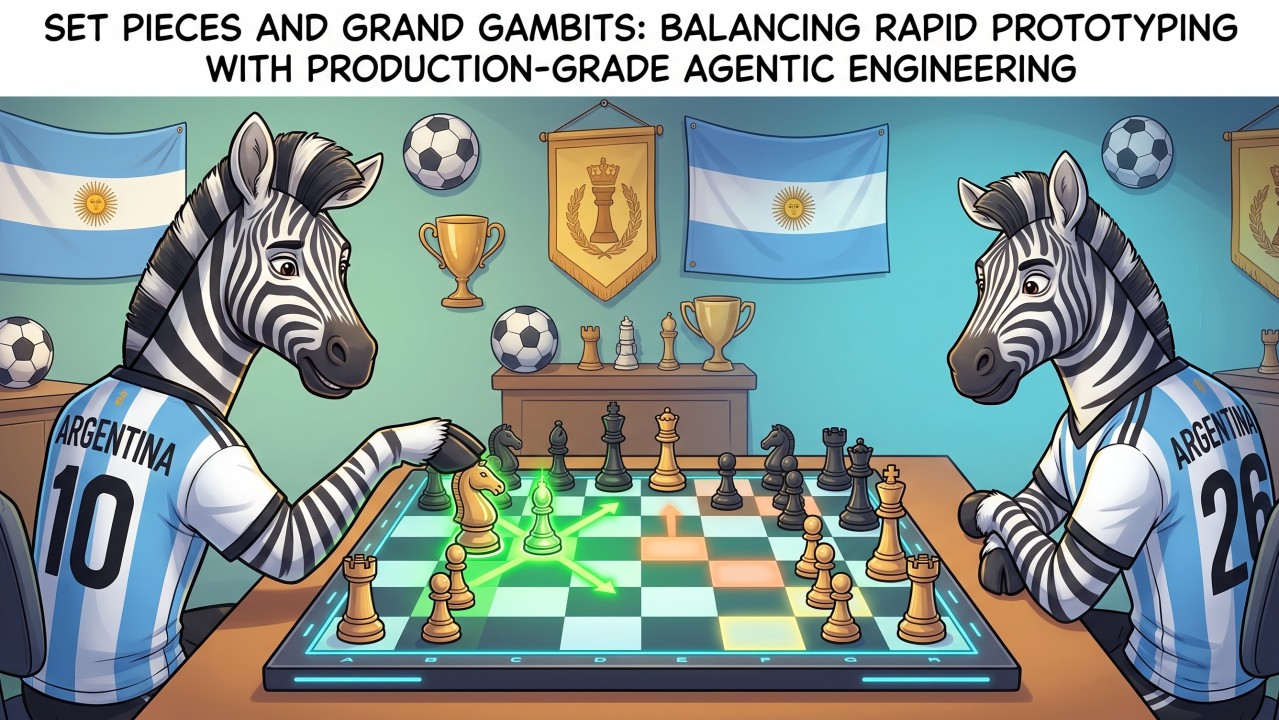
This tension between immediate innovation and infrastructural endurance is the defining challenge for today's technology leaders. To understand how we are navigating this balance at The Zebra, we have to look entirely outside the realm of insurance and focus on two battlegrounds of pure strategy: a living room chess board and the pitches of the 2026 World Cup.
The ChessUp 2 Paradox: Real-Time Assistance vs. Systemic Depth
My five-year-old daughter, Isabella, recently started taking chess lessons. As someone who has loved the game since childhood, despite being arguably quite terrible at it (I am comfortably hovering at a humbling sub-900 ELO), I eagerly used her new hobby as an excuse to buy what has quickly become my favorite product of the year: the ChessUp 2 board.
If you haven’t seen this piece of hardware, it is an absolute marvel of modern UX. It doesn't physically move the pieces for you, but the board itself lghts up dynamically as you touch a piece. It instantly calculates potential paths, color-coding the squares based on the strategic strength of the move. For a beginner, it is an incredible tool. When my daughter is trying to figure out where her knights can jump, the board removes the cognitive friction of basic mechanics. We can set her board profile to a baseline assistant level, turn mine up to a slightly more punishing setting, and immediately enjoy an engaged, balanced game. My two-year-old even helps us set up the board.
Valentina on ChessUp 2 Board
But as I watched Isabella play, the core paradox of the technology became starkly apparent:
While real-time assistance allows a novice to make immediate, functionally correct moves, it does not inherently teach them how to think three steps ahead. It handles the tactical friction of the present moment, but it cannot synthesize a long-term grand strategy.
This is exactly where enterprise software development stands today. Natural language code generation and real-time AI assistance have given every employee the ability to make instant moves on the digital board. But lighting up a single square is not the same as winning the match.
The Truth About Vibe Coding: It’s Not Dead, It Just Found Its Limits
Recently, a team member,
[
Isabel Rittenberg
](https://www.linkedin.com/in/isabelrittenberg?trk=article-ssr-frontend-pulse_little-mention)
, slacked me with a valid concern: "Daniel, in our last company-wide initiative, we pushed everyone to embrace 'vibe coding' to spin up applications in minutes. But didn't you just hint in an industry discussion that vibe coding was dead? Which one is it?"
It is a fair question, and it deserves a candid answer. Declaring the shift away from pure vibe coding isn't about abandoning natural language generation; it is about recognizing its natural boundary lines.
Vibe coding is an extraordinary tool for rapid functional prototyping and immediate validation. It allows product managers, marketers, and analysts to articulate a goal, generate a working concept, and test an idea before the traditional software development life cycle even sets up a kickoff meeting.
However, relying entirely on un-orchestrated code generation to run an enterprise architecture is how companies accidentally build modern spaghetti code. The future of production-grade development does not lie in loose, single-prompt scripts. It lies in Agentic Engineering.
- Vibe Coding asks an AI to write a functional piece of software based on a human's immediate mood and description.
- Agentic Engineering builds a deterministic framework of multi-agent systems, continuous evaluation loops (evals), robust version-control pipelines, and strict repository governance.
The novelty of the single conversational chatbot has worn off. To move from a cool weekend project to a compliant, resilient tool in a highly regulated market, you must transition from unstructured vibing to highly engineered orchestration.
World Cup Set Pieces and the Myth of the AI Freestyle
This balance between immediate execution and deep architecture is perfectly mirrored in the 2026 World Cup matches taking over our screens right now. In my household, football isn't just a sport; it is an absolute religion. My wife was born in Argentina, meaning our living room is a sea of light blue and white stripes, and Lionel Messi occupies a space safely adjacent to a deity.
We recently had the opportunity to watch the opening match in Miami: Uruguay versus Saudi Arabia.
Hard Rock Stadium: Fifa World Cup
To a casual observer, elite soccer can look like a beautiful exercise in vibe coding. It looks like eleven players fluidly improvising on an open canvas, reacting entirely in real time to the ball. When a player like Messi suddenly materializes out of nowhere in the penalty box to strike a decisive shot, it feels like visual magic, the sporting equivalent of a chess Queen appearing instantly for a checkmate.
But that spontaneity is an illusion.
Behind every seemingly improvised breakthrough is an exhausting library of meticulously designed, relentlessly rehearsed set pieces and known gambits.
The team spends thousands of hours analyzing spatial telemetry, practicing mid-game transitions, and structuring defensive frameworks. They probe their opponents early in the game, deliberately executing minor variations to see how the defensive line reacts. They test, they fail, they analyze the feedback loop, and then, when the structural flaw is exposed, they execute a pre-planned set piece with surgical precision.
In the enterprise landscape, your product cannot just "freestyle" its way to success. Your front-end user experience needs to feel as smooth and adaptive as a striker navigating a defensive wall, but your back-end infrastructure must be built on the rigid execution of an engineered set piece.
Racking the Legacy Underbelly: Moving Beyond the Transactional Funnel
At The Zebra, applying this "move fast, think slow" philosophy means we are actively making the uncomfortable, necessary effort to rip apart our historical funnel experience.
For years, the insurtech industry has built its data architectures around a transactional milestone. In legacy systems, this is often driven by structures like the URM (User Rate Model). At its core, a URM is a data schema designed to do one specific thing: collect a highly structured, rigid set of fields (VIN, driving history, zip code, deductible preferences) required to ping a carrier database and return an insurance rate for a single transaction.
While a URM is incredibly efficient for a linear form-filling experience, it represents an architectural dead-end when it hits an agentic ecosystem.
Autonomous AI agents do not interact with the world through static form fields. They require a holistic, dynamic graph of a customer's entire life context, evolving risk profile, and long-term financial goals. If an agent is out securely scouting the market on behalf of a user, it cannot be bottlenecked by a data model that assumes the user is just a row in a database trying to get a one-time auto quote.
Therefore, our long-term strategic planning isn't focused on building prettier front-end chat boxes. We are doing the heavy lifting of shifting our entire underlying architecture from transactional models to dynamic customer graphs.
By overhauling this foundational data layer, we are building the long-term "set pieces" of our infrastructure. This allows our non-technical product teams to leverage tools like Figma AI, Snowflake Cortex, and internal prototyping environments to build rapid front-end experiments without ever compromising the governance, safety, and systemic integrity of our core engine.
Failing Smartly in the Agentic Era
It is a common corporate platitude to declare that "failure is the best way to learn." I can tell you firsthand from losing dozens of consecutive chess matches to an AI opponent that raw, un-analyzed failure is just exhausting. It holds zero intrinsic value.
As our CEO,
[
Keith Melnick
](https://www.linkedin.com/in/keith-melnick-6558a2?trk=article-ssr-frontend-pulse_little-mention)
, reminded me “we should not be too careful, but we still need to be thoughtful and intentional.”
Playing ten thousand blind chess games without evaluating your mistakes won't turn you into a grandmaster (unless you’re a neural net); it just deepens your bad habits. The true competitive advantage in modern product development doesn't come from failing frequently or fast, it comes from failing smartly.
Failing smartly means ensuring that every rapid experiment, every vibe-coded internal app, and every exploratory consumer interface has rigorous telemetry built around it. If a prototype fails to convert or an experimental agent encounters an edge case, that data must automatically feed back into your central evaluation platforms to fine-tune your core models.
As we look toward the remainder of the year, our organizational focus is about mastering this dual-speed execution. We are keeping our engineering foundations deliberately thoughtful and uncompromised, while keeping our exploratory layer blindingly fast. We are building an environment where our herd of specialized agents can safely probe the complexities of the insurance marketplace, learn from real-world friction, and seamlessly deliver an unprecedented level of financial clarity directly to our consumers.