
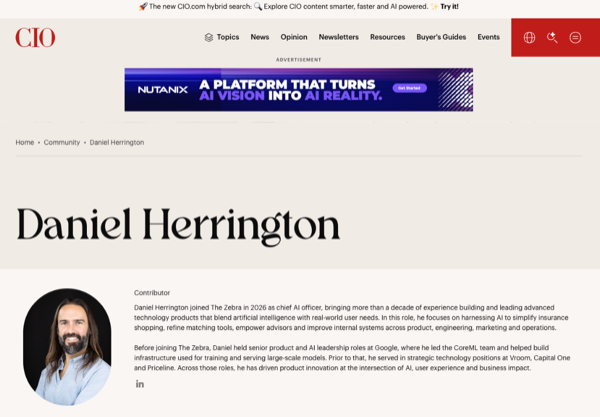
Originally published in CIO Magazine by Daniel Herrington.
For decades, insurance shopping has been synonymous with filling out tedious 40-question forms. Consumers are asked to recall specific vehicle trims, annual mileage estimates, roof construction dates, and past claim histories before receiving a single meaningful policy quote.
Generative AI and modern data architectures are fundamentally dismantling this paradigm. By leveraging real-time contextual signals, automated intent parsing, and natural conversational interfaces, insurance is transitioning from a reactive form-filling transaction into an ongoing, context-aware financial partnership.
1. From Static Forms to Progressive Conversational Discovery
The traditional insurance funnel suffered from massive abandonment rates because users were asked for low-relevance details upfront. With conversational AI:
- Data intake is progressive: the user only provides information when it directly influences the risk rating or coverage options.
- Contextual enrichment fills in standard vehicle configurations and regional risk profiles automatically using trusted APIs, leaving the consumer to simply confirm rather than research.
- Technical insurance jargon (deductibles, collision vs comprehensive, liability limits) is explained dynamically in plain English tailored to the user's specific lifestyle.
2. Real-Time Contextual Adaptation
Insurance should not be a static policy renewed once a year. Modern connected devices, telematics, and smart homes provide real-time signals that can adapt coverage dynamically:
- Driving behaviors and commute shifts adjust auto premiums accurately.
- Weather alerts and home telemetry trigger proactive risk-mitigation advice before losses occur.
- Changes in life stages (new child, marriage, home purchase) seamlessly adjust umbrella and life insurance protection.
3. Trust, Isolation, and Deterministic Compliance
In financial services and regulated property and casualty insurance, conversational experiences must remain strictly trustworthy:
- Customer data must remain private, air-gapped, and isolated from open LLM training pools.
- Conversational models act as interface routers; all calculations, price quotes, and binding actions are delegated to deterministic rating calculators and state insurance department-approved filings.
- Every automated recommendation must be explainable and auditable.